



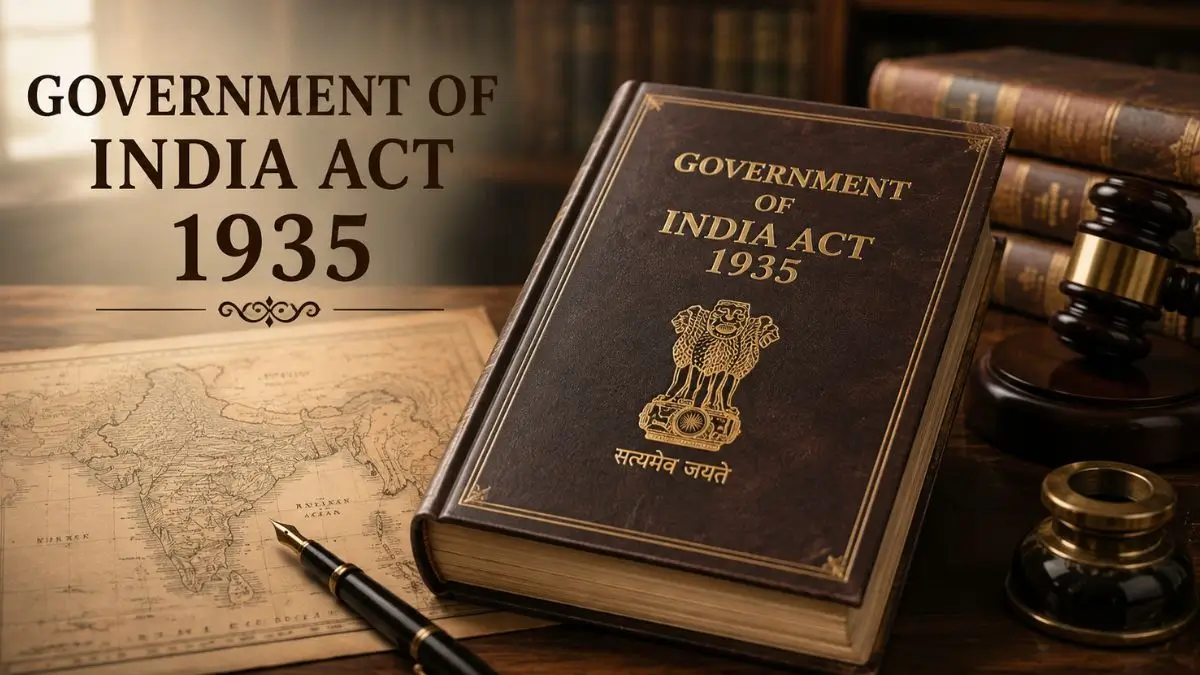
Government of India Act 1935 introduced provincial autonomy, proposed an All-India Federation and established the Federal Court. Learn its key features and exam facts.
Government of India Act 1935 and Its Historical Significance
The Government of India Act 1935 was one of the most extensive constitutional reforms introduced by the British Parliament for governing India before independence. It emerged after several rounds of constitutional discussions, political developments and growing demands for self-government. The Act attempted to restructure the administration of British India while retaining substantial powers in the hands of the British authorities.
Background to the Government of India Act 1935
The constitutional reforms that eventually resulted in the Government of India Act 1935 developed over several years. The Government of India Act 1919 had introduced dyarchy in the provinces, but the arrangement failed to satisfy Indian demands for responsible government. The appointment of the Simon Commission in 1927, the Round Table Conferences held between 1930 and 1932, the Communal Award of 1932 and the British Government’s White Paper of 1933 contributed to the constitutional discussions that preceded the 1935 legislation.
Provincial Autonomy Under the 1935 Act
One of the most important features of the Act was the introduction of provincial autonomy. Dyarchy, which had operated in the provinces under the 1919 reforms, was abolished. Provincial governments received greater authority over subjects assigned to them. The system became particularly important after the provincial elections of 1937, when Indian political parties formed ministries in several provinces and gained practical experience in parliamentary administration.
Proposed All-India Federation
The Government of India Act 1935 proposed an All-India Federation consisting of British Indian provinces and princely states. However, this federal arrangement was never implemented because the required participation of the princely states was not secured. Therefore, although the federal scheme was an important constitutional proposal, it did not become operational during British rule.
Division of Legislative Powers
The Act provided for a distribution of legislative responsibilities through three lists: the Federal List, Provincial List and Concurrent List. Matters such as defence, foreign affairs and communications were placed under the Federal List, while subjects such as police, public health and agriculture came under the Provincial List. The Concurrent List included subjects such as criminal law and marriage. Residuary powers were assigned to the Governor-General.
Bicameral Legislatures in Six Provinces
The Act introduced or expanded bicameral legislatures in six provinces: Bengal, Bombay, Madras, United Provinces, Bihar and Assam. These provinces had both a Legislative Assembly and a Legislative Council. This arrangement represented an important development in the evolution of legislative institutions in colonial India and provided greater experience of representative government.
Expansion of the Franchise
The Government of India Act 1935 substantially increased the number of Indians eligible to vote compared with earlier constitutional reforms. However, it did not establish universal adult suffrage. Voting eligibility depended on qualifications such as property, income and education. Consequently, only a limited section of the Indian population could participate in elections.
Federal Court and Public Service Commissions
The Act provided for the establishment of a Federal Court, which came into existence in 1937. It dealt with constitutional matters and interpretation of the Act, although the Privy Council in London remained the highest appellate authority. The Act also provided for Federal, Provincial and Joint Public Service Commissions, strengthening the institutional framework for recruitment and administration of public services.
Separate Electorates and Communal Representation
Another significant feature was the continuation and extension of separate electorates and communal representation. While these arrangements provided political representation to different communities and groups, they also contributed to the continuation of communal political divisions. This aspect remains important for understanding the constitutional and political developments that preceded independence.
Powers of the Governor-General and Governors
Despite introducing several reforms, the Act retained extensive discretionary authority for the British-appointed Governor-General and provincial Governors. The Governor-General had important powers relating to defence, foreign affairs, financial stability, security and constitutional safeguards. Provincial Governors also retained special responsibilities and discretionary powers, limiting the extent of responsible self-government.
Impact on India’s Constitutional Development
The Government of India Act 1935 had a lasting influence on India’s constitutional development. Its provisions concerning federal arrangements, legislative lists, provincial administration, public services and institutional governance provided experience and precedents that were relevant to constitution-making after independence. The provincial governments formed after the 1937 elections also gave Indian political leaders practical experience of parliamentary governance.
Limitations of the 1935 Act
The Act did not provide independence or complete responsible government to India. British sovereignty remained intact, the proposed federation was never established, voting rights were restricted and Governors retained significant discretionary powers. The continuation of separate electorates was also controversial. Thus, the Act represented a major constitutional reform but remained fundamentally within the framework of British colonial rule.
Reactions of Indian Political Groups
The Indian National Congress opposed the constitutional limitations of the Act but eventually participated in the 1937 elections and formed ministries in several provinces. The Muslim League also participated in the electoral process while seeking to protect its political interests. Meanwhile, many princely rulers were reluctant to join the proposed federation because of concerns regarding their autonomy and relationship with the central authority.
Government of India Act 1935 for Competitive Exams
For UPSC, PCS, SSC, banking, railways, teaching, police and defence examinations, the Government of India Act 1935 is an important topic under modern Indian history and constitutional development. Aspirants should particularly remember provincial autonomy, the proposed All-India Federation, the three legislative lists, the Federal Court, bicameralism in six provinces, restricted franchise, separate electorates and the discretionary powers of the Governor-General and Governors. These features help connect colonial constitutional reforms with the development of India’s parliamentary and federal institutions.

Why This News is Important
Importance for Modern Indian History
The Government of India Act 1935 is important because it represented the most comprehensive constitutional framework introduced by the British for governing India before independence. Its provisions reflected the outcome of prolonged constitutional negotiations and political developments involving Indian nationalists, British authorities and princely states.
Importance for Indian Polity
Several institutional concepts associated with the Act are highly relevant to the study of Indian polity. Provincial autonomy, division of legislative subjects and the proposed federal structure are particularly useful for understanding the evolution of India’s constitutional system. Although the Act was colonial in character, some of its institutional arrangements influenced later constitutional development.
Importance for Competitive Examinations
Government exams frequently test factual connections between constitutional reforms and their features. Questions may ask which Act introduced provincial autonomy, which provinces had bicameral legislatures, when the Federal Court was established, or which legislative lists were created. Therefore, understanding the 1935 Act can help candidates answer questions in modern history, polity and general studies.
Link with the 1937 Elections
The 1937 provincial elections are especially significant because they allowed Indian political parties to gain practical experience in administering provincial governments. The formation of ministries demonstrated the growing role of elected Indian representatives in governance before independence.
Relevance to the Constitution of India
The Act also helps aspirants understand the historical roots of India’s federal and administrative institutions. The distribution of legislative subjects, public service institutions and other governmental arrangements formed part of the constitutional experience inherited and subsequently transformed after independence.
Historical Context of the Government of India Act 1935
Government of India Act 1919
The constitutional journey toward the 1935 Act included the Government of India Act 1919, which introduced dyarchy in the provinces. Under this arrangement, provincial subjects were divided between elected Indian ministers and officials. The system did not meet nationalist expectations for responsible government and became one of the reasons for seeking further constitutional reform.
Simon Commission
The Simon Commission, appointed in 1927, was tasked with examining constitutional reforms. Its lack of Indian members led to widespread opposition and boycott in India. Nevertheless, its work became part of the broader constitutional debate that eventually contributed to later reforms.
Round Table Conferences
Three Round Table Conferences were held in London from 1930 to 1932 to discuss India’s constitutional future. Major subjects included federation, provincial autonomy and minority representation. Although the conferences did not produce a complete political settlement, their discussions contributed to the constitutional process.
Communal Award and White Paper
The Communal Award of 1932, announced by British Prime Minister Ramsay MacDonald, dealt with representation for various communities and groups. This was followed by the British Government’s White Paper of 1933, which outlined proposals concerning India’s future constitutional structure. These developments formed part of the background to the 1935 legislation.
From Constitutional Reform to Independence
The Government of India Act 1935 did not satisfy the demand for complete independence. Nevertheless, its implementation of provincial autonomy and the elections of 1937 provided an important phase of political and administrative experience. The subsequent struggle for independence ultimately led to the end of British rule and the establishment of independent India in 1947.
Key Takeaways from Government of India Act 1935
| S. No. | Key Takeaway |
|---|---|
| 1 | The Government of India Act 1935 was the most extensive constitutional reform introduced by the British for India before independence. |
| 2 | It abolished dyarchy in the provinces and introduced provincial autonomy. |
| 3 | It proposed an All-India Federation of British Indian provinces and princely states, but the federation was never implemented. |
| 4 | It provided for three legislative lists, a Federal Court, expanded franchise, bicameral legislatures in six provinces and Public Service Commissions. |
| 5 | Despite its reforms, the Act retained substantial powers for the Governor-General and Governors and did not provide India with independence or universal adult franchise. |
FAQs
1. What was the Government of India Act 1935?
The Government of India Act 1935 was a major constitutional reform enacted by the British Parliament to provide a new framework for governing British India. It was the most extensive constitutional legislation introduced in India before independence.
2. Which Act introduced provincial autonomy in India?
The Government of India Act 1935 introduced provincial autonomy by abolishing dyarchy at the provincial level.
3. What happened to dyarchy under the Government of India Act 1935?
Dyarchy, which had been introduced in the provinces by the Government of India Act 1919, was abolished in the provinces under the 1935 Act.
4. Did the Government of India Act 1935 establish an All-India Federation?
The Act proposed an All-India Federation consisting of British Indian provinces and princely states. However, the federation never came into operation because the necessary participation of princely states was not achieved.
5. What were the three legislative lists under the Government of India Act 1935?
The Act divided legislative powers into the Federal List, Provincial List and Concurrent List. This division was an important step in the development of India’s federal constitutional structure.
6. Which provinces had bicameral legislatures under the Government of India Act 1935?
Bicameral legislatures were provided for in six provinces: Bengal, Bombay, Madras, United Provinces, Bihar and Assam.
7. When was the Federal Court of India established?
The Federal Court of India was established in 1937 under the provisions of the Government of India Act 1935.
8. Did the Government of India Act 1935 provide universal adult franchise?
No. The Act significantly expanded the electorate but did not introduce universal adult franchise. Voting rights continued to depend on qualifications such as property, income and education.
9. What was the significance of the 1937 provincial elections?
The elections held in 1937 under the Act enabled Indian political parties to form provincial ministries. They gave Indian leaders valuable practical experience in parliamentary government and provincial administration.
10. Which important constitutional features of the 1935 Act influenced independent India?
The Act provided important precedents relating to federalism, legislative lists, provincial administration, public services and institutional governance. Several concepts were subsequently adapted in India’s constitutional framework.
Some Important Current Affairs Links