





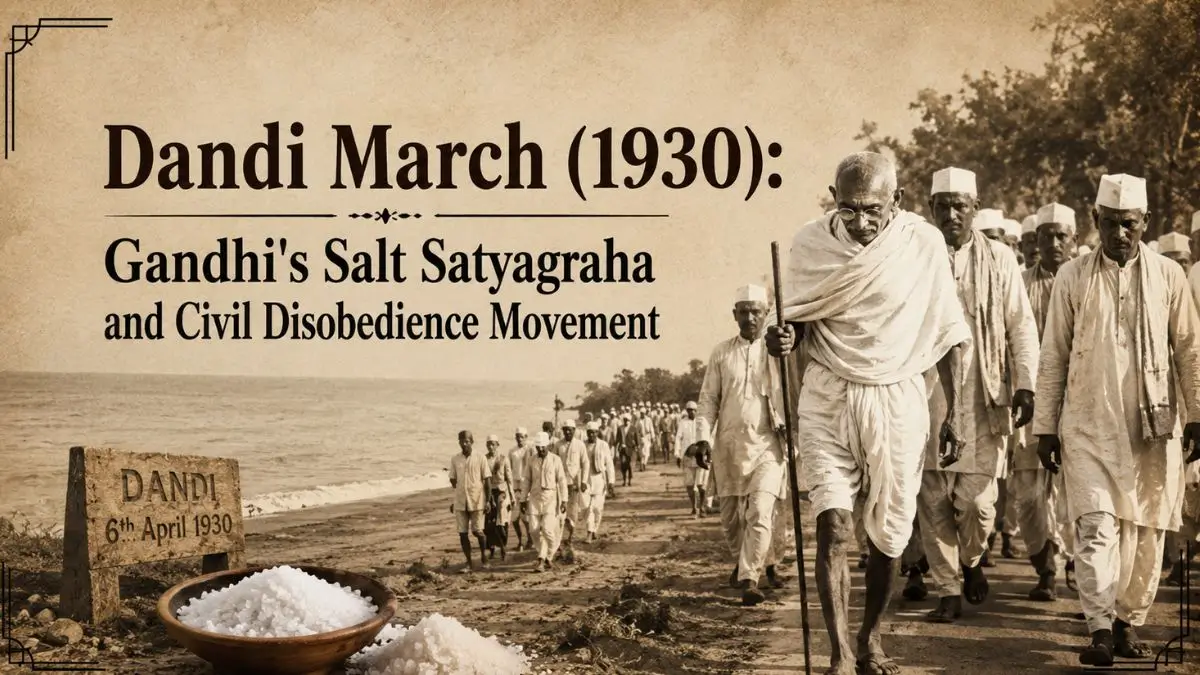
Dandi March 1930 led by Mahatma Gandhi marked a major phase of the Civil Disobedience Movement. Know its date, significance, Salt Satyagraha and exam facts.
Introduction to the Dandi March
The Dandi March of 1930, led by Mahatma Gandhi, was one of the most significant events in India’s freedom struggle. It transformed opposition to British rule into a mass movement by focusing on an everyday commodity—salt. Gandhi used the issue of the British salt monopoly to demonstrate how colonial policies affected ordinary Indians and to mobilise people through non-violent civil disobedience.
Beginning of the Historic March
Mahatma Gandhi began the march from Sabarmati Ashram in Ahmedabad on 12 March 1930 with 78 selected volunteers. The march covered approximately 240 miles (about 390 km) and continued for 24 days. Gandhi and his followers travelled through villages, interacting with local communities and spreading the message of non-violence, self-rule and resistance to unjust colonial laws.
Why Salt Became the Symbol of Protest
Salt was deliberately chosen because it was an essential commodity used by people across social and economic groups. Under British colonial rule, the government maintained control over salt production and imposed taxes and restrictions on its manufacture and sale. The Salt Act of 1882 strengthened the colonial monopoly, making salt an effective symbol of economic exploitation.
Gandhi’s Eleven Demands and the Salt Issue
Before launching the movement, Gandhi wrote to Lord Irwin, the Viceroy of India, presenting a set of demands. Among them, the abolition of the salt tax and the government’s salt monopoly was particularly important. Gandhi considered the salt restrictions an example of the unjust nature of colonial rule because the commodity was essential and naturally available along India’s coastline.
Arrival at Dandi and Breaking of the Salt Law
After completing the historic journey, Gandhi reached Dandi on the Gujarat coast. On 6 April 1930, he openly violated the colonial salt law by making salt from seawater. This seemingly simple act became a powerful political statement and marked the beginning of a much wider campaign of civil disobedience against British authority.
Expansion of the Civil Disobedience Movement
The breaking of the salt law at Dandi encouraged people across India to participate in similar acts of resistance. Volunteers produced salt, sold it, organised demonstrations and challenged other colonial regulations. The movement was not restricted to Gujarat; resistance spread to different regions, where local leaders and ordinary citizens adopted their own forms of civil disobedience.
Participation of Different Sections of Society
The Dandi campaign helped broaden participation in the national movement. Men, women and children became involved in various forms of protest. In several regions, people organised marches, violated salt laws, promoted swadeshi and challenged restrictions imposed by the colonial administration. This wider participation strengthened the character of the freedom struggle as a mass movement.
Spread of Salt Satyagraha Across India
The Salt Satyagraha was not limited to the Dandi coastline. In places such as Chinnapuram in present-day Andhra Pradesh, Congress volunteers organised campaigns to collect and sell salt while spreading the messages of ahimsa, swadeshi and swaraj. Such regional actions demonstrated how a local act of protest could become part of a nationwide movement.
Dharasana and Continued Resistance
The Civil Disobedience Movement continued after the Dandi March. One important episode was the Dharasana Salt Works protest, where volunteers challenged the colonial salt administration. The campaign attracted considerable attention and became another important example of organised non-violent resistance following Gandhi’s Salt March.
Significance of the Dandi March
The Dandi March was important because it connected a simple economic grievance with the larger demand for Swaraj. Gandhi demonstrated that non-violent resistance could challenge the legitimacy of colonial laws while allowing ordinary people to participate. The march therefore became an important turning point in the Indian national movement and helped give the Civil Disobedience Movement a nationwide character.
Dandi March and Competitive Examinations
For government examinations, the Dandi March is particularly important under Modern Indian History and the Indian National Movement. Candidates should remember the starting date of 12 March 1930, the destination of Dandi, Gandhi’s leadership, the 78 initial volunteers, the salt tax and monopoly, and the act of breaking the salt law on 6 April 1930. Questions may also connect the march with the Civil Disobedience Movement, Lord Irwin, Gandhi’s eleven demands and the broader strategy of non-violent resistance.

Why This News is Important
A Turning Point in India’s Freedom Struggle
The Dandi March represents a major turning point in the history of India’s independence movement. Instead of limiting political resistance to constitutional demands or elite leadership, Gandhi used an issue directly connected with everyday life to mobilise ordinary Indians. The choice of salt made the protest understandable and accessible to people across social and economic groups.
Demonstration of Non-Violent Civil Disobedience
The march provides an important example of Gandhi’s strategy of Satyagraha and Ahimsa. The objective was not simply to protest against a particular tax but to challenge unjust colonial authority through deliberate and peaceful violation of laws. The campaign showed how non-violent resistance could be organised on a large scale.
Mass Mobilisation of Indians
The Salt Satyagraha helped bring the national movement closer to ordinary citizens. As the campaign spread, people in different parts of the country produced salt, organised demonstrations and participated in various forms of civil disobedience. Regional movements demonstrated that the campaign had developed beyond Gandhi’s original march from Sabarmati to Dandi.
Importance for Government Examinations
For UPSC, State PCS, SSC, Railways, banking, defence, police and teaching examinations, the Dandi March is a frequently relevant topic in Modern Indian History. Its chronology, causes, leadership, route, objectives and relationship with the Civil Disobedience Movement are particularly important for objective and descriptive questions.
Symbolism of Salt in the Freedom Movement
The choice of salt was politically significant because it represented the economic burdens imposed by colonial rule. Gandhi turned a basic household necessity into a symbol of resistance. The Dandi March therefore demonstrates how nationalist movements can use an everyday issue to communicate a larger political message and build broad public participation.
Historical Context: Background to the Dandi March
End of the Non-Cooperation Movement
The Dandi March must be understood against the background of the earlier Non-Cooperation Movement. Gandhi had withdrawn that movement after the Chauri Chaura incident in February 1922, when violence resulted in the deaths of police personnel. The withdrawal reflected Gandhi’s commitment to non-violence and temporarily changed the course of the nationalist struggle.
Simon Commission and Growing Political Tensions
During the late 1920s, opposition to British rule intensified. The arrival of the Simon Commission in 1928, which had no Indian member, generated widespread protests. The demand for greater political autonomy became increasingly prominent, contributing to the atmosphere in which the Congress adopted the goal of Purna Swaraj at its Lahore session in December 1929.
Lahore Congress and Purna Swaraj
The Lahore Session of the Indian National Congress in 1929, presided over by Jawaharlal Nehru, was a major milestone. The Congress declared complete independence as its objective, and 26 January 1930 was observed as Independence Day. Gandhi subsequently sought a practical issue through which the struggle for independence could be transformed into mass civil disobedience.
Gandhi’s Eleven Demands
Gandhi communicated his demands to Viceroy Lord Irwin before beginning the campaign. The demands addressed several economic and political issues, with abolition of the salt tax and the salt monopoly receiving special prominence. The failure to secure a satisfactory response contributed to Gandhi’s decision to begin civil disobedience.
Salt Law as an Instrument of Colonial Control
The British salt regulations restricted Indian access to salt production and placed the commodity under colonial control. Since salt was essential for daily life and available naturally along India’s coastline, the restrictions provided Gandhi with a powerful example of colonial economic exploitation. Breaking the salt law therefore had both practical and symbolic significance.
Beginning of the Civil Disobedience Movement
On 12 March 1930, Gandhi left Sabarmati Ashram with his volunteers and began the journey to Dandi. After reaching the coast and breaking the salt law on 6 April, the protest expanded rapidly. Across India, people challenged colonial laws and participated in demonstrations, making the Civil Disobedience Movement one of the major phases of the freedom struggle.
Legacy of the Dandi March
The Dandi March remains an enduring symbol of peaceful resistance. Its importance extends beyond the immediate salt protest because it demonstrated Gandhi’s ability to connect national political objectives with everyday economic concerns. The march also inspired cultural and artistic representations, including Nandalal Bose’s well-known depiction of Gandhi’s journey.
Key Takeaways from Dandi March 1930
This News: Gandhi’s Salt Satyagraha and Civil Disobedience Movement
| S. No. | Key Takeaway |
|---|---|
| 1 | Dandi March began on 12 March 1930 from Sabarmati Ashram under the leadership of Mahatma Gandhi. |
| 2 | Gandhi started the march with 78 volunteers and travelled approximately 240 miles (390 km) to Dandi. |
| 3 | The main target was the British salt monopoly and salt tax, which Gandhi considered a symbol of colonial exploitation. |
| 4 | Gandhi broke the salt law at Dandi on 6 April 1930 by making salt from seawater. |
| 5 | The Dandi March became a major catalyst for the Civil Disobedience Movement, encouraging mass participation and resistance to British rule across India. |
FAQs: Dandi March 1930 and Salt Satyagraha
1. What was the Dandi March?
The Dandi March was a historic non-violent protest led by Mahatma Gandhi against the British salt tax and monopoly. It marked the beginning of a major phase of the Civil Disobedience Movement.
2. When did the Dandi March begin?
The Dandi March began on 12 March 1930 from Sabarmati Ashram in Ahmedabad, Gujarat.
3. Where did the Dandi March end?
The march ended at Dandi, a coastal village in Gujarat, where Gandhi broke the British salt law by making salt from seawater.
4. When did Gandhi break the Salt Law?
Mahatma Gandhi broke the Salt Law at Dandi on 6 April 1930.
5. How many volunteers accompanied Gandhi at the beginning of the Dandi March?
Gandhi began the march with 78 selected volunteers from Sabarmati Ashram.
6. Why did Gandhi choose salt as the main issue of the protest?
Salt was an essential commodity used by rich and poor alike. The British monopoly and tax on salt made it an effective symbol of colonial economic exploitation and allowed Gandhi to connect the freedom struggle with an issue affecting ordinary people.
7. Which movement was launched following the Dandi March?
The Dandi March became the starting point of the Civil Disobedience Movement, which involved the deliberate and peaceful violation of unjust colonial laws.
8. Who was the Viceroy of India when the Dandi March took place?
Lord Irwin was the Viceroy of India during the Dandi March and the early phase of the Civil Disobedience Movement.
9. What was the significance of the Lahore Congress Session of 1929?
The Lahore Session of the Indian National Congress, presided over by Jawaharlal Nehru, adopted Purna Swaraj or complete independence as the Congress objective. This provided the political background for the Civil Disobedience Movement.
10. What was the Salt Act of 1882?
The Salt Act of 1882 strengthened British control over salt production and distribution in India and restricted Indians from freely producing salt. Gandhi’s challenge to these restrictions became a powerful act of civil disobedience.
Some Important Current Affairs Links