









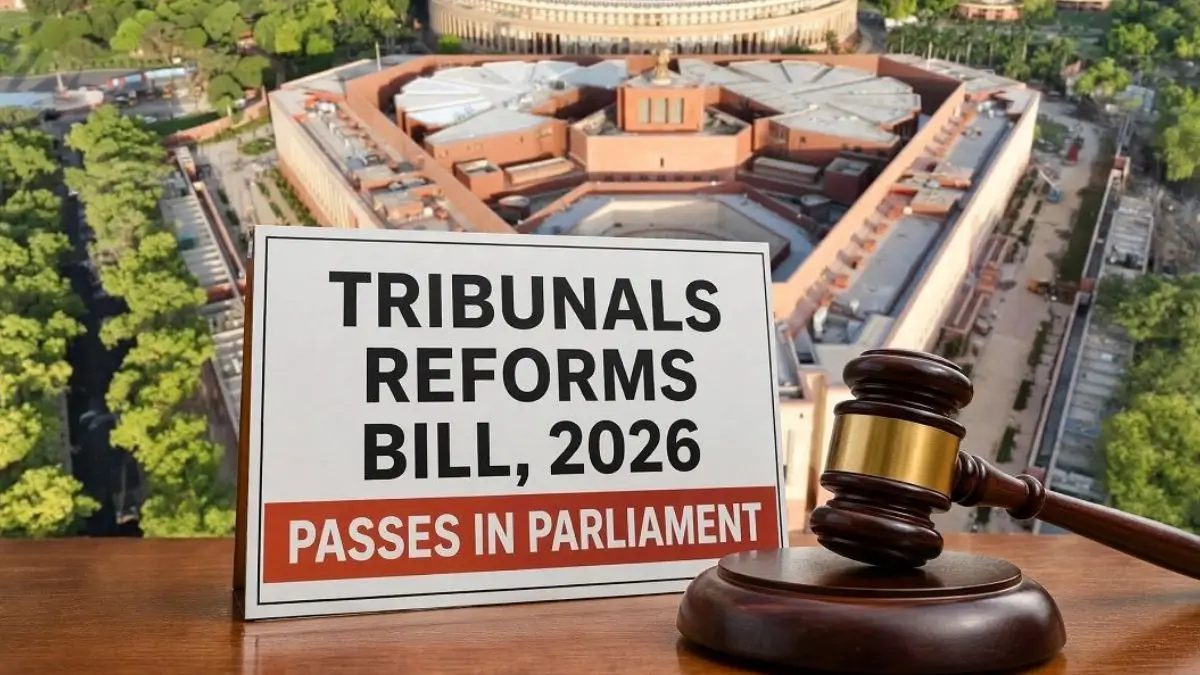
Tribunals Reforms Bill 2026 proposes major changes in India’s tribunal system, including the National Tribunals Commission. Check key provisions, background and exam facts.
Parliament Approves Tribunals Reforms Bill 2026
The Tribunals Reforms Bill, 2026 has emerged as a significant development in India’s judicial and administrative framework. The legislation seeks to introduce structural changes in the functioning of tribunals and provide a more coordinated institutional mechanism for their administration. The Lok Sabha passed the Bill on August 10, 2026, amid opposition protests, making tribunal reform an important topic for current affairs and competitive examinations.
National Tribunals Commission Proposed
One of the most important provisions of the Bill is the proposed establishment of a National Tribunals Commission (NTC). The commission is intended to function as an independent institutional mechanism overseeing important aspects of tribunal administration. It is expected to deal with appointments, functioning, performance and grievances associated with tribunals. The proposed framework covers around 16 major tribunals and their associated appellate bodies.
Five-Member Commission and Judicial Consultation
The proposed National Tribunals Commission is expected to have five members, with appointments made after consultation with the Chief Justice of India. This provision is particularly significant because tribunal appointments have repeatedly raised questions concerning judicial independence, executive influence and the constitutional separation of powers. The new mechanism seeks to create a more transparent and institutionally balanced process.
Changes in Tribunal Administration
The Bill seeks to create a clearer administrative structure for tribunals. The proposed system separates responsibilities among tribunals, a dedicated secretariat and the concerned administrative ministry. Such a three-tier arrangement is intended to reduce overlapping responsibilities and improve accountability. It could also provide a more systematic mechanism for dealing with infrastructure, staffing and administrative requirements.
Focus on Transparency and Efficiency
A major objective of the reforms is to improve the efficiency and credibility of India’s tribunal system. Tribunals were established to provide specialised and comparatively speedy mechanisms for resolving disputes in areas such as taxation, company law, service matters and other regulatory fields. However, vacancies, administrative difficulties and questions over appointment procedures have affected their effectiveness. The proposed reforms attempt to address these institutional challenges.
Supreme Court Judgments and Tribunal Independence
The current reform initiative is closely connected with the Supreme Court’s long-running scrutiny of tribunal administration. In November 2025, the Supreme Court struck down several provisions of the Tribunals Reforms Act, 2021, raising constitutional concerns about provisions relating to appointments, tenure and the functioning of tribunals. The Court’s intervention reinforced the importance of maintaining judicial independence while designing the administrative framework for tribunals.
Why Tribunal Reforms Matter for Governance
Tribunals occupy an important position between ordinary administrative decision-making and the regular judicial system. Their specialised nature enables them to deal with technically complex disputes. Effective tribunals can reduce the burden on constitutional courts and provide specialised dispute-resolution mechanisms. Therefore, reforms aimed at improving their independence, administration and efficiency have wider implications for India’s justice-delivery system.
Importance for Government Exam Aspirants
The Tribunals Reforms Bill 2026 is particularly relevant for UPSC, State PCS, SSC, banking, railway, police and defence examinations because it connects current affairs with constitutional law, judicial independence, governance and administrative reforms. Aspirants should remember the proposed National Tribunals Commission, its five-member structure, its role in supervising tribunals and the background of Supreme Court interventions concerning tribunal reforms.
Broader Constitutional Significance
The reform debate also highlights the constitutional balance between the executive and judiciary. While the government has administrative responsibilities concerning tribunals, the judiciary has repeatedly emphasised that tribunal structures must preserve adjudicatory independence. The proposed NTC is therefore significant not merely as an administrative body but as an institutional response to long-standing concerns about the governance and independence of tribunals.
Expected Impact of the Reform
If effectively implemented, the new framework could improve coordination among tribunals, streamline appointments and strengthen administrative accountability. It may also help address vacancies and infrastructure-related challenges that can contribute to delays in dispute resolution. However, the success of the reform will ultimately depend on how the institutional safeguards are implemented and how effectively judicial independence is maintained.

Why This News Is Important
Strengthening India’s Tribunal System
The Tribunals Reforms Bill 2026 is important because it seeks to address structural problems affecting India’s tribunal system. Tribunals handle specialised disputes and can contribute significantly to faster justice. A more coordinated administrative structure can help tribunals function more efficiently and reduce unnecessary delays.
National Tribunals Commission as a New Institution
For examination purposes, the proposed National Tribunals Commission is the most important feature of the Bill. The commission is envisaged as an institutional authority responsible for important administrative aspects of tribunals, including appointments, functioning, performance and grievances. The proposed body is expected to oversee around 16 major tribunals and related appellate institutions.
Link with Judicial Independence
The issue is also significant from the perspective of constitutional governance. Tribunal appointments and service conditions have been examined repeatedly by the Supreme Court. The proposed system attempts to address concerns regarding transparency and judicial participation in appointments. This makes the Bill relevant to questions concerning separation of powers and judicial independence.
Relevance for Competitive Examinations
For UPSC and State PCS aspirants, the topic can be connected with Indian Polity, Governance, Judiciary, Constitutional Bodies and Current Affairs. Questions may ask about the National Tribunals Commission, the purpose of tribunals, recent Supreme Court judgments or the Tribunals Reforms Act, 2021.
Improving Accountability and Administration
The Bill’s proposed three-level administrative architecture is another important aspect. Clearly defining the roles of tribunals, their secretariat and administrative ministries could reduce institutional overlap. The reforms therefore combine judicial concerns with administrative efficiency and accountability.
Historical Context: Background of Tribunal Reforms in India
Emergence of Tribunals in India
Tribunals developed as specialised adjudicatory institutions intended to deal with particular categories of disputes. Their growth was linked to the need for specialised expertise and mechanisms that could complement the regular judicial system. Over time, tribunals became important components of India’s administrative and regulatory framework.
Constitutional Foundation
The 42nd Constitutional Amendment Act, 1976 inserted provisions relating to tribunals into the Constitution. Articles 323A and 323B provide the constitutional framework for administrative tribunals and tribunals dealing with other specified matters. This development marked an important stage in India’s effort to create specialised mechanisms for dispute resolution.
Major Rationalisation in 2017
The Finance Act, 2017 reorganised India’s tribunal structure by merging tribunals with similar functions. According to PRS analysis, the number of tribunals was reduced from 26 to 19 through this rationalisation process.
Tribunals Reforms Act, 2021
The Tribunals Reforms Bill, 2021 sought to rationalise the tribunal system and dissolve certain appellate bodies, transferring their functions to other judicial institutions. It was introduced in August 2021 and followed an earlier ordinance on the subject.
Supreme Court’s Continuing Intervention
Tribunal reforms have repeatedly reached the Supreme Court because of concerns about appointment procedures, tenure, qualifications and executive control. In November 2025, the Supreme Court struck down several provisions of the 2021 law, bringing renewed attention to the need for an institutionally sound tribunal framework.
Road to the 2026 Reform
The Tribunals Reforms Bill 2026 represents the latest stage in this continuing reform process. Its proposal for a National Tribunals Commission seeks to create a dedicated institutional mechanism for tribunal administration and address concerns that have persisted through earlier reforms. The Bill therefore represents an important development in India’s broader effort to strengthen specialised dispute resolution.
Key Takeaways from Tribunals Reforms Bill 2026
Important Points for Government Exams
| S. No. | Key Takeaway |
|---|---|
| 1 | The Tribunals Reforms Bill, 2026 seeks major structural and administrative reforms in India’s tribunal system. |
| 2 | The Bill proposes the establishment of a National Tribunals Commission (NTC). |
| 3 | The proposed NTC is expected to have five members and appointments would involve consultation with the Chief Justice of India. |
| 4 | The proposed commission is intended to oversee important aspects of around 16 major tribunals and associated appellate bodies, including appointments, functioning, performance and grievances. |
| 5 | The reform is linked to long-standing concerns about tribunal independence, transparency, accountability and efficient justice delivery, including issues examined by the Supreme Court. |
FAQs: Tribunals Reforms Bill 2026
1. What is the Tribunals Reforms Bill 2026?
The Tribunals Reforms Bill 2026 is legislation aimed at restructuring and improving the administration and functioning of tribunals in India. It proposes institutional changes, including the establishment of a National Tribunals Commission.
2. What is the National Tribunals Commission?
The National Tribunals Commission (NTC) is the proposed institutional body intended to oversee important administrative aspects of tribunals, including appointments, functioning, performance and grievances.
3. How many members are proposed for the National Tribunals Commission?
The proposed National Tribunals Commission is expected to have five members.
4. Why is the National Tribunals Commission important?
The commission is intended to create a more organised and independent administrative framework for tribunals. It could improve transparency, accountability, appointments and overall tribunal functioning.
5. How many major tribunals are proposed to come under the NTC framework?
The proposed framework is expected to cover around 16 major tribunals and associated appellate bodies.
6. What is the constitutional basis of tribunals in India?
The 42nd Constitutional Amendment Act, 1976 introduced provisions relating to tribunals into the Constitution through Articles 323A and 323B.
7. What is Article 323A related to?
Article 323A deals with administrative tribunals, particularly tribunals established for disputes and matters relating to recruitment and conditions of service of public servants.
8. What is Article 323B related to?
Article 323B enables the appropriate legislature to establish tribunals for specified matters such as taxation, foreign exchange, industrial and labour disputes, land reforms and related areas.
9. Why have tribunal reforms been a subject of Supreme Court scrutiny?
The Supreme Court has examined issues concerning tribunal appointments, tenure, qualifications, administrative control and judicial independence. The Court has emphasised that tribunal structures should preserve the independence of adjudicatory institutions.
10. What was the Tribunals Reforms Act, 2021?
The Tribunals Reforms Act, 2021 sought to rationalise India’s tribunal system, including abolishing certain tribunals and transferring their functions to existing judicial bodies.
Some Important Current Affairs Links