





President Murmu Gandhi Bust North Macedonia marks a significant step in India’s cultural diplomacy as the Mahatma Gandhi bust in Skopje highlights peace, non-violence, and India-North Macedonia relations.
India’s Cultural Diplomacy Reaches North Macedonia
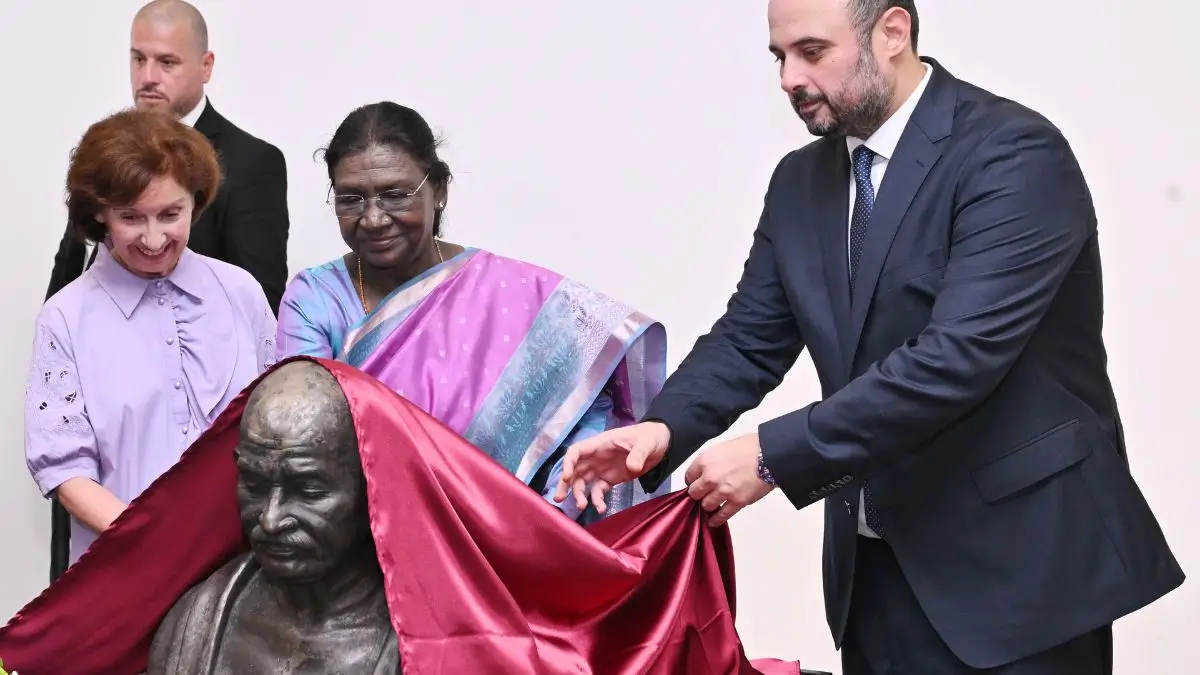
President of India Smt. Droupadi Murmu unveiled a bust of Mahatma Gandhi at the Museum of the City of Skopje in North Macedonia on July 22, 2026. The ceremony was conducted jointly with the President of North Macedonia, Gordana Siljanovska-Davkova. The installation of Gandhi’s bust represents the shared values of peace, tolerance, humanity, and friendship between India and North Macedonia.
Mahatma Gandhi’s Ideals Highlighted on Global Platform
Addressing the gathering, President Droupadi Murmu highlighted that Mahatma Gandhi belonged to India, but his message of truth and non-violence belonged to the entire world. She stated that Gandhi’s principles demonstrated that non-violence was not a symbol of weakness but a powerful instrument for achieving justice, dignity, and freedom.
The President emphasised that in an era marked by conflicts, intolerance, and divisions, Gandhi’s philosophy of dialogue, compassion, and peaceful coexistence continues to remain relevant. The bust installed at the Museum of the City of Skopje will serve as a reminder of these universal values for future generations.
Symbol of India-North Macedonia Friendship
The unveiling of Mahatma Gandhi’s bust is considered an important step in strengthening cultural and people-to-people relations between India and North Macedonia. It reflects India’s approach of using cultural heritage and shared values to enhance diplomatic relations with other nations.
President Murmu described the bust as a lasting symbol of friendship between the two countries and their commitment towards peace, tolerance, and humanity. The event also highlighted the importance of cultural diplomacy in building stronger international partnerships.
President Murmu’s Historic Visit to North Macedonia
The unveiling ceremony took place during President Droupadi Murmu’s state visit to North Macedonia. This visit was significant as it marked the first-ever state visit by an Indian President to North Macedonia since the establishment of diplomatic relations between the two countries.
During the visit, both countries discussed ways to enhance bilateral cooperation in areas such as education, technology, renewable energy, skill development, and cultural exchanges. India also announced an increase in Indian Technical and Economic Cooperation (ITEC) training opportunities for North Macedonia, including courses related to Artificial Intelligence.
Importance of Gandhi’s Philosophy in Modern Times
Mahatma Gandhi’s ideas of truth, non-violence, and peaceful resistance have influenced several global movements for justice and equality. His philosophy continues to inspire leaders, social movements, and institutions worldwide.
The installation of Gandhi’s bust in North Macedonia further expands international recognition of his contribution to humanity. For competitive exam aspirants, this event is important from the perspective of international relations, Indian foreign policy, cultural diplomacy, and the global influence of Gandhian principles.

Why this News is Important
Importance for India’s Foreign Relations
The unveiling of Mahatma Gandhi’s bust in North Macedonia is important because it highlights India’s growing cultural diplomacy and international engagement. Cultural symbols often play a major role in strengthening relationships between countries by promoting shared values and mutual understanding.
India has consistently used the teachings of Mahatma Gandhi as part of its global identity. Gandhi’s principles of non-violence, peace, and tolerance have helped India project its soft power internationally.
Relevance for International Relations Studies
For students preparing for UPSC, State PSC, SSC, Banking, Defence, and other government examinations, this event is significant under topics related to India’s foreign policy and bilateral relations.
India’s relationship with European countries, including nations in the Balkan region such as North Macedonia, is becoming increasingly important. Cooperation in education, technology, renewable energy, and cultural exchange forms an important part of modern diplomacy.
Importance of Mahatma Gandhi’s Global Legacy
Mahatma Gandhi remains one of the most influential figures associated with peace and non-violence worldwide. Several international institutions and countries recognise his contribution to promoting peaceful conflict resolution.
The installation of his bust in Skopje reinforces the relevance of Gandhian philosophy in addressing contemporary global challenges such as conflicts, intolerance, and social divisions.
Historical Context: India, Mahatma Gandhi and Global Recognition
Mahatma Gandhi’s Role in India’s Freedom Movement
Mahatma Gandhi (1869–1948) was one of the most important leaders of India’s freedom struggle. He introduced the methods of Satyagraha and non-violent resistance, which became powerful tools against colonial rule.
Movements such as the Non-Cooperation Movement (1920), Civil Disobedience Movement (1930), and Quit India Movement (1942) reflected Gandhi’s commitment to achieving independence through peaceful means.
Global Influence of Gandhian Philosophy
Gandhi’s ideas influenced several international leaders and movements advocating civil rights and social justice. Leaders such as Martin Luther King Jr. in the United States and Nelson Mandela in South Africa were inspired by his philosophy of non-violence.
The United Nations observes October 2, Gandhi’s birth anniversary, as the International Day of Non-Violence, recognising his contribution to global peace.
India-North Macedonia Relations
India and North Macedonia maintain diplomatic relations based on mutual respect and cooperation. Both nations have explored opportunities in areas including trade, education, technology, and cultural exchanges.
President Murmu’s visit further strengthened bilateral ties and opened new possibilities for cooperation between the two countries.
Key Takeaways from President Murmu Unveils Mahatma Gandhi Bust in North Macedonia
| S. No. | Key Takeaway |
|---|---|
| 1 | President Droupadi Murmu unveiled a bust of Mahatma Gandhi at the Museum of the City of Skopje, North Macedonia, on July 22, 2026. |
| 2 | The bust represents India-North Macedonia friendship and shared commitment towards peace, tolerance, and humanity. |
| 3 | President Murmu highlighted Gandhi’s principles of truth, non-violence, dialogue, and peaceful coexistence. |
| 4 | The event took place during the first-ever state visit by an Indian President to North Macedonia since diplomatic relations were established. |
| 5 | The development reflects India’s cultural diplomacy and the continued global relevance of Mahatma Gandhi’s philosophy. |
Frequently Asked Questions (FAQs) Related to President Murmu Unveils Mahatma Gandhi Bust in North Macedonia
1. Who unveiled the bust of Mahatma Gandhi in North Macedonia?
President of India Smt. Droupadi Murmu unveiled the bust of Mahatma Gandhi at the Museum of the City of Skopje in North Macedonia.
2. Where was the Mahatma Gandhi bust unveiled?
The bust of Mahatma Gandhi was unveiled at the Museum of the City of Skopje, North Macedonia.
3. Who accompanied President Droupadi Murmu during the unveiling ceremony?
President Murmu unveiled the bust jointly with the President of North Macedonia, Gordana Siljanovska-Davkova.
4. Why is the installation of Mahatma Gandhi’s bust in North Macedonia significant?
The installation represents the strong cultural ties between India and North Macedonia and highlights the global importance of Gandhi’s principles of peace, truth, tolerance, and non-violence.
5. What message of Mahatma Gandhi was highlighted during the ceremony?
President Murmu highlighted Gandhi’s message of truth, non-violence, compassion, and peaceful coexistence, stating that these values remain relevant in today’s world.
6. What is the significance of Mahatma Gandhi’s philosophy in international affairs?
Gandhi’s philosophy of non-violence has influenced global peace movements and helped promote peaceful methods of resolving conflicts.
7. Which city is the capital of North Macedonia?
The capital city of North Macedonia is Skopje.
8. Which international day is observed on Mahatma Gandhi’s birth anniversary?
The International Day of Non-Violence is observed on October 2 every year, marking the birth anniversary of Mahatma Gandhi.
9. When was Mahatma Gandhi born?
Mahatma Gandhi was born on October 2, 1869, in Porbandar, Gujarat.
10. Which movements were launched by Mahatma Gandhi during India’s freedom struggle?
Major movements led by Mahatma Gandhi include:
- Non-Cooperation Movement (1920)
- Civil Disobedience Movement (1930)
- Quit India Movement (1942)
11. What is the capital of North Macedonia important for India’s diplomacy?
Skopje is important as it serves as a centre for political and cultural engagement between India and North Macedonia.
12. What is cultural diplomacy?
Cultural diplomacy refers to using culture, heritage, traditions, and shared values to strengthen relations between countries.
Some Important Current Affairs Links