






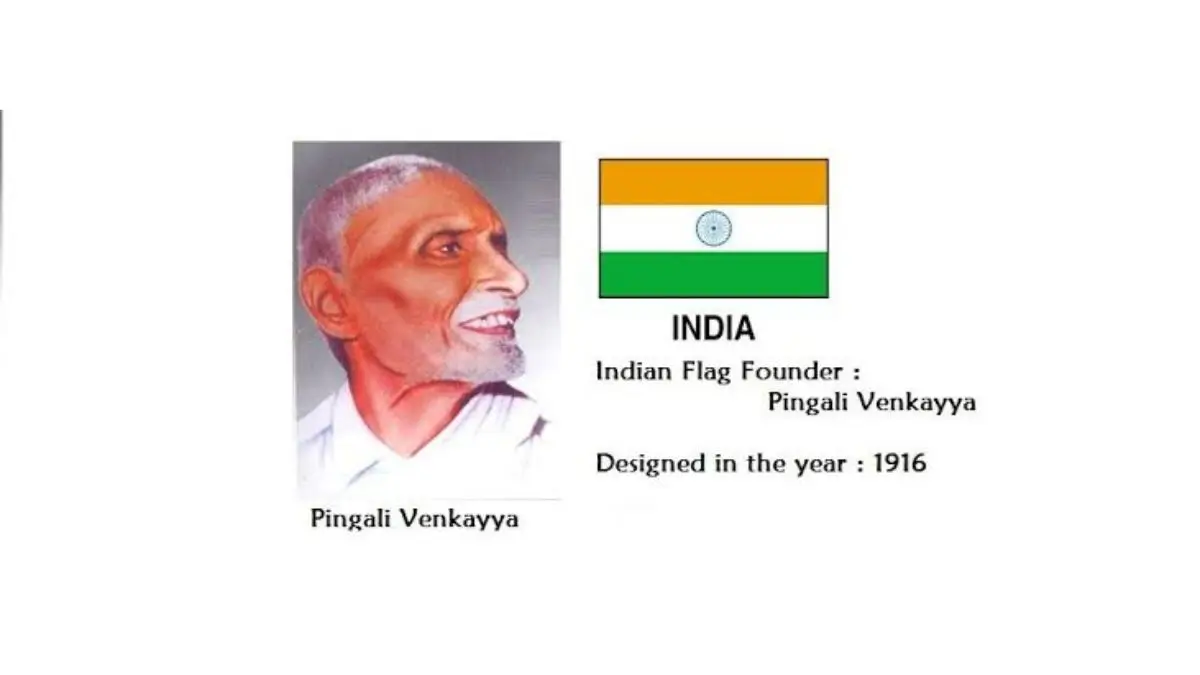
Indian National Flag designer Pingali Venkayya, the 1921 flag design, 22 July 1947 adoption, Tricolour colours and 24-spoke Ashoka Chakra explained for government exams.
Introduction: The Story Behind India’s National Flag
The Indian National Flag, popularly known as the Tiranga, is one of the most important symbols of India’s sovereignty, unity and national identity. On Independence Day and Republic Day, the Tricolour is displayed across the country, making its history an important topic for General Knowledge, History and Indian Polity sections of competitive examinations. The story of the flag is closely associated with Pingali Venkayya, the freedom fighter and designer whose work contributed significantly to the evolution of India’s national flag.
Who Was Pingali Venkayya?
Pingali Venkayya was born in 1876 in present-day Andhra Pradesh. He was a freedom fighter, scholar and designer who developed a strong interest in the idea of creating a distinctive national flag for India. His association with the freedom movement and his efforts to develop flag designs eventually brought his work to the attention of Mahatma Gandhi.
Pingali Venkayya’s Book on the National Flag
An important milestone in Venkayya’s journey was the publication of his 1916 work, A National Flag for India. The book presented different possible designs and reflected his belief that India needed a recognizable national symbol. His efforts demonstrated that the idea of a national flag had become an important part of the broader nationalist movement.
The 1921 Flag Design and Mahatma Gandhi
In 1921, Pingali Venkayya presented a flag design to Mahatma Gandhi. The design subsequently underwent changes as leaders considered how a national symbol could represent the country’s diversity and aspirations. Gandhi supported incorporating a white band and the charkha, or spinning wheel, into the design. The charkha represented ideals such as Swadeshi, self-reliance, economic independence and dignity of labour.
From the Freedom Movement to the National Flag
The Indian National Flag evolved through several stages rather than being created in a single form. Different designs were associated with the freedom struggle, reflecting changing political ideas and the search for a symbol capable of representing India as a whole. The evolution of the flag therefore forms an important part of the history of the Indian national movement.
Adoption of the Present Tricolour in 1947
The Constituent Assembly adopted the present design of the Indian National Flag on 22 July 1947, shortly before India became independent. The final design consisted of three horizontal bands of India saffron, white and India green, with a navy-blue Ashoka Chakra at the centre of the white band. The charkha was replaced by the Ashoka Chakra in the final design.
Meaning of the Three Colours
The three colours of the Indian National Flag carry important symbolic associations. India saffron is associated with courage and sacrifice, while white represents truth and peace. India green is associated with the land, plant life and the country’s relationship with agriculture. These meanings are especially important for students preparing for examinations involving Indian national symbols and constitutional awareness.
Significance of the Ashoka Chakra
The navy-blue Ashoka Chakra is positioned at the centre of the white band. It contains 24 equally spaced spokes and is derived from the Ashoka Chakra associated with the Lion Capital of Ashoka at Sarnath. The wheel represents dharma, righteousness, movement and progress. Its presence replaced the charkha in the final national flag adopted in 1947.
Important Flag Facts for Government Exams
The present National Flag has a length-to-height ratio of 3:2. According to the Flag Code of India, the top panel is India saffron, the middle panel is white with the navy-blue Ashoka Chakra, and the bottom panel is India green. The Ministry of Home Affairs also provides rules governing the display and use of the National Flag.
Why Pingali Venkayya’s Contribution Matters
Pingali Venkayya’s contribution is significant because the development of the Indian National Flag was connected with the wider freedom struggle and the search for a unifying national identity. His designs and advocacy helped establish the foundation for a symbol that eventually became the official National Flag of independent India. For competitive-exam aspirants, remembering Venkayya, 1921, 22 July 1947, the Ashoka Chakra and the symbolism of the Tricolour can be particularly useful.
Conclusion: The Tricolour as a Symbol of National Identity
The Indian National Flag represents more than three colours and a wheel. Its evolution reflects India’s freedom struggle, ideas of unity, self-reliance, sacrifice, truth, peace, dharma and progress. Pingali Venkayya’s role in developing the early design makes him an important figure in the history of the Tricolour, while the Constituent Assembly’s adoption of the present design on 22 July 1947 marked a decisive step in establishing the national symbol of independent India.

Why This News Is Important
Relevance for Government Examinations
The history of the Indian National Flag is highly relevant to competitive examinations because questions on national symbols frequently appear in General Awareness, Static GK, Indian History and Polity sections. Candidates preparing for UPSC, State PCS, SSC, Railways, Banking, Defence and teaching examinations should remember the major milestones associated with the Tricolour.
Importance of Pingali Venkayya
Pingali Venkayya is an important name associated with the development of India’s National Flag. His efforts demonstrate how national symbols evolved alongside the freedom movement. Questions may test his identity, his contribution, the year 1921 and his association with Mahatma Gandhi.
Importance of 22 July 1947
The Constituent Assembly adopted the present National Flag on 22 July 1947. This date is particularly important for examination preparation because it connects the flag’s history with the final phase of India’s transition to independence.
Importance of the Ashoka Chakra
The Ashoka Chakra is another frequently tested fact. It has 24 spokes, is navy blue and occupies the centre of the white band. Its symbolism is associated with dharma, righteousness and continuous movement.
Importance for Indian History and Polity
The story of the Tricolour connects the freedom struggle, nationalist movements, the Constituent Assembly and the institutional framework governing the National Flag. Understanding this evolution helps aspirants answer both direct factual questions and conceptual questions concerning national identity and constitutional history.
Historical Context: Evolution of the Indian National Flag
National Symbols During the Freedom Movement
During India’s freedom struggle, nationalists sought symbols capable of expressing the country’s aspirations and strengthening a shared sense of identity. The idea of a national flag consequently developed alongside political mobilisation and the broader movement for independence. Different designs appeared before the final form was adopted in 1947.
Pingali Venkayya’s Early Contribution
Pingali Venkayya played a prominent role in the search for an Indian national flag. His 1916 publication, A National Flag for India, reflected his systematic interest in developing a distinctive national symbol. His work later became associated with the flag design presented to Mahatma Gandhi in 1921.
The Charkha and the Swadeshi Ideal
The charkha became closely connected with the freedom movement and Mahatma Gandhi’s emphasis on Swadeshi and self-reliance. It symbolised economic independence and the dignity of labour. Gandhi’s involvement therefore influenced the ideological meaning attached to the developing flag design.
Adoption of the Final Design
After several stages of development, the Constituent Assembly adopted the present National Flag on 22 July 1947. The final design retained the three-colour structure while replacing the charkha with the Ashoka Chakra. The resulting flag became the national symbol of independent India.
Flag Code and Present-Day Rules
The National Flag is governed by the Flag Code of India, 2002, as amended. The Ministry of Home Affairs specifies important characteristics, including the three equal horizontal panels, the 3:2 ratio and the 24-spoke navy-blue Ashoka Chakra.
Key Takeaways from The Story of the Indian National Flag
| S. No. | Key Takeaway |
|---|---|
| 1 | Pingali Venkayya was a prominent figure associated with the development of the Indian National Flag. |
| 2 | Venkayya presented a flag design to Mahatma Gandhi in 1921, after which the design evolved further. |
| 3 | The Constituent Assembly adopted the present National Flag on 22 July 1947. |
| 4 | The final Tricolour contains India saffron, white and India green, with a navy-blue Ashoka Chakra in the centre. |
| 5 | The Ashoka Chakra has 24 equally spaced spokes and represents ideas including dharma, righteousness, movement and progress. |
Frequently Asked Questions
1. Who designed the Indian National Flag?
Pingali Venkayya is widely associated with the design and development of the Indian National Flag. He presented a flag design to Mahatma Gandhi in 1921.
2. When was the present Indian National Flag adopted?
The Constituent Assembly adopted the present design of the Indian National Flag on 22 July 1947, shortly before India became independent.
3. Who designed the Indian National Flag in 1921?
Pingali Venkayya presented a flag design to Mahatma Gandhi in 1921. The design was subsequently modified and evolved into the present Tricolour.
4. What are the three colours of the Indian National Flag?
The three horizontal bands are India saffron at the top, white in the middle and India green at the bottom.
5. What is present in the centre of the Indian National Flag?
The centre of the white band contains a navy-blue Ashoka Chakra.
6. How many spokes are there in the Ashoka Chakra?
The Ashoka Chakra has 24 equally spaced spokes.
7. What replaced the charkha on the Indian National Flag?
The Ashoka Chakra replaced the charkha in the final design adopted in 1947.
8. What does the Ashoka Chakra represent?
The Ashoka Chakra is associated with dharma, righteousness, movement and progress and is derived from the Dharma Chakra associated with the Lion Capital of Ashoka at Sarnath.
9. What is the ratio of the Indian National Flag?
The length-to-height ratio of the Indian National Flag is 3:2.
10. Which body adopted the Indian National Flag in 1947?
The Constituent Assembly of India adopted the present National Flag on 22 July 1947.
11. What was the significance of the charkha in the earlier flag design?
The charkha was closely associated with Swadeshi, self-reliance, economic independence and the dignity of labour, particularly through Mahatma Gandhi’s national movement.
12. Which important book did Pingali Venkayya publish in 1916?
Pingali Venkayya published A National Flag for India in 1916, presenting different ideas for an Indian national flag.
Some Important Current Affairs Links