






Panchayat Advancement Index award received the Gold Award at the National e-Governance Awards 2026. Learn about PAI 2.0, Gram Panchayat assessment, digital governance, Ministry of Panchayati Raj initiatives, and exam-focused key facts for UPSC, SSC, Banking, Railway, Defence, and State PCS aspirants.
Panchayat Advancement Index Wins Gold Award at National e-Governance Awards 2026
Introduction to the Achievement
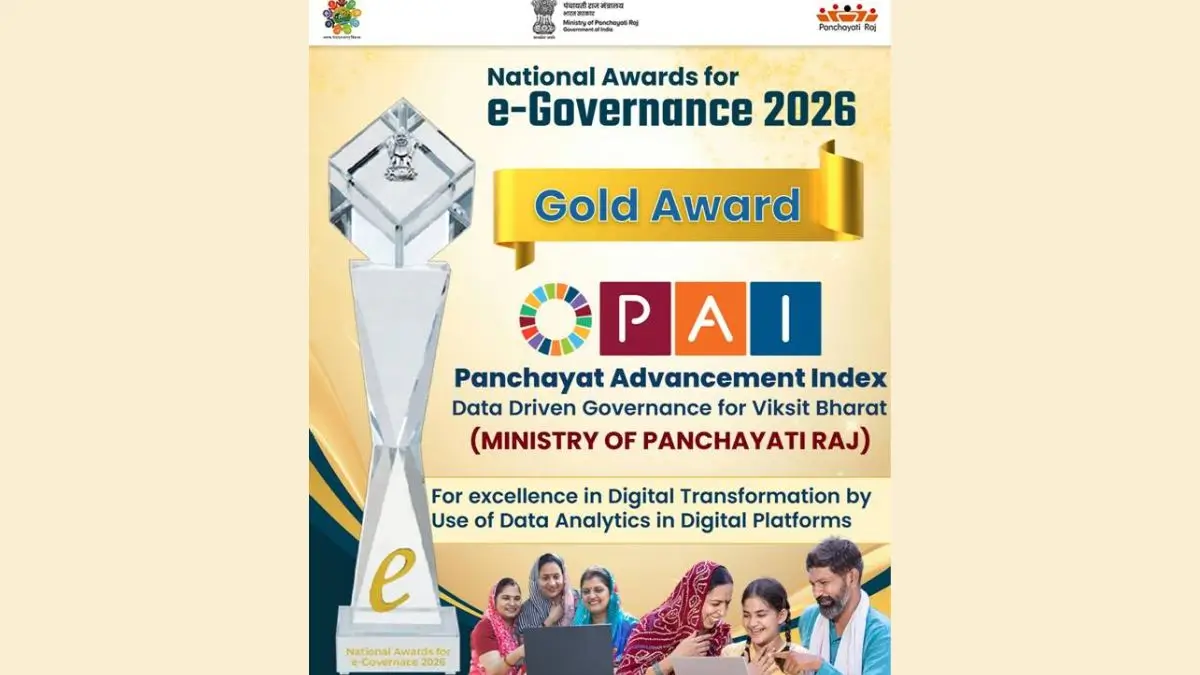
The Ministry of Panchayati Raj’s flagship initiative, the Panchayat Advancement Index (PAI), has received the prestigious Gold Award at the National Awards for e-Governance (NAeG) 2026. The award recognizes excellence in digital transformation through the use of data analytics in governance platforms and highlights India’s growing emphasis on data-driven decision-making at the grassroots level.
What is the Panchayat Advancement Index?
The Panchayat Advancement Index (PAI) is India’s first comprehensive data-driven framework designed to assess, monitor, and rank the performance of Gram Panchayats across the country. It serves as a standardized evaluation mechanism that measures local governance outcomes and developmental progress.
The initiative aligns with the Localisation of Sustainable Development Goals (LSDGs) and helps rural local bodies identify strengths, weaknesses, and areas requiring policy intervention. Through data analytics and evidence-based governance, the index supports better planning and resource allocation.
Significance of PAI 2.0
The latest version, PAI 2.0, represents a major advancement in rural governance assessment. It evaluates more than 2.6 lakh Gram Panchayats using 150 indicators and 230 data points. Based on composite scores, Gram Panchayats are categorized into different performance groups, enabling comparative assessment and targeted developmental support.
The improved version has significantly enhanced participation from local bodies across states and Union Territories, making it one of the largest governance evaluation exercises in the world. The framework provides a reliable mechanism for monitoring progress toward sustainable rural development goals.
National e-Governance Awards 2026
The National Awards for e-Governance are among India’s most respected recognitions for innovation in public administration and digital governance. These awards are presented annually to encourage government organizations to adopt technology-enabled solutions that improve transparency, efficiency, and citizen service delivery.
In 2026, seventeen projects and initiatives were selected across seven categories. The Panchayat Advancement Index secured the Gold Award under Category VII, which focuses on digital transformation through data analytics by ministries, states, and Union Territories.
Award Presentation and Benefits
The award will be presented during the 29th National Conference on e-Governance scheduled to be held in Jaipur, Rajasthan, on 1–2 July 2026. The conference is being organized jointly by the Department of Administrative Reforms and Public Grievances (DARPG), the Ministry of Electronics and Information Technology (MeitY), and the Government of Rajasthan.
As part of the Gold Award, the Ministry of Panchayati Raj will receive a trophy, citation, and a cash incentive of ₹10 lakh. The incentive will be utilized to further strengthen the initiative and enhance public welfare outcomes.
Importance for Rural Governance
The recognition of PAI demonstrates the increasing role of digital governance in rural India. By using data analytics, Gram Panchayats can make informed decisions, improve service delivery, and ensure accountability in developmental programs. The initiative promotes transparency and encourages healthy competition among Panchayats to achieve better governance outcomes.
Furthermore, the index contributes to the broader vision of “Viksit Bharat 2047” by integrating technology, data analytics, and evidence-based policymaking into grassroots governance structures.

Why This News is Important
Relevance for UPSC and State PCS Examinations
This development is highly important for UPSC, State PSC, and other government examinations because it relates directly to Panchayati Raj Institutions, local governance, digital governance, sustainable development goals, and rural administration. Questions on governance reforms and government initiatives frequently appear in both prelims and mains examinations.
Importance in Governance and Public Administration
The award highlights India’s transition toward evidence-based governance. Aspirants preparing for civil services, administrative services, and public administration-related examinations should understand how data analytics is being used to improve decision-making and service delivery at the grassroots level.
Significance for Digital India Initiatives
PAI represents a practical example of Digital India in action. The initiative demonstrates how technology can be integrated with governance to improve accountability, transparency, and development outcomes. Such examples are frequently used in essay papers, interview discussions, and governance case studies.
Connection with Sustainable Development Goals
The Panchayat Advancement Index is linked to the localization of Sustainable Development Goals (SDGs). Understanding this connection helps aspirants answer questions related to inclusive development, grassroots democracy, and international development frameworks.
Historical Context
Evolution of Panchayati Raj in India
The Panchayati Raj system was constitutionally recognized through the 73rd Constitutional Amendment Act, 1992. This amendment established a three-tier system of local self-government and empowered rural local bodies to participate actively in development planning and implementation.
Growth of Digital Governance
Over the last decade, India has increasingly adopted digital platforms to improve governance. Initiatives such as eGramSwaraj, SVAMITVA, and other e-Panchayat projects have modernized rural administration and enhanced transparency. The Ministry of Panchayati Raj has previously received national recognition for several digital governance initiatives.
Emergence of Data-Driven Governance
As governance challenges became more complex, policymakers recognized the need for measurable indicators and real-time data. The Panchayat Advancement Index emerged as a solution to objectively evaluate Gram Panchayat performance and promote evidence-based policymaking. Its latest version, PAI 2.0, significantly expanded coverage and analytical capabilities.
National e-Governance Awards Legacy
The National Awards for e-Governance have been recognizing innovative governance practices for many years. These awards encourage ministries, states, and local bodies to adopt technological innovations that improve citizen services and public administration.
Key Takeaways from This News
| S. No. | Key Takeaway |
|---|---|
| 1 | Panchayat Advancement Index (PAI) won the Gold Award at the National e-Governance Awards 2026. |
| 2 | The award was received under Category VII for Digital Transformation through Data Analytics. |
| 3 | PAI is India’s first comprehensive framework for assessing and ranking Gram Panchayat performance. |
| 4 | PAI 2.0 evaluates more than 2.6 lakh Gram Panchayats using 150 indicators and 230 data points. |
| 5 | The award will be presented during the 29th National Conference on e-Governance in Jaipur on 1–2 July 2026, and includes a ₹10 lakh incentive. |
Frequently Asked Questions (FAQs)
1. What is the Panchayat Advancement Index (PAI)?
The Panchayat Advancement Index (PAI) is a data-driven assessment framework developed by the Ministry of Panchayati Raj to evaluate the performance and development outcomes of Gram Panchayats across India.
2. Which award did the Panchayat Advancement Index receive in 2026?
The Panchayat Advancement Index received the Gold Award at the National Awards for e-Governance (NAeG) 2026.
3. Under which category did PAI win the Gold Award?
PAI won the Gold Award under Category VII: Digital Transformation through Data Analytics by Ministries, States, and Union Territories.
4. Which ministry developed the Panchayat Advancement Index?
The Ministry of Panchayati Raj, Government of India, developed the Panchayat Advancement Index.
5. What is the objective of the Panchayat Advancement Index?
The objective is to measure Panchayat performance, improve governance, strengthen accountability, and promote evidence-based rural development planning.
6. How many Gram Panchayats are assessed under PAI 2.0?
PAI 2.0 evaluates more than 2.6 lakh Gram Panchayats across India.
7. How many indicators are used in PAI 2.0?
PAI 2.0 uses 150 indicators and 230 data points to assess Panchayat performance.
8. What are the National Awards for e-Governance?
The National Awards for e-Governance are annual awards recognizing excellence and innovation in digital governance and public service delivery in India.
9. Where will the National e-Governance Awards 2026 be presented?
The awards will be presented during the 29th National Conference on e-Governance in Jaipur, Rajasthan.
10. Why is this topic important for competitive examinations?
The topic is important because it covers Panchayati Raj, Digital India, Sustainable Development Goals (SDGs), e-Governance, data analytics, and rural development—frequently asked themes in UPSC, State PSC, SSC, Banking, Railway, Defence, and Teaching examinations.
11. Which Constitutional Amendment gave constitutional status to Panchayati Raj Institutions?
The 73rd Constitutional Amendment Act, 1992 granted constitutional status to Panchayati Raj Institutions.
12. What is meant by Localisation of Sustainable Development Goals (LSDGs)?
LSDGs refer to adapting and implementing the Sustainable Development Goals at the local government level, including Panchayats and municipalities.
Some Important Current Affairs Links