







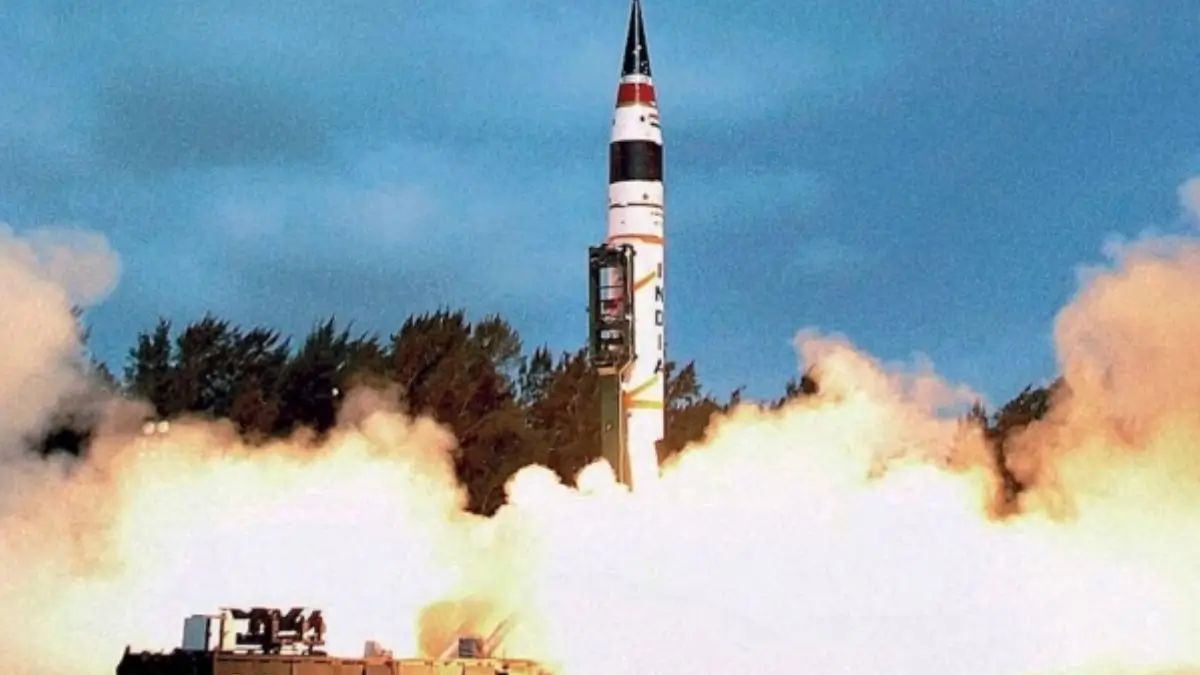
Agni-4 missile test Odisha highlights India’s strategic missile capability, DRDO’s indigenous technology, the 4,000-km range missile and its importance for government exams.
Agni-4 Missile Test Conducted Successfully
India successfully test-fired the Agni-4 ballistic missile from the Integrated Test Range (ITR) at Chandipur in Odisha on 6 August 2026. The test was conducted under the aegis of the Strategic Forces Command (SFC) and successfully validated the missile’s operational and technical parameters. The latest launch is an important development for India’s strategic defence preparedness and indigenous missile capabilities.
Agni-4 is a Medium-Range Ballistic Missile
Agni-4 is a strategic medium-range ballistic missile (MRBM) developed indigenously by the Defence Research and Development Organisation (DRDO). The missile has a reported strike range of approximately 4,000 kilometres, placing it among India’s important long-range strategic missile systems. Its range and mobility provide India with an additional capability for maintaining a credible strategic deterrent.
Strategic Forces Command Conducted the Trial
The latest test was conducted under the Strategic Forces Command, an important component of India’s nuclear command structure. The successful user-oriented trial demonstrated the missile system’s operational preparedness in addition to validating its technical performance. Reports indicate that this was the tenth test of Agni-4, with the Strategic Forces Command having handled six of these tests.
Road-Mobile Design Enhances Operational Flexibility
One of the important characteristics of Agni-4 is its road-mobile launch capability. A mobile missile system can be moved between different locations, making it comparatively more difficult for an adversary to identify and target its launch assets. This mobility adds operational flexibility and contributes to the survivability of India’s strategic missile forces.
Agni-4 Strengthens India’s Strategic Deterrence
The successful test reinforces India’s efforts to maintain a credible strategic deterrent. Agni-4 forms part of the wider Agni family of missiles developed to provide India with different ranges and strategic capabilities. Its successful testing demonstrates continued progress in India’s indigenous missile programme and supports the country’s broader objective of strengthening national defence preparedness.
Indigenous Defence Technology Gets a Boost
The Agni programme represents India’s long-term investment in indigenous missile technology. DRDO has developed several technologies associated with the Agni family, contributing to India’s ability to design, test and deploy sophisticated strategic systems domestically. Such developments are also relevant to the Aatmanirbhar Bharat objective in the defence sector, which seeks greater domestic capability in defence research, manufacturing and technology.
Odisha Remains a Major Missile Testing Hub
Odisha has an important role in India’s missile-testing infrastructure. The Integrated Test Range at Chandipur and Dr APJ Abdul Kalam Island have been used for testing several missile systems. In May 2026, India also successfully conducted a flight trial of an advanced Agni missile equipped with Multiple Independently Targeted Re-entry Vehicle (MIRV) technology from Dr APJ Abdul Kalam Island.
Importance for Government Exam Preparation
For government exam aspirants, the Agni-4 test is significant under Defence Current Affairs, Indian Defence Technology, DRDO, Missile Technology and National Security. Candidates should remember the missile’s name, approximate range, launch location, organisation involved and the role of the Strategic Forces Command. The distinction between ballistic and cruise missiles, as well as the different categories within the Agni missile family, can also be relevant for defence, banking, railways, police and civil-service examinations.

Why this News is Important
Strengthening India’s Strategic Preparedness
The successful Agni-4 test is important because it demonstrates India’s continued efforts to maintain and improve its strategic defence preparedness. A reliable ballistic missile capability contributes to the country’s broader deterrence framework and provides an important component of national security planning. The successful trial also demonstrates confidence in the missile’s operational and technical performance.
Significance for India’s Missile Programme
Agni-4 is an important member of India’s indigenous Agni missile family. Its approximately 4,000-kilometre range places it in a strategically important category between shorter-range and longer-range systems. Continued testing allows defence authorities to assess operational reliability and maintain readiness of the system.
Importance of DRDO and Indigenous Technology
The development of Agni missiles highlights the role of DRDO in India’s defence research ecosystem. Indigenous development of advanced missile systems reduces dependence on foreign technology and supports India’s long-term defence self-reliance. The Agni programme therefore has importance beyond a single missile test and represents the country’s broader technological development in strategic systems.
Relevance to Competitive Examinations
The development is highly relevant to current-affairs sections of examinations such as UPSC Civil Services, State PCS, SSC, banking, railways, defence examinations, police recruitment and teaching examinations. Questions may focus on Agni-4, DRDO, Chandipur, Odisha, Strategic Forces Command, ballistic missiles and India’s nuclear deterrence framework.
Historical Context: Background of India’s Agni Missile Programme
Beginning of the Integrated Guided Missile Development Programme
India’s indigenous missile-development journey received a major institutional push through the Integrated Guided Missile Development Programme (IGMDP) launched in the 1980s. The programme sought to develop a range of missile systems for India’s defence requirements. It became an important foundation for subsequent indigenous missile technologies.
Evolution of the Agni Missile Family
The Agni series developed progressively from earlier technology demonstrators into a family of strategic ballistic missiles with different ranges and capabilities. Systems in the Agni family have been designed to address different strategic requirements, with increasing improvements in guidance, propulsion, mobility and accuracy.
Development of Agni-4
Agni-4 represents an important stage in this technological evolution. The missile incorporates advanced technologies and provides a longer-range capability compared with earlier members of the series. Its road-mobile configuration also provides greater operational flexibility. The system has been subjected to repeated testing to establish reliability and operational readiness.
Recent Advances in Agni Technology
India has continued to develop advanced technologies associated with the Agni programme. In May 2026, an advanced Agni missile featuring MIRV technology was successfully flight-tested from Odisha. The test demonstrated the capability to deliver multiple payloads toward different targets and represented another milestone in India’s strategic missile technology.
Key Takeaways from Agni-4 Missile Test
| S. No. | Key Takeaway |
|---|---|
| 1 | India successfully test-fired the Agni-4 ballistic missile on 6 August 2026. |
| 2 | The missile was launched from the Integrated Test Range (ITR), Chandipur, Odisha. |
| 3 | Agni-4 is a medium-range ballistic missile with an approximate range of 4,000 km. |
| 4 | The latest test was conducted under the aegis of the Strategic Forces Command (SFC). |
| 5 | The successful trial demonstrated India’s continued progress in strategic deterrence, missile technology and indigenous defence capabilities. |
FAQs: Agni-4 Ballistic Missile Test
1. What is Agni-4?
Agni-4 is an Indian Intermediate-Range Ballistic Missile (IRBM) developed indigenously by the Defence Research and Development Organisation (DRDO). It is part of India’s Agni family of strategic ballistic missiles.
2. What is the approximate range of Agni-4?
Agni-4 has an approximate range of 4,000 kilometres, giving India a significant intermediate-range strategic missile capability.
3. Where was the Agni-4 missile tested?
Agni-4 was test-fired from the Integrated Test Range (ITR) at Chandipur in Odisha. ITR Chandipur is one of India’s major facilities for missile testing. DRDO records confirm an earlier successful Agni-4 launch from the same facility.
4. Which organisation developed Agni-4?
The Defence Research and Development Organisation (DRDO) is responsible for the indigenous development of the Agni missile family.
5. Which command is associated with the Agni-4 test?
The test was conducted under the aegis of the Strategic Forces Command (SFC). The SFC is responsible for the management of India’s strategic nuclear assets and forms an important component of the country’s nuclear command structure.
6. What type of missile is Agni-4?
Agni-4 is an Intermediate-Range Ballistic Missile (IRBM). It is a surface-to-surface strategic missile.
7. What is the significance of the Agni-4 test for India?
The successful test demonstrates India’s continued efforts to maintain strategic deterrence, missile reliability and operational preparedness. It also highlights India’s progress in indigenous defence technology.
8. What is the difference between a ballistic missile and a cruise missile?
A ballistic missile follows a largely ballistic trajectory after its powered phase and can travel through the upper atmosphere before descending toward its target. A cruise missile, by contrast, generally remains within the atmosphere and uses sustained propulsion and aerodynamic flight for much of its journey.
9. What is the Agni missile series?
The Agni series is a family of Indian ballistic missiles developed for different ranges and strategic requirements. The programme has evolved over several decades, incorporating advances in propulsion, navigation, guidance, re-entry technology and mobility.
10. Why is Odisha important for India’s defence sector?
Odisha hosts major missile-testing infrastructure, particularly the Integrated Test Range at Chandipur and Dr APJ Abdul Kalam Island. These facilities have been used for testing several indigenous missile systems.
Some Important Current Affairs Links