








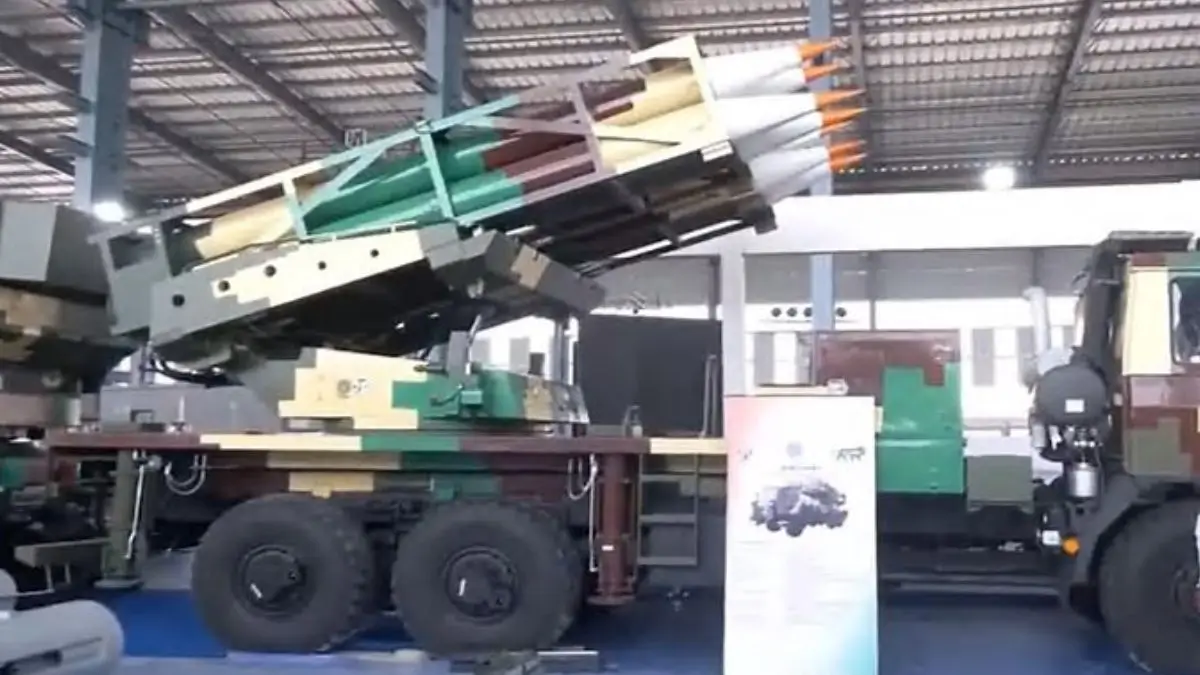
Suryastra 300 km rocket system launched by India marks a major defence breakthrough under Atmanirbhar Bharat. Learn key facts, importance, MCQs, FAQs, and historical context for UPSC, SSC, Banking, Railways, Defence, and PSC exams.
Rajnath Singh Launches India’s First 300 KM Rocket System ‘Suryastra’ in Major Defence Boost
Introduction to the Suryastra Rocket System
India achieved a major milestone in indigenous defence manufacturing after Defence Minister Rajnath Singh flagged off the country’s first indigenous 300-kilometre Universal Rocket Launching System named “Suryastra” in Shirdi, Maharashtra. The launch took place during the inauguration of a new private-sector defence manufacturing complex developed by NIBE Limited.
The development marks a significant advancement in India’s push towards self-reliance in advanced defence technologies under the “Atmanirbhar Bharat” initiative. The Suryastra system is designed to provide long-range precision strike capability to the Indian Army and strengthen India’s strategic military preparedness.
What is the Suryastra Rocket System?
Suryastra is India’s first indigenous Universal Rocket Launching System capable of striking targets up to 300 kilometres away with high precision. The system has been developed by NIBE Limited, a Pune-based private defence company.
The rocket launcher system demonstrated the capability to fire guided rockets with ranges of both 150 km and 300 km during testing at the Integrated Test Range (ITR) in Chandipur, Odisha. Reports indicate that the system can hit targets with exceptional accuracy, making it one of the most advanced indigenous rocket systems developed in India.
The long-range capability of Suryastra allows the Indian Army to target enemy infrastructure, command centres, and strategic assets deep inside hostile territory without requiring air support. This enhances India’s deterrence capability and operational flexibility in modern warfare scenarios.
Launch Event Held in Maharashtra
The Suryastra system was officially flagged off during the inauguration of a massive defence manufacturing hub in Shirdi, Maharashtra. The event was attended by Maharashtra Chief Minister Devendra Fadnavis and senior defence officials.
During the ceremony, Rajnath Singh emphasized that countries capable of manufacturing their own weapons become strategically independent and stronger. He highlighted that future wars would increasingly depend on automation, precision systems, and indigenous defence technology rather than merely the size of armed forces.
The inauguration also included the foundation stone laying for a missile complex associated with the Suryastra project. The defence manufacturing complex will focus on artillery systems, missile technologies, rocket systems, autonomous defence platforms, and energetic materials.
Role of Private Sector in Defence Manufacturing
The Suryastra project represents the growing role of private companies in India’s defence ecosystem. Earlier, defence manufacturing in India was largely dominated by public sector undertakings and ordnance factories. However, recent reforms by the Government of India have encouraged private sector participation in defence production.
According to Rajnath Singh, private sector contribution to defence production has increased significantly over the years. Companies are no longer limited to manufacturing spare parts but are now producing complete weapon systems and advanced defence technologies.
This transformation supports India’s long-term goal of becoming a major global defence exporter while reducing dependence on foreign imports.
Strategic Importance of the Rocket System
The induction of Suryastra is expected to strengthen India’s deep-strike capability, particularly along sensitive border regions. Long-range rocket systems provide rapid response capability and precision attacks against enemy targets.
Military experts believe that systems like Suryastra can significantly improve battlefield dominance because they can neutralize enemy assets from safer distances. The capability becomes especially important amid evolving regional security challenges and changing warfare technologies.
The launch also reflects India’s increasing focus on indigenous military modernization programs such as Pinaka rocket systems, BrahMos missiles, and other long-range precision-guided weapons.

Why This News is Important
Boost to India’s Defence Self-Reliance
The launch of the Suryastra rocket system is important because it reflects India’s growing self-reliance in defence manufacturing. India has traditionally depended on foreign countries for advanced military technologies and weapon systems. Indigenous projects like Suryastra reduce dependence on imports and strengthen strategic independence.
The development aligns with the Government of India’s “Atmanirbhar Bharat” mission, which encourages domestic manufacturing and technological innovation in critical sectors, including defence.
Strengthening National Security
The 300-km strike capability of Suryastra significantly enhances India’s military preparedness. Modern warfare increasingly requires long-range precision systems capable of neutralizing threats quickly and accurately.
The rocket system can support the Indian Army in targeting enemy installations, logistics hubs, and strategic assets deep within hostile territory. Such systems improve deterrence capability and strengthen border security.
Expansion of Private Sector Participation
The Suryastra project highlights the increasing contribution of private companies in India’s defence production sector. Earlier dominated by government organizations, the defence industry is now witnessing greater private participation, technological innovation, and investment.
This development is important for competitive defence manufacturing, employment generation, and export opportunities.
Relevance for Competitive Exams
This news is highly important for government exam aspirants because questions related to defence exercises, indigenous missile systems, military modernization, and Atmanirbhar Bharat frequently appear in exams such as UPSC, SSC, Banking, Defence, Railways, and State PSC examinations.
Historical Context
India’s Journey Towards Indigenous Defence Manufacturing
India has historically depended on foreign suppliers such as Russia, France, Israel, and the United States for advanced defence systems. However, repeated geopolitical challenges and supply chain uncertainties highlighted the need for domestic defence manufacturing.
Over the years, organizations like Defence Research and Development Organisation (DRDO) and Indian private companies have developed indigenous systems such as Agni missiles, Akash missile systems, Pinaka rocket launchers, and BrahMos cruise missiles.
Evolution of Rocket Artillery Systems in India
India’s rocket artillery modernization began with systems like the Pinaka Multi-Barrel Rocket Launcher. The Pinaka system was designed to replace older Soviet-origin Grad launchers and provide high-volume firepower support to the Indian Army.
Recent years have seen efforts to develop longer-range and precision-guided rocket systems. The Suryastra project represents the next stage in this evolution by introducing a 300-km indigenous universal rocket launching system.
Rise of Private Defence Manufacturing
The Indian government introduced several reforms to allow greater private sector involvement in defence manufacturing. Policies such as “Make in India” and “Atmanirbhar Bharat” encouraged domestic production, technology transfer, and export-oriented defence industries.
Companies like NIBE Limited are now participating in advanced defence projects, marking a shift from traditional public-sector dominance to a more competitive and innovation-driven ecosystem.
Key Takeaways from This News
| S.No. | Key Takeaway |
|---|---|
| 1 | India launched its first indigenous 300-km Universal Rocket Launching System named “Suryastra”. |
| 2 | The rocket system was flagged off by Rajnath Singh in Shirdi, Maharashtra. |
| 3 | Suryastra was developed by NIBE Limited under India’s indigenous defence modernization efforts. |
| 4 | The system enhances India’s long-range precision strike capability and military preparedness. |
| 5 | The project supports the “Atmanirbhar Bharat” initiative and highlights growing private sector participation in defence manufacturing. |
FAQs Related to Suryastra Rocket System
1. What is the Suryastra rocket system?
Suryastra is India’s first indigenous 300-km Universal Rocket Launching System designed for long-range precision attacks and battlefield support.
2. Who launched the Suryastra rocket system?
The Suryastra system was flagged off by Defence Minister Rajnath Singh in Shirdi, Maharashtra.
3. Which company developed the Suryastra system?
The rocket system was developed by NIBE Limited, a private Indian defence manufacturing company based in Pune.
4. What is the strike range of Suryastra?
The Suryastra rocket system has a strike range of up to 300 kilometres.
5. Why is the Suryastra project important for India?
The project strengthens India’s indigenous defence capability, enhances long-range strike power, and supports the Atmanirbhar Bharat initiative.
6. Under which government initiative does this project gain importance?
The project is closely linked with the “Atmanirbhar Bharat” and “Make in India” initiatives.
7. Where was the Suryastra system inaugurated?
The system was inaugurated in Shirdi, Maharashtra during the opening of a defence manufacturing complex.
8. Which organization traditionally develops missile systems in India?
The Defence Research and Development Organisation (DRDO) has traditionally led indigenous missile and rocket development programs in India.
9. Which existing Indian rocket system is related to Suryastra?
The Pinaka Multi-Barrel Rocket Launcher is one of India’s important indigenous rocket artillery systems related to this field.
10. Why is this news important for competitive exams?
Questions related to indigenous defence systems, defence ministers, military technology, Atmanirbhar Bharat, and missile systems are frequently asked in UPSC, SSC, Banking, Railways, Defence, and State PSC exams.
Some Important Current Affairs Links