







Vyommitra humanoid robot ISRO plays a key role in India’s Gaganyaan mission 2025, simulating human functions and enhancing astronaut safety.
Vyommitra: India’s Humanoid Robot for Gaganyaan Mission
Introduction to Vyommitra
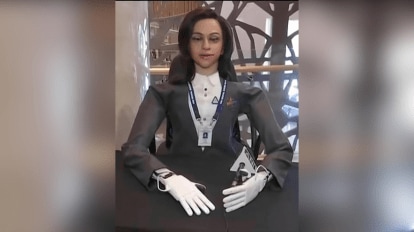
Vyommitra, a Sanskrit term meaning “Space Friend,” is a humanoid robot developed by the Indian Space Research Organisation (ISRO). Unveiled on January 22, 2020, at the Human Spaceflight and Exploration Symposium in Bengaluru, Vyommitra is designed to simulate astronaut functions aboard the Gaganyaan spacecraft. Unlike traditional animal-based experiments, Vyommitra aims to provide insights into the effects of space travel on the human body.
Design and Capabilities
Vyommitra is a half-humanoid robot, meaning it has an upper body resembling a human, while the lower body is absent. Constructed primarily from aluminum alloy, it is engineered to withstand the high-pressure and vibration conditions of space travel. The robot is equipped with artificial intelligence, enabling it to recognize astronauts, converse in Hindi and English, and perform tasks such as operating switch panels and monitoring environmental parameters like air pressure and temperature. Additionally, Vyommitra can provide warnings in case of any anomalies within the spacecraft’s environment.
Role in the Gaganyaan Mission
Vyommitra’s primary role is to act as a test subject in uncrewed missions, simulating human responses to space conditions. The first uncrewed mission, Gaganyaan-1 (G1), is scheduled for launch in December 2025. During this mission, Vyommitra will monitor life support systems, avionics, and environmental controls, providing critical data for future crewed missions. The data collected will help ISRO ensure the safety and well-being of astronauts during extended space missions.
Importance of Vyommitra
The development of Vyommitra signifies India’s commitment to advancing space technology and human spaceflight capabilities. By integrating AI into space missions, ISRO is not only enhancing its technological prowess but also setting a precedent for other nations in the field of space robotics. Vyommitra’s participation in the Gaganyaan mission underscores the importance of robotics in modern space exploration.
Why This News is Important
Advancements in Space Technology
Vyommitra’s development showcases India’s strides in integrating artificial intelligence with space technology. This advancement positions India as a key player in the global space exploration arena.
Enhancing Human Spaceflight Safety
By simulating human functions, Vyommitra helps in identifying potential risks and challenges that astronauts might face, thereby enhancing the safety protocols for future missions.
Educational and Research Opportunities
The Gaganyaan mission provides a platform for students and researchers to study the effects of space travel on the human body, fostering educational growth and scientific inquiry.
International Collaboration Prospects
India’s progress in space robotics opens avenues for international collaborations, allowing for shared knowledge and joint missions with other space-faring nations.
Inspiration for Future Generations
Vyommitra serves as an inspiration for young minds, encouraging them to pursue careers in science, technology, engineering, and mathematics (STEM) fields.
Historical Context
Early Space Exploration
The journey of human space exploration began in the mid-20th century, with the Soviet Union’s launch of Sputnik 1 in 1957. This was followed by the United States’ Mercury and Gemini programs, which laid the groundwork for the Apollo missions.
India’s Space Endeavors
India’s space journey commenced with the establishment of ISRO in 1969. The country achieved significant milestones with missions like Chandrayaan-1 (2008) and Mangalyaan (2013). These successes demonstrated India’s growing capabilities in space technology.
Emergence of Robotics in Space
The use of robotics in space exploration gained prominence in the late 20th century. Robots like NASA’s Robonaut and Japan’s Kirobo have been instrumental in assisting astronauts and conducting experiments in space.
India’s Foray into Space Robotics
Vyommitra marks India’s entry into the realm of space robotics. Developed by ISRO, it reflects the nation’s commitment to advancing space technology and preparing for future human spaceflight missions.
Key Takeaways from Vyommitra: India’s Humanoid Robot for Gaganyaan Mission
| No. | Key Takeaway |
|---|---|
| 1. | Vyommitra is an AI-enabled half-humanoid robot developed by ISRO for the Gaganyaan mission. |
| 2. | The first uncrewed mission, Gaganyaan-1, is scheduled for launch in December 2025. |
| 3. | Vyommitra will simulate human functions and monitor spacecraft systems during the mission. |
| 4. | The data collected will aid in ensuring astronaut safety for future crewed missions. |
| 5. | Vyommitra’s development underscores India’s advancements in space technology and robotics. |
FAQs: Frequently Asked Questions
1. What is Vyommitra?
Vyommitra is India’s first AI-enabled humanoid robot developed by ISRO to simulate human functions for the Gaganyaan space mission.
2. What does the name Vyommitra mean?
Vyommitra is derived from Sanskrit, meaning “Space Friend.”
3. When is the first uncrewed Gaganyaan mission scheduled?
The first uncrewed mission, Gaganyaan-1, is scheduled for December 2025.
4. What are the main functions of Vyommitra?
Vyommitra can monitor environmental parameters, operate switch panels, recognize astronauts, converse in Hindi and English, and provide warnings for anomalies in the spacecraft.
5. Why is Vyommitra important for the Gaganyaan mission?
Vyommitra helps simulate human responses to space conditions, ensuring astronaut safety and providing critical data for future crewed missions.
6. What material is Vyommitra made of?
Vyommitra is constructed primarily from aluminum alloy to withstand vibration and high-pressure conditions of space.
7. How does Vyommitra contribute to space research?
Vyommitra provides valuable insights into human physiology in space and helps in testing spacecraft systems before human astronauts are onboard.
8. Can Vyommitra speak multiple languages?
Yes, Vyommitra can converse in both Hindi and English.
9. Is Vyommitra a full humanoid robot?
No, Vyommitra is a half-humanoid robot, with only the upper body resembling a human.
10. Has India used robots in space before Vyommitra?
No, Vyommitra is India’s first humanoid robot designed specifically for space missions.
Some Important Current Affairs Links