





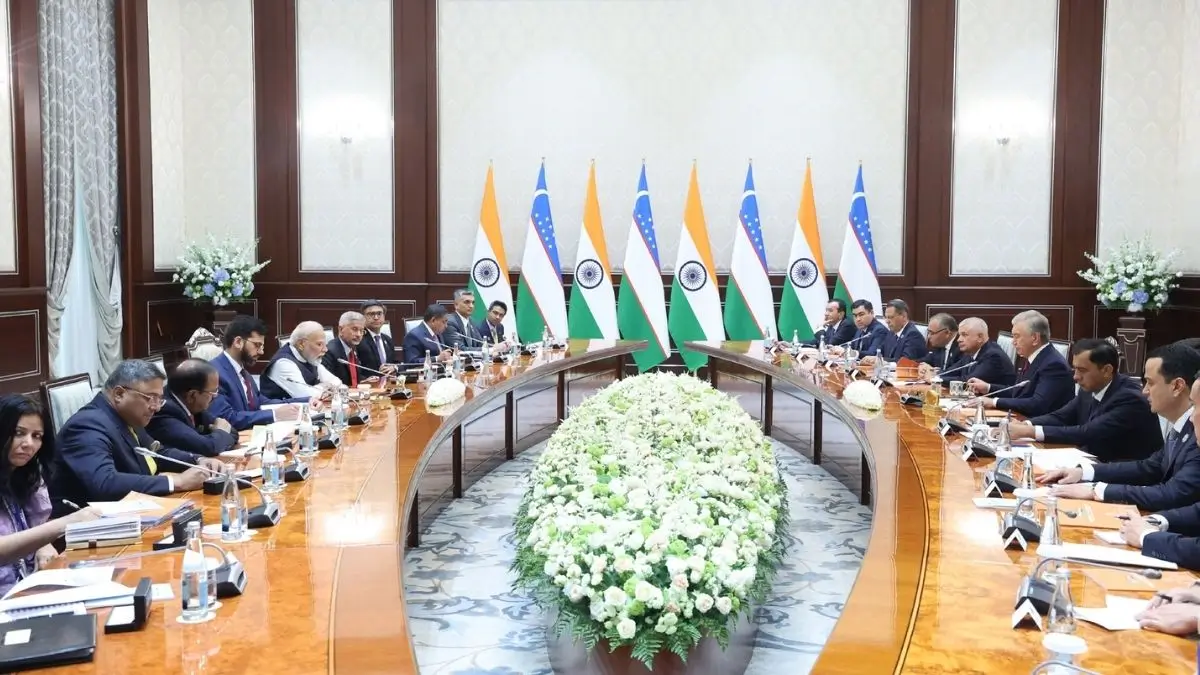
PM Modi Uzbekistan visit strengthens India-Uzbekistan ties through a Comprehensive Strategic Partnership, long-term uranium supply and a US$5 billion trade target by 2030.
India and Uzbekistan Elevate Bilateral Relations
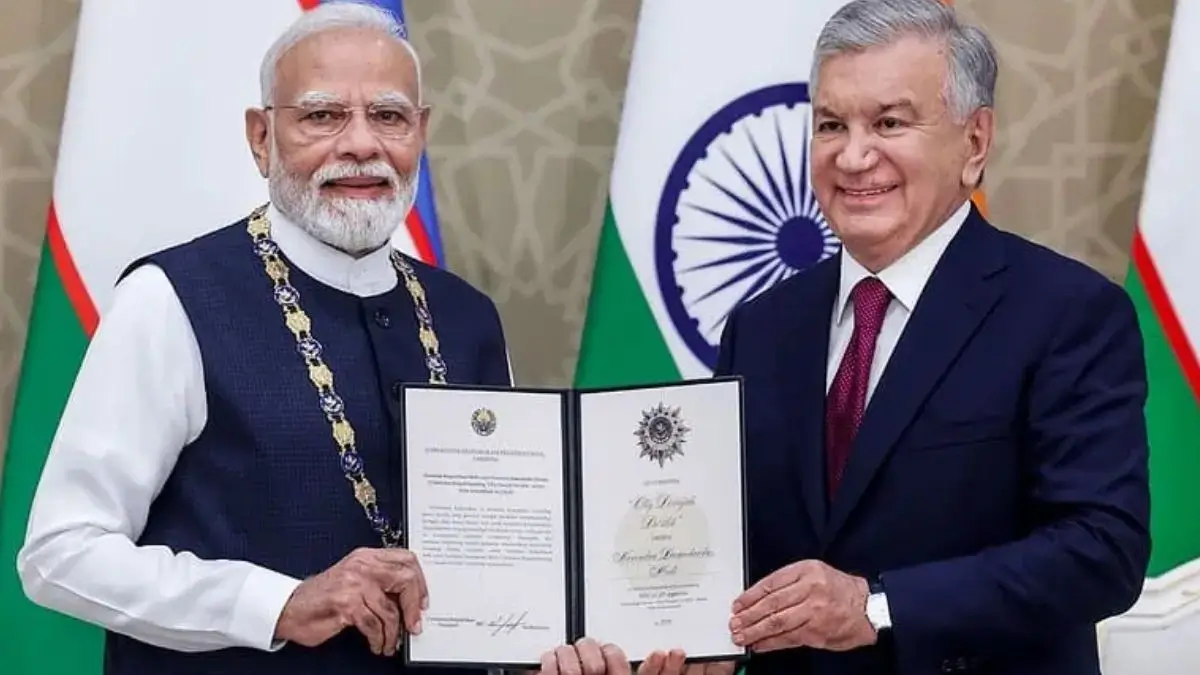
Prime Minister Narendra Modi’s visit to Uzbekistan has given a major boost to India–Uzbekistan relations, with the two countries agreeing to deepen cooperation in energy, trade, defence, connectivity, digital technology and critical minerals. During discussions with Uzbek President Shavkat Mirziyoyev in Tashkent, the two sides decided to elevate their relationship to a Comprehensive Strategic Partnership. The development is particularly significant because it coincides with the 15th anniversary of the India–Uzbekistan Strategic Partnership.
Long-Term Uranium Supply Arrangement
One of the most important outcomes of the visit was the decision to establish a long-term arrangement for uranium supplies from Uzbekistan to India. Uranium is a critical fuel for nuclear power generation, and securing reliable supplies is important for India as it expands its civilian nuclear energy programme. The agreement is therefore significant from the perspective of India’s long-term energy security and diversification of nuclear fuel sources.
$5 Billion Bilateral Trade Target by 2030
India and Uzbekistan have also set an ambitious target of increasing bilateral trade to US$5 billion annually by 2030. Bilateral trade has already crossed the US$1 billion mark, but both countries want to substantially expand economic engagement. Areas such as market access, connectivity, banking, payment systems, trade and investment are expected to receive greater attention to achieve the new target.
The two countries are also expanding cooperation in geology, mining and critical minerals. Uzbekistan possesses important mineral resources, including uranium, making cooperation in this area relevant to India’s energy security and industrial requirements. The focus on critical minerals reflects the growing importance of securing reliable supply chains for strategic industries and emerging technologies.
Digital Connectivity and UPI Cooperation
Digital connectivity has emerged as another area of India–Uzbekistan cooperation. The countries are working to expand digital payment and technology-based economic linkages. India’s Unified Payments Interface, or UPI, is also expected to play a role in strengthening digital payment connectivity between the two countries. Such cooperation can facilitate tourism, trade and people-to-people exchanges.
New Institutional Mechanisms for Cooperation
The two countries have agreed to strengthen institutional mechanisms for bilateral coordination. The existing Joint Commission is being upgraded to the ministerial level, while a coordination mechanism involving the foreign ministers is also being established. These mechanisms are expected to improve the implementation of bilateral decisions and provide a structured platform for addressing emerging issues.
Cultural and Educational Cooperation
The partnership extends beyond strategic and economic interests. India and Uzbekistan share historical connections through trade, culture, Buddhism and the broader civilisational exchanges of Central Asia. Recent agreements also cover areas such as education, environmental cooperation and preservation of Buddhist heritage. These initiatives can strengthen people-to-people relations and cultural diplomacy.
Uzbekistan’s Importance for India
Uzbekistan is the most populous country in Central Asia and occupies an important geographical position in the heart of the region. Its location makes it strategically relevant for India’s efforts to improve engagement with Central Asia. Stronger relations with Uzbekistan can help India expand economic, security, cultural and connectivity partnerships across the wider region.
Significance for India’s Central Asia Policy
The developments during PM Modi’s visit demonstrate India’s continuing focus on strengthening its engagement with Central Asian countries. Cooperation with Uzbekistan provides opportunities in energy, trade, defence, critical minerals, connectivity and digital technology. It also supports India’s broader objective of maintaining an active strategic presence in a region where several major powers have significant economic and security interests.
Key Exam Relevance
For government-exam aspirants, the visit is important because it connects several frequently tested topics: India’s foreign policy, Central Asia, nuclear energy, uranium, critical minerals, international trade, strategic partnerships and regional organisations. Students should particularly remember the elevation of India–Uzbekistan relations to a Comprehensive Strategic Partnership, the long-term uranium supply arrangement and the US$5 billion bilateral trade target for 2030.

Why PM Modi’s Uzbekistan Visit Is Important
Importance for India’s Energy Security
The proposed long-term uranium supply arrangement is one of the most significant outcomes of the visit. Nuclear energy is an important component of India’s strategy for meeting rising electricity demand while diversifying its energy mix. A reliable international supply of nuclear fuel can support the functioning and expansion of India’s civilian nuclear programme.
Strategic Importance of Central Asia
Uzbekistan occupies a strategically important position in Central Asia. India’s stronger engagement with the country can contribute to New Delhi’s broader regional outreach. Central Asia is important because of its geographical location, natural resources, connectivity potential and geopolitical significance.
Economic Importance
The US$5 billion bilateral trade target for 2030 reflects the ambition to substantially increase economic relations. Achieving this objective will require improvements in market access, connectivity, banking and payment systems. The target is therefore relevant to questions on India’s international trade and economic diplomacy.
Defence and Critical Minerals
Defence cooperation and collaboration in critical minerals add a strategic dimension to the partnership. Critical minerals are increasingly important for modern industries, clean-energy technologies and strategic sectors. Cooperation with resource-rich countries can help India diversify supply chains.
Importance for Competitive Exams
The development is particularly relevant for UPSC, State PCS, SSC, banking, defence and other government examinations. Questions may be framed around Uzbekistan’s capital, Central Asia, India’s nuclear-energy policy, uranium, bilateral trade targets, strategic partnerships and India’s foreign-policy initiatives.
Historical and Civilisational Links
India and Uzbekistan have historical connections dating back centuries. Central Asia served as an important corridor for trade, cultural exchanges and the movement of ideas between South Asia and other parts of Eurasia. Buddhist influences and later commercial and cultural interactions contributed to long-standing civilisational links.
Establishment of Diplomatic Relations
India recognised Uzbekistan as an independent state following the dissolution of the Soviet Union. Diplomatic relations between the two countries were established in 1992. Since then, bilateral cooperation has gradually expanded across political, economic, cultural and security areas.
Strategic Partnership
India and Uzbekistan developed their relationship into a Strategic Partnership in 2011. The relationship has subsequently expanded into areas such as defence, counter-terrorism, education, trade, pharmaceuticals, information technology and culture. The elevation to a Comprehensive Strategic Partnership in 2026 represents a further strengthening of this relationship.
Central Asia and India’s Foreign Policy
India has increasingly focused on strengthening ties with the Central Asian republics of Kazakhstan, Kyrgyzstan, Tajikistan, Turkmenistan and Uzbekistan. Uzbekistan is particularly important because of its central geographical position and economic and strategic significance.
Tashkent and India’s Historical Memory
Tashkent also holds special significance in India’s modern diplomatic history. The Tashkent Declaration of 1966, signed after the 1965 India–Pakistan war, remains an important event in Indian foreign-policy history. The declaration was associated with Prime Minister Lal Bahadur Shastri and Pakistan President Ayub Khan.
Key Takeaways from PM Modi’s Uzbekistan Visit
| S. No. | Key Takeaway |
|---|---|
| 1 | India and Uzbekistan elevated their relationship to a Comprehensive Strategic Partnership in 2026. |
| 2 | The two countries agreed to establish a long-term arrangement for uranium supplies from Uzbekistan to India. |
| 3 | India and Uzbekistan set a target of US$5 billion in annual bilateral trade by 2030. |
| 4 | Cooperation is being expanded in defence, critical minerals, mining, energy, digital connectivity and trade. |
| 5 | The visit strengthens India’s broader strategic engagement with Central Asia and is important for questions on India’s foreign policy and energy security. |
Frequently Asked Questions (FAQs)
1. What was the major outcome of PM Modi’s Uzbekistan visit?
India and Uzbekistan agreed to elevate their bilateral relationship to a Comprehensive Strategic Partnership, marking a significant expansion of cooperation between the two countries.
2. What important uranium-related agreement was discussed during the visit?
India and Uzbekistan agreed to establish a long-term arrangement for uranium supplies from Uzbekistan to India, supporting India’s long-term nuclear energy requirements.
3. What is the bilateral trade target set by India and Uzbekistan?
The two countries have set a target of achieving US$5 billion in annual bilateral trade by 2030.
4. Why is uranium important for India?
Uranium is an important nuclear fuel used in civilian nuclear power generation. Stable access to uranium is significant for India’s energy security and the expansion of nuclear power capacity.
5. Which country is Uzbekistan located in?
Uzbekistan is a landlocked country in Central Asia.
6. What is the capital of Uzbekistan?
The capital of Uzbekistan is Tashkent. It is also one of the major political, economic and cultural centres of Central Asia.
7. When did India and Uzbekistan establish diplomatic relations?
India and Uzbekistan established diplomatic relations in 1992, following Uzbekistan’s emergence as an independent country after the dissolution of the Soviet Union.
8. When was the India-Uzbekistan Strategic Partnership established?
India and Uzbekistan established their Strategic Partnership in 2011, which subsequently expanded into several areas including defence, trade, education and counter-terrorism.
9. Why is Uzbekistan strategically important for India?
Uzbekistan is strategically important because of its central location in Central Asia, natural resources, connectivity potential and role in regional security and economic cooperation.
10. What other areas of cooperation are important in India-Uzbekistan relations?
Besides uranium and trade, cooperation includes defence, critical minerals, mining, digital connectivity, education, culture, pharmaceuticals, counter-terrorism and economic engagement.
Some Important Current Affairs Links