






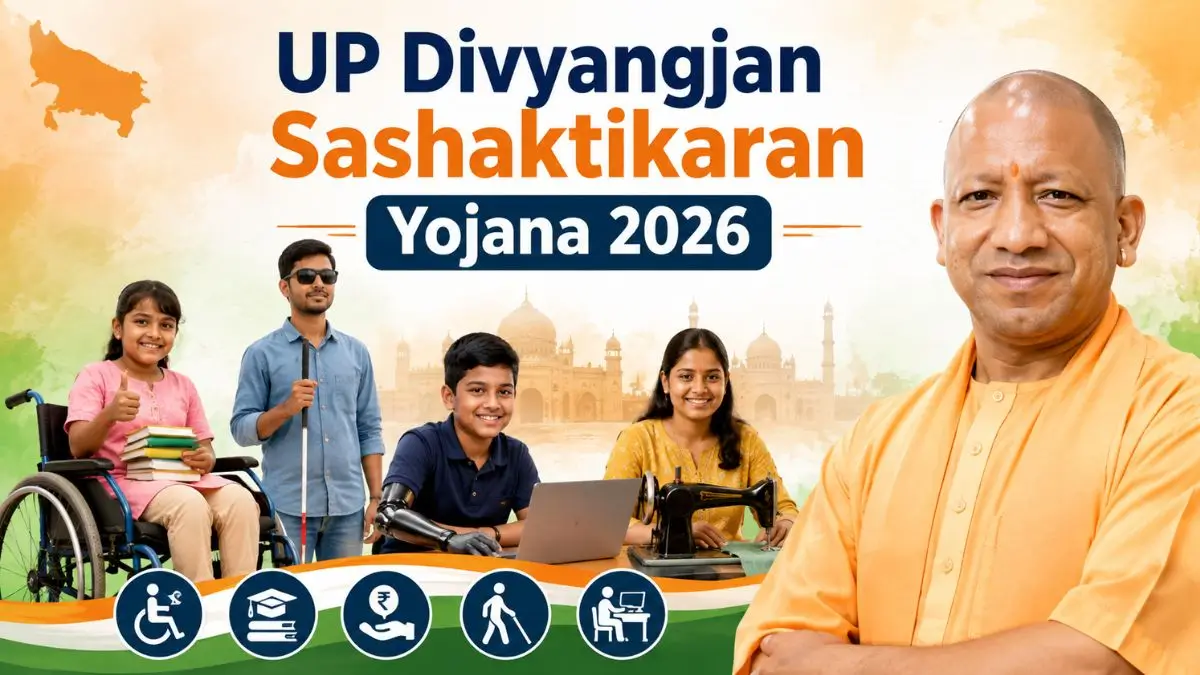
UP Divyangjan Sashaktikaran Yojana 2026: Know the benefits, eligibility, required documents, application process and key exam facts about this Uttar Pradesh government scheme.
UP Divyangjan Sashaktikaran Yojana 2026: An Inclusive Welfare Initiative
The UP Divyangjan Sashaktikaran Yojana 2026 is an important Uttar Pradesh government welfare initiative aimed at improving the social and economic well-being of persons with disabilities (Divyangjan). The scheme focuses on providing eligible beneficiaries with assistance that can improve their independence, education, mobility, livelihood opportunities and participation in society. The 2026 scheme is particularly relevant for government-exam aspirants because it connects with topics such as social justice, welfare administration, inclusive development and state government schemes.
Objective of the UP Divyangjan Sashaktikaran Yojana
The central objective of the initiative is to empower persons with disabilities and reduce the barriers that may prevent them from participating fully in economic and social life. Government support under disability-welfare programmes can help beneficiaries access essential services, educational opportunities, assistive equipment and financial assistance. The broader approach is to promote dignity, self-reliance and equal opportunity rather than treating disability welfare only as financial relief.
Financial Assistance and Social Security Support
One important component associated with the scheme is financial support for eligible Divyangjan. Disability pension is intended to provide a basic source of regular assistance to qualifying beneficiaries who meet the prescribed conditions. Government information available through the UMANG platform indicates that applicants for the Uttar Pradesh Divyang Pension Yojana provide personal, bank, income and disability-related information during the application process.
Assistive Devices and Mobility Support
Persons with disabilities may face significant difficulties in mobility, communication or performing everyday activities. Welfare support therefore includes assistance related to assistive devices, depending on the applicable programme and eligibility requirements. Such support can increase independence and make education, employment and public participation more accessible. Mobility-related assistance is particularly significant because physical accessibility remains an important component of inclusive development.
Educational and Skill Development Opportunities
Education and skill development are important pathways to long-term empowerment. Disability-focused welfare programmes can support students and help eligible Divyangjan acquire skills that improve their prospects for employment or self-employment. The emphasis on education and livelihood is significant for competitive-exam aspirants because it reflects the government’s broader approach of combining social protection with capacity building.
Eligibility Requirements for Beneficiaries
Eligibility depends on the particular benefit being sought and the rules applicable to that component of the programme. For disability pension-related assistance in Uttar Pradesh, publicly available scheme information indicates requirements such as Uttar Pradesh residence, a qualifying disability certificate and prescribed income conditions. A minimum disability level of 40% is commonly specified for the disability pension component. Applicants should always verify the latest eligibility requirements through the applicable government portal before submitting an application.
Documents Required for Application
Applicants generally need documents that establish identity, residence, disability status, income and banking details. Commonly required documents include an Aadhaar card, disability certificate, domicile or residence proof, income certificate, bank-account details or passbook and a recent photograph. The exact document list can vary according to the specific benefit and current government instructions. Applicants should ensure that their disability certificate and other supporting documents are valid and correctly recorded.
Application Process for Eligible Applicants
Eligible applicants can use the designated government online systems where online applications are available. The applicant generally needs to select the relevant disability-welfare service, enter personal and disability information, provide income and bank details, upload the required documents and submit the form. After submission, applicants should preserve the application or acknowledgement details for future status tracking. Official government platforms should be preferred over private websites or intermediaries when applying for welfare benefits.
Importance for Government Exam Aspirants
The UP Divyangjan Sashaktikaran Yojana 2026 is useful from an examination perspective because questions on state government schemes frequently test the scheme’s target beneficiaries, objectives, implementing state, benefits and eligibility conditions. Aspirants preparing for UPPSC, UPSSSC, police recruitment, teaching examinations, banking examinations and other government recruitment tests should distinguish between state-specific disability schemes and broader central government initiatives.
Inclusive Development and Social Empowerment
The scheme represents the principle that development should reach vulnerable and disadvantaged sections of society. Financial assistance can provide immediate support, while education, assistive technology and skill development can contribute to longer-term independence. In this sense, disability welfare is connected with the larger goals of social justice, equal opportunity and inclusive growth.
Key Exam Facts About the Scheme
For examinations, candidates should remember that the scheme is associated with the Government of Uttar Pradesh and focuses on the empowerment and welfare of persons with disabilities. Important areas for revision include its beneficiaries, financial and social-support components, disability certification, documentation requirements and application mechanism. Since eligibility rules and benefit amounts can change through government notifications, aspirants should verify numerical details before using them in an examination.

Why This News Is Important for Government Exams
Relevance to Social Justice and Governance
The UP Divyangjan Sashaktikaran Yojana 2026 is important because it provides an example of how state governments address the needs of persons with disabilities through targeted welfare interventions. Government examinations frequently include questions related to social justice, vulnerable sections, welfare schemes and inclusive governance. Understanding the purpose and beneficiary group of this scheme can therefore help candidates answer both factual and conceptual questions.
Connection With Inclusive Development
Inclusive development means ensuring that economic and social progress benefits sections that may face structural disadvantages. Persons with disabilities can encounter barriers related to education, employment, mobility and access to public services. Measures such as financial assistance, assistive devices, educational support and skill development seek to reduce these barriers and encourage greater participation in society.
Importance for State-Level Examinations
For aspirants preparing for UPPSC, UPSSSC, Uttar Pradesh Police, teaching recruitment and other state-level examinations, state-specific schemes are particularly important. Questions may ask candidates to identify the state implementing a particular programme, its target beneficiaries or the type of assistance provided. The scheme therefore deserves a place in Uttar Pradesh-specific current-affairs notes.
Administrative and Policy Perspective
The programme also illustrates the importance of last-mile delivery in public welfare. Designing a scheme is only one part of governance; beneficiaries must also be able to obtain certificates, submit applications, provide documentation and receive benefits efficiently. Digital application systems can make access easier, while proper verification helps ensure that assistance reaches eligible beneficiaries.
Link With Constitutional and Legal Principles
Disability welfare can also be studied alongside the broader constitutional objectives of equality, social justice and dignity. At the national level, India’s disability-rights framework has progressively moved toward greater inclusion and equal participation. State-level welfare schemes complement this broader policy direction by providing practical assistance to eligible citizens.
Historical Context: Background of Disability Welfare in India and Uttar Pradesh
Evolution of Disability Welfare Policies
India’s approach to disability has gradually evolved from a welfare-oriented model toward one emphasizing rights, accessibility, participation and empowerment. Earlier interventions largely focused on assistance and rehabilitation, while later policies increasingly recognized the need for equal opportunities in education, employment and public life.
Persons with Disabilities Act, 1995
A major milestone was the Persons with Disabilities (Equal Opportunities, Protection of Rights and Full Participation) Act, 1995, which established a more structured legal framework for disability-related rights and government responsibilities. It helped strengthen the policy focus on education, employment, rehabilitation and accessibility.
Rights of Persons with Disabilities Act, 2016
The legal framework was significantly strengthened through the Rights of Persons with Disabilities Act, 2016. The law expanded the recognition of disabilities and emphasized rights, equality, non-discrimination, accessibility and participation. It represents an important milestone in India’s transition toward a rights-based approach to disability inclusion.
Role of State Governments
State governments play an important role in translating national principles into welfare delivery. Uttar Pradesh has developed programmes and administrative mechanisms addressing the financial, educational and social needs of Divyangjan. Disability pension and other support measures form part of the wider social-welfare framework implemented at the state level.
Shift Towards Empowerment
Modern disability policy increasingly emphasizes empowerment rather than dependence. Financial support can provide social security, but access to assistive devices, education, training and employment opportunities can help beneficiaries become more economically independent. The UP Divyangjan Sashaktikaran Yojana 2026 can therefore be studied as part of this broader shift toward inclusive and empowerment-oriented welfare governance.
Key Takeaways from UP Divyangjan Sashaktikaran Yojana 2026
| S. No. | Key Takeaway |
|---|---|
| 1 | Implementing Government: The scheme is associated with the Government of Uttar Pradesh and focuses on the welfare and empowerment of persons with disabilities. |
| 2 | Target Beneficiaries: The primary beneficiaries are eligible persons with disabilities (Divyangjan). |
| 3 | Major Support Areas: Assistance can cover areas such as financial support, assistive devices, education, mobility and skill-related opportunities, depending on the applicable component. |
| 4 | Eligibility and Documents: Applicants must satisfy the prescribed conditions and generally provide identity, residence, disability, income and banking documents where required. |
| 5 | Exam Relevance: The scheme is important for questions on Uttar Pradesh government schemes, social justice, disability welfare, inclusive development and public administration. |
Frequently Asked Questions (FAQs)
1. What is the UP Divyangjan Sashaktikaran Yojana 2026?
The UP Divyangjan Sashaktikaran Yojana 2026 is a Uttar Pradesh government welfare initiative focused on the social and economic empowerment of eligible persons with disabilities.
2. Who are the main beneficiaries of the scheme?
The primary beneficiaries are eligible persons with disabilities (Divyangjan) residing in Uttar Pradesh who satisfy the prescribed conditions for the relevant benefit.
3. What is the main objective of the scheme?
The major objective is to promote the welfare, independence and social inclusion of persons with disabilities by facilitating financial assistance and other forms of support.
4. What types of assistance are associated with disability welfare programmes in Uttar Pradesh?
Depending on the specific programme and eligibility, assistance may include disability pension, assistive devices, educational support, mobility assistance and measures supporting skill development and livelihood.
5. What is the minimum disability percentage commonly associated with the disability pension component?
The disability pension component commonly requires a minimum of 40% disability, subject to the applicable rules and verification requirements.
6. Which documents may be required while applying?
Applicants may be required to provide documents such as an Aadhaar card, disability certificate, income certificate, residence or domicile proof, bank-account details/passbook and photograph. Requirements can vary according to the particular benefit.
7. Why is the scheme important for UPPSC and UPSSSC aspirants?
It is relevant to Uttar Pradesh-specific current affairs and questions concerning government schemes, social justice, welfare of vulnerable groups, disability empowerment and inclusive development.
8. Which national law is an important part of India’s disability-rights framework?
The Rights of Persons with Disabilities Act, 2016 is a major legislation governing disability rights and inclusion in India.
9. Which earlier law preceded the Rights of Persons with Disabilities Act, 2016?
The Persons with Disabilities (Equal Opportunities, Protection of Rights and Full Participation) Act, 1995 preceded the 2016 legislation.
10. What is the broader significance of disability empowerment schemes?
Such schemes contribute to inclusive development by addressing barriers faced by persons with disabilities in areas including education, employment, mobility, social security and participation in public life.
Some Important Current Affairs Links