








MQ-9B Sea Guardian India Navy: Know about India’s ₹1,943 crore lease agreement for two Sea Guardian drones, their 30-month lease, features, maritime surveillance role and defence significance.
India Signs ₹1,943 Crore Deal for Two MQ-9B Sea Guardian Drones
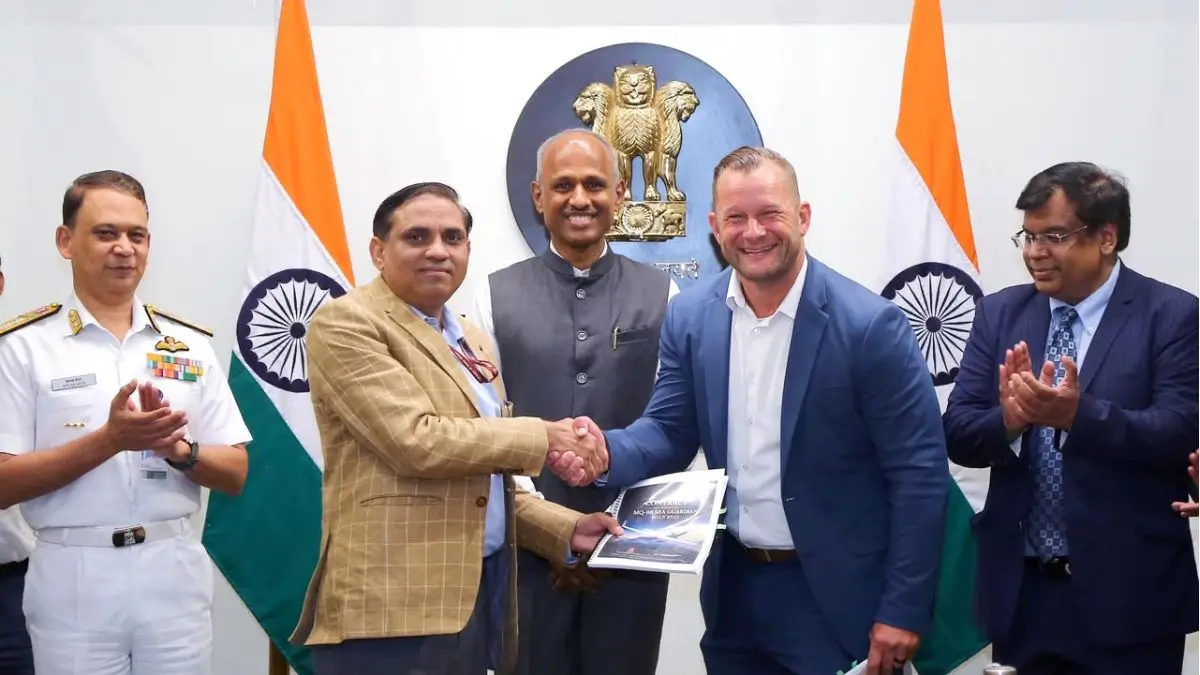
India has signed a contract with US-based General Atomics Aeronautical Systems Inc. (GA-ASI) to lease two MQ-9B Sea Guardian drones for the Indian Navy. The agreement, valued at approximately ₹1,943 crore, covers a 30-month leasing period. The move is aimed at strengthening India’s maritime surveillance, reconnaissance and overall maritime domain awareness in the Indian Ocean Region.
MQ-9B Sea Guardian: High-Altitude Long-Endurance Surveillance Platform
The MQ-9B Sea Guardian is a High-Altitude Long-Endurance (HALE) remotely piloted aircraft system designed for persistent surveillance over large areas. Its long endurance makes it particularly useful for monitoring extensive maritime zones where conventional surveillance assets may require frequent rotation. The platform belongs to the wider MQ-9 family developed by General Atomics.
Indian Navy to Strengthen Maritime Surveillance
The two leased drones are expected to enhance the Indian Navy’s ability to observe developments across strategically important maritime areas. Persistent aerial surveillance can support intelligence, surveillance and reconnaissance (ISR), help track maritime activity and provide information to naval commanders for operational decision-making. The agreement therefore contributes to India’s efforts to maintain stronger maritime domain awareness across the Indian Ocean Region.
Why Long-Endurance Drones Matter in the Indian Ocean Region
The Indian Ocean is strategically important because it contains major international shipping routes and connects several economically and geopolitically significant regions. Monitoring such a vast maritime space requires surveillance platforms capable of remaining airborne for extended periods. HALE drones can complement satellites, maritime patrol aircraft, ships and other surveillance systems by providing persistent aerial observation.
Lease Model Provides Operational Capability
India’s decision to lease the drones rather than immediately acquire them outright highlights the operational value of flexible defence procurement. Leasing can allow armed forces to obtain access to advanced platforms while avoiding some of the immediate costs and timelines associated with conventional acquisition. India’s experience with leased MQ-9 systems has already provided operational exposure to remotely piloted aircraft.
MQ-9 Experience with the Indian Navy
The Indian Navy has previously operated MQ-9A remotely piloted aircraft supplied under a company-owned, company-operated lease arrangement. General Atomics reported that two MQ-9As operated by the Navy crossed 10,000 combined flight hours in November 2022 after beginning operations in November 2020. The company said the aircraft supported over-the-horizon intelligence, surveillance and reconnaissance missions and helped cover a very large operating area.
India-US Defence Cooperation Gets Another Boost
The new lease agreement also reflects continuing defence and technology cooperation between India and the United States. General Atomics is a major developer of remotely piloted aircraft systems, sensors and related technologies. The contract demonstrates India’s interest in advanced unmanned systems as part of the modernisation of its armed forces.
Importance for Defence and Competitive Examinations
For UPSC, PCS, defence, banking and other government examinations, this development is important because it connects several recurring topics: Indian defence modernisation, unmanned aerial vehicles, maritime security, India-US strategic relations and the Indian Ocean Region. Candidates should remember the MQ-9B Sea Guardian’s classification as a HALE remotely piloted aircraft system, its maritime surveillance role, the ₹1,943 crore contract value and the 30-month lease period.

Why This News is Important
Strengthening Maritime Domain Awareness
The leasing of two MQ-9B Sea Guardian drones is important because maritime security depends heavily on the ability to detect, identify and monitor activities across large oceanic areas. The Indian Navy operates in an environment where continuous surveillance of important sea lanes and maritime approaches is strategically significant. The new platforms are expected to strengthen persistent intelligence, surveillance and reconnaissance capabilities.
Supporting India’s Defence Modernisation
Modern warfare increasingly involves unmanned systems, advanced sensors, networked surveillance and real-time information. The MQ-9B Sea Guardian represents this shift towards technology-enabled military operations. Its induction strengthens the Indian Navy’s unmanned aerial surveillance capabilities and complements existing manned and unmanned assets.
Significance for the Indian Ocean Region
The Indian Ocean Region is vital for India’s security and economic interests. A substantial volume of global maritime trade passes through the region. Improved aerial surveillance can help India develop a clearer picture of activities occurring across strategically important waters and improve the Navy’s ability to respond to emerging situations.
Importance of India-US Defence Partnership
The contract also highlights the expanding defence relationship between India and the United States. Cooperation in areas such as unmanned aerial systems demonstrates the growing role of advanced technology in bilateral defence engagement. For examination purposes, the development can therefore be linked with India’s broader strategic partnerships and defence technology cooperation.
Relevance for Government Exams
The news is particularly useful for UPSC, State PCS, CDS, AFCAT, NDA, police and other government examinations. Questions may focus on the MQ-9B’s category, manufacturer, purpose, contract value, lease duration and the Indian Navy’s maritime surveillance role. Candidates should also understand the broader concepts of HALE drones, ISR and maritime domain awareness.
Historical Context
Beginning of India’s MQ-9 Operational Experience
India’s experience with General Atomics’ remotely piloted aircraft predates the latest lease agreement. Two MQ-9A aircraft began their Indian Navy operations in November 2020. By November 2022, the two aircraft had collectively completed 10,000 flight hours in support of Indian national security missions.
Evolution Towards Maritime Surveillance
The MQ-9 family has evolved into specialised configurations for different operational requirements. The SeaGuardian configuration is designed for maritime surveillance and forms part of General Atomics’ broader family of long-endurance remotely piloted aircraft systems. General Atomics has described the SeaGuardian as its maritime surveillance configuration.
Growing Role of Unmanned Systems
Over the past several years, unmanned aerial systems have become increasingly important in military surveillance. Their ability to remain airborne for long periods can provide persistent observation without placing pilots directly in danger. This has made drones valuable for intelligence gathering, border monitoring and maritime surveillance.
India’s Maritime Security Focus
India’s geographical position gives the Indian Ocean a central role in national security. The country’s long coastline, island territories and proximity to important international sea routes make maritime domain awareness a major defence requirement. The deployment of long-endurance surveillance systems forms part of India’s broader effort to improve its ability to monitor maritime developments.
Key Takeaways from MQ-9B Sea Guardian Drone Lease
| Serial Number | Key Takeaway |
|---|---|
| 1 | India has signed a contract to lease two MQ-9B Sea Guardian drones for the Indian Navy. |
| 2 | The contract is worth approximately ₹1,943 crore and covers a 30-month lease period. |
| 3 | The drones are High-Altitude Long-Endurance (HALE) remotely piloted aircraft systems. |
| 4 | Their primary importance is enhancing maritime surveillance, ISR and maritime domain awareness. |
| 5 | The drones are manufactured by General Atomics Aeronautical Systems Inc. (GA-ASI), USA, highlighting continued India-US defence cooperation. |
FAQs
1. What is the MQ-9B Sea Guardian?
The MQ-9B Sea Guardian is a High-Altitude Long-Endurance (HALE) remotely piloted aircraft system developed for missions including maritime surveillance, intelligence, surveillance and reconnaissance (ISR).
2. How many MQ-9B Sea Guardian drones will the Indian Navy lease?
The Indian Navy will lease two MQ-9B Sea Guardian drones.
3. What is the value of the MQ-9B lease agreement?
The agreement is worth approximately ₹1,943 crore.
4. What is the duration of the lease?
The two drones will be leased for 30 months.
5. Which company manufactures the MQ-9B Sea Guardian?
The MQ-9B is manufactured by General Atomics Aeronautical Systems Inc. (GA-ASI) of the United States.
6. What is the primary purpose of the MQ-9B Sea Guardian for India?
Its major purpose is to strengthen the Indian Navy’s maritime surveillance, intelligence, surveillance and reconnaissance, and maritime domain awareness capabilities.
7. Why is maritime domain awareness important for India?
Maritime domain awareness enables India to monitor activities across its maritime areas, including shipping movements and other developments of strategic importance. It is particularly important because of India’s extensive coastline and its location near major Indian Ocean shipping routes.
8. What does HALE stand for?
HALE stands for High-Altitude Long-Endurance. HALE aircraft are designed to operate at high altitudes and remain airborne for extended periods.
9. What does ISR stand for in defence terminology?
ISR stands for Intelligence, Surveillance and Reconnaissance. These capabilities help armed forces collect and analyse information needed for military operations and decision-making.
10. Which Indian armed force is the main beneficiary of this lease?
The Indian Navy is the main beneficiary because the Sea Guardian configuration is particularly suited to maritime surveillance missions.
11. What is the significance of this agreement for India-US relations?
The agreement reflects continuing India-US defence cooperation, particularly in advanced defence technologies and unmanned aerial systems.
Some Important Current Affairs Links