









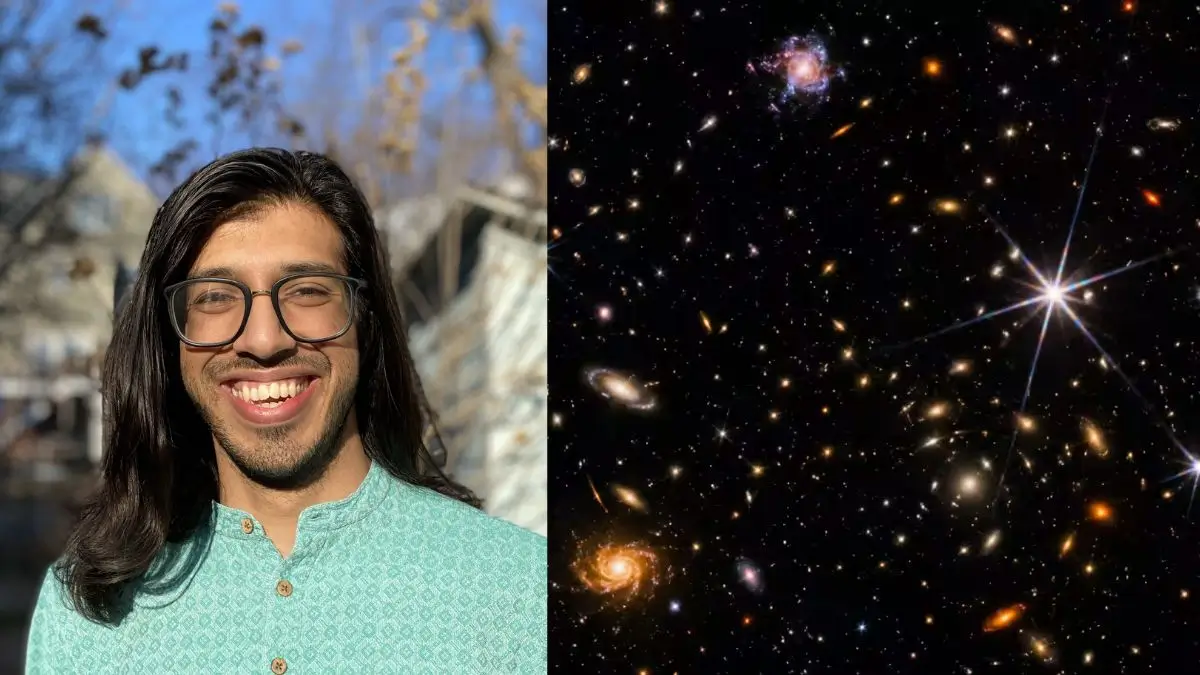
Rohan Naidu black hole discovery: Learn about MIT astronomer Rohan Naidu, MoM-BH*-1, the possible black hole star, JWST observations and its importance for government exams.
Who Is Rohan Naidu?
Dr. Rohan Naidu, a Hyderabad-born astronomer and MIT researcher, has emerged as a prominent scientist associated with a remarkable discovery involving an unusual cosmic object from the early universe. His research has focused on understanding some of the most distant and mysterious objects observed by the James Webb Space Telescope (JWST). His latest work has drawn international attention because it provides a possible new explanation for how massive black holes could have formed during the universe’s earliest stages.
Discovery of the Mysterious Black Hole Star
The research team led by Rohan Naidu and collaborators identified an unusual object designated MoM-BH-1*, described as a possible “black hole star.” The object is believed to date from approximately 660 million years after the Big Bang, placing it in the period known as the cosmic dawn. Its unusual brightness and spectral characteristics distinguish it from ordinary stars and conventional early galaxies.
What Is a Black Hole Star?
A black hole star is a proposed exotic cosmic object in which a black hole may be surrounded by an extremely dense envelope of hydrogen gas. The black hole and its surrounding material can produce extraordinary amounts of energy, causing the object to appear remarkably bright. Scientists are investigating whether this configuration could represent an intermediate stage in the growth of the supermassive black holes found at the centres of galaxies today.
Role of the James Webb Space Telescope
The James Webb Space Telescope played a central role in this discovery. JWST was specifically designed to observe infrared light and investigate some of the earliest galaxies and cosmic structures. Its ability to detect extremely faint and distant objects has transformed research into the early universe. The telescope began revealing the mysterious population of compact “little red dots” in its deep observations, creating new questions about their physical nature.
Why MoM-BH*-1 Is Scientifically Important
MoM-BH*-1 is significant because its properties may help scientists address one of astronomy’s major questions: how supermassive black holes appeared so quickly in the young universe. Conventional models involving ordinary stellar evolution can have difficulty explaining the existence of extremely massive black holes when the universe was less than a billion years old. A black hole star could provide a possible pathway for rapid black-hole growth.
Connection with the Little Red Dots
The discovery may also contribute to solving the mystery of the “little red dots” observed by JWST. These compact, distant objects have unusual brightness and spectral characteristics. Scientists have proposed several explanations for them, including models involving black holes and massive stars. Research into black hole stars provides another possible framework for understanding at least some of these enigmatic objects.
Rohan Naidu’s Unconventional Scientific Journey
Rohan Naidu’s career has also attracted attention because of his unconventional academic journey. Reports state that he left engineering at the age of 18 and subsequently pursued his interest in astronomy, eventually becoming a researcher at MIT. His journey demonstrates the importance of scientific curiosity, specialised research and persistence in pursuing a career in fundamental science.
Importance for Government Exams
For students preparing for UPSC, State PCS, SSC, banking, railways, defence and teaching examinations, this development is relevant to science and technology, space science, astronomy and current affairs. Important facts include Rohan Naidu’s association with MIT, the James Webb Space Telescope, the possible black hole star MoM-BH*-1, the cosmic dawn and the scientific effort to understand the origin of supermassive black holes. The topic can be particularly useful for objective questions as well as science-and-technology sections of competitive examinations.

Why This News Is Important
Understanding the Early Universe
The discovery associated with Rohan Naidu is important because it provides scientists with another potential window into the universe’s earliest stages. MoM-BH*-1 is believed to have existed only hundreds of millions of years after the Big Bang. Studying such ancient objects allows astronomers to investigate how the first stars, galaxies and black holes evolved.
Explaining the Rapid Growth of Black Holes
One of the major unresolved questions in cosmology is how supermassive black holes became so large relatively soon after the Big Bang. The black hole star hypothesis could offer clues about the initial stages of black-hole formation and growth. If supported by additional observations, such objects could help bridge the gap between early massive structures and the supermassive black holes found in modern galaxies.
Significance of JWST
The development also highlights the importance of the James Webb Space Telescope in modern astronomy. JWST’s infrared capabilities allow researchers to observe extremely distant objects whose light has been stretched by the expansion of the universe. Its observations have already introduced scientists to previously poorly understood populations such as the little red dots.
Indian-Origin Scientific Contribution
Rohan Naidu’s involvement makes the discovery particularly noteworthy for Indian students and competitive-exam aspirants. His career illustrates the contribution of Indian-origin scientists to international scientific research. His work at MIT demonstrates how advanced research institutions collaborate across national boundaries to address fundamental questions about the universe.
Historical Context: From the Big Bang to Supermassive Black Holes
The Big Bang and Cosmic Evolution
According to the prevailing cosmological model, the universe began approximately 13.8 billion years ago in an extremely hot and dense state. It subsequently expanded and cooled, allowing the formation of atoms, stars and galaxies. The earliest period of star and galaxy formation is particularly important because it established the structures that eventually evolved into the modern universe.
The Cosmic Dawn
The period when the first stars and galaxies began appearing is commonly referred to as the cosmic dawn. Astronomers have been attempting to observe this period directly because it contains evidence about the formation of the earliest luminous structures. JWST was developed partly to investigate such distant and ancient objects.
The Mystery of Early Supermassive Black Holes
Astronomers have discovered quasars powered by enormous black holes at surprisingly early cosmic times. This created a major theoretical challenge: ordinary stellar remnants would seemingly require considerable time to grow into such enormous black holes. Research into primordial supermassive stars and other unconventional pathways has therefore become an important area of astrophysics.
Emergence of the Black Hole Star Hypothesis
Recent research has expanded the possibilities for explaining early black-hole formation. The black hole star concept proposes that a black hole embedded within a massive hydrogen-rich environment could produce an exceptionally luminous object. Such objects could potentially represent an evolutionary phase connected to the emergence of larger black holes.
JWST and the Little Red Dot Mystery
The launch of JWST opened a new observational era. From 2022 onward, its deep observations revealed numerous compact objects known as little red dots. Their unusual properties generated competing scientific explanations. Continued observations and theoretical modelling are helping researchers determine whether these objects represent massive stars, active black holes, or other unusual structures.
Key Takeaways from Rohan Naidu’s Black Hole Star Discovery
| S. No. | Key Takeaway |
|---|---|
| 1 | Rohan Naidu is a Hyderabad-born astronomer and MIT researcher associated with research into the early universe and the possible black hole star MoM-BH*-1. |
| 2 | MoM-BH-1* is a proposed black hole star dating to roughly 660 million years after the Big Bang. |
| 3 | The James Webb Space Telescope (JWST) was crucial in studying this distant and unusual cosmic object. |
| 4 | The discovery may provide clues about the rapid formation and growth of supermassive black holes in the early universe. |
| 5 | The research is also relevant to the mystery of JWST’s little red dots, making it an important development in modern astronomy and cosmology. |
FAQs: Rohan Naidu and Black Hole Star Discovery
1. Who is Rohan Naidu?
Rohan Naidu is an Indian-origin astronomer and researcher associated with the Massachusetts Institute of Technology (MIT). His research focuses on distant galaxies, black holes and the early universe.
2. What is the major discovery associated with Rohan Naidu?
The research has identified MoM-BH-1*, a candidate for an unusual cosmic object described as a possible black hole star from the early universe.
3. What is a black hole star?
A black hole star is a proposed type of extremely luminous object in which a black hole is embedded within a massive, dense envelope of gas. It is being studied as a possible pathway for the formation of massive black holes.
4. What is MoM-BH*-1?
MoM-BH*-1 is the designation given to the unusual early-universe object discussed in the research. It is believed to date to roughly 660 million years after the Big Bang.
5. Which telescope helped scientists study the object?
The James Webb Space Telescope (JWST) played a key role in observations of distant and ancient cosmic objects relevant to this research.
6. What is the James Webb Space Telescope?
JWST is a large space-based observatory designed primarily for infrared astronomy. It studies distant galaxies, stars, exoplanets and other objects, including structures from the early universe.
7. What is the cosmic dawn?
The cosmic dawn refers broadly to the period when the first stars and galaxies began forming after the early, dark phase of the universe.
8. Why are early supermassive black holes a scientific mystery?
Astronomers have detected extremely massive black holes when the universe was still very young. Explaining how these black holes accumulated enormous masses in such a short cosmic period remains an important problem in astrophysics.
9. What are JWST’s “little red dots”?
Little red dots are compact, distant objects detected in large numbers in JWST observations. Their nature has been the subject of continuing scientific investigation, with black-hole-related and stellar explanations among the possibilities being studied.
10. Why is this discovery important for competitive examinations?
The topic connects astronomy, space science, black holes, the James Webb Space Telescope, cosmology and Indian-origin scientists. These areas can be relevant to Science and Technology sections of UPSC, State PCS, SSC, Railways, Banking, Defence and other government examinations.
Some Important Current Affairs Links