









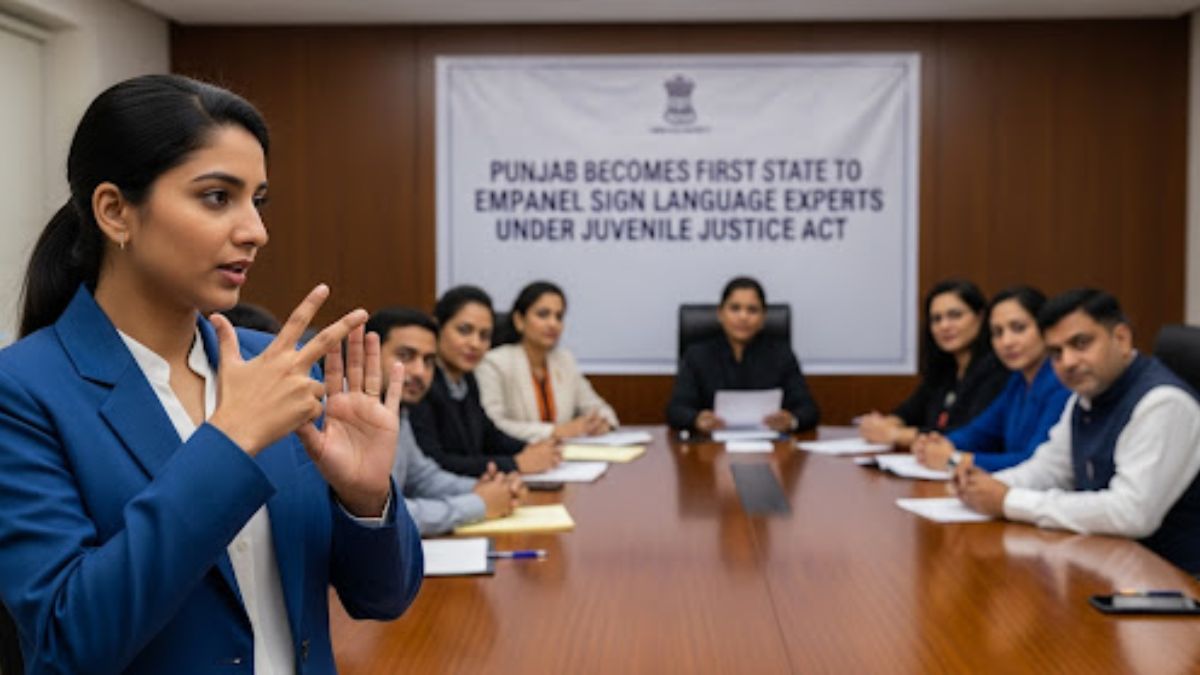
Punjab sign language interpreters empaneled under Juvenile Justice Act 2015 and POCSO Act 2012, ensuring inclusive legal access for children with disabilities — a first in India.
Punjab Becomes First State to Empanel Sign Language Experts Under JJ Act
Ensuring Inclusive Access to Justice
Punjab has emerged as the first state in India to formally empanel sign language interpreters, translators, and special educators under the Juvenile Justice (Care and Protection of Children) Act, 2015 as well as the Protection of Children from Sexual Offences (POCSO) Act, 2012 This pioneering step emphasizes equitable access to judicial proceedings for children with hearing and speech impairments.
Bridging Communication Gaps
According to Dr. Baljit Kaur, Punjab’s Minister for Social Security, Women and Child Development, this initiative is designed to eliminate communication barriers and facilitate timely, fair, and transparent legal processes for children with special needs
District-wise Deployment and Compensation
The empaneled professionals will be deployed across districts and compensated in accordance with provisions outlined in the relevant ActsThis structured deployment ensures consistent and reliable support for children during court proceedings statewide.
Building on Accessible Governance
This move builds upon Punjab’s earlier initiative of broadcasting important proceedings of the Punjab Vidhan Sabha in sign language, reinforcing its commitment to inclusive governance and broader civic participation
A Model for Inclusive Legal Frameworks
By taking this landmark step, Punjab has positioned itself as a trailblazer in child rights and inclusive justice. This initiative not only enhances legal access but also sets a precedent that other states could follow to empower specially-abled children and uphold their fundamental rights.

Why This News Is Important
Advancing Inclusive Governance
With this pioneering move, Punjab has demonstrated that inclusivity is fundamental to justice. Empaneling sign language experts under the Juvenile Justice Act ensures that children with hearing or speech impairments can fully participate in legal proceedings and have their voices heard—a critical stride toward democratizing legal access.
Strengthening Legal Empowerment
By integrating trained interpreters and educators into the justice system, the state ensures that children with special needs receive impartial legal outcomes. This initiative not only elevates the quality of judicial processes but also bolsters trust in the legal framework among marginalized groups.
Setting a National Precedent
As the first state to operationalize such an inclusive framework, Punjab is setting a benchmark for others. This move could inspire nationwide reforms, encouraging broader adoption of similar provisions to reinforce child rights across India.
Historical Context
Foundations of the Juvenile Justice Act, 2015
The Juvenile Justice (Care and Protection of Children) Act, 2015, enacted on 7 May 2015 and effective from 15 January 2016, replaced the earlier JJ Act of 2000. It was designed to ensure child-friendly adjudication, rehabilitation, and protection for both children in conflict with the law and those in need of care and protection
Evolution of Accessibility in Governance
Punjab’s previous efforts, such as broadcasting legislative proceedings in sign language, reflect sustained efforts toward inclusive governance. The new empanelment is the logical next step to extend these efforts into the legal domain.
Legal Rights of Children with Disability
The integration of specialized professionals under both the JJ Act and the POCSO Act, 2012 reflects a growing recognition of the intersectional rights of children—especially those with disabilities—within the legal framework. This aligns with global human rights norms and India’s evolving legal reforms aimed at inclusive justice.
Key Takeaways from This News
| S. No. | Key Takeaway |
|---|---|
| 1. | Punjab is the first state in India to empanel sign language interpreters, translators, and special educators under the JJ Act (2015) and POCSO Act (2012). |
| 2. | The initiative aims to bridge communication gaps for children with hearing or speech impairments in legal proceedings. |
| 3. | Empaneled professionals will be deployed district-wise and compensated as per statutory provisions. |
| 4. | Punjab previously set a precedent by broadcasting Vidhan Sabha proceedings in sign language. |
| 5. | This move strengthens inclusive justice, child rights, and may serve as a model for other states. |
FAQs – Frequently Asked Questions
Q1. Which state has become the first in India to empanel sign language experts under the Juvenile Justice Act?
Punjab.
Q2. Under which two Acts has Punjab empaneled sign language interpreters, translators, and special educators?
The Juvenile Justice (Care and Protection of Children) Act, 2015 and the Protection of Children from Sexual Offences (POCSO) Act, 2012.
Q3. What is the main purpose of empaneling sign language experts in Punjab’s justice system?
To ensure children with hearing or speech impairments have equal access to fair and transparent legal proceedings.
Q4. Who announced the empanelment initiative in Punjab?
Dr. Baljit Kaur, Minister for Social Security, Women and Child Development, Punjab.
Q5. How will the empaneled professionals be deployed?
They will be deployed district-wise across Punjab.
Q6. What precedent did Punjab set earlier regarding accessibility in governance?
Broadcasting important Vidhan Sabha proceedings in sign language.
Q7. What is the significance of the Juvenile Justice Act, 2015 in this context?
It provides a legal framework to protect and rehabilitate children, ensuring a child-friendly judicial process.
Q8. When was the Juvenile Justice Act, 2015 enforced?
It was enacted on 7 May 2015 and came into force on 15 January 2016.
Q9. How does this move align with global human rights principles?
It aligns with UNCRPD and other global standards for inclusive justice and protection of disabled persons.
Q10. Can other states adopt a similar model?
Yes, this initiative can serve as a model for nationwide reforms in inclusive justice for children with disabilities.
Some Important Current Affairs Links