





Fa Hien visited India reign is a frequently asked competitive exam topic. Learn why Fa-Hien visited India during Chandragupta II’s reign, his travel account, important facts, MCQs, and key points for UPSC, SSC, Banking, Railways, Defence, and State PSC exams.
Introduction
Questions related to ancient Indian history are frequently asked in competitive examinations such as UPSC, State PSCs, SSC CGL, CHSL, Banking, Railways, Defence, Police recruitment, CTET, REET and other teaching examinations. One such frequently repeated question is: “Fa-Hien visited India during the reign of which Gupta dynasty ruler?”
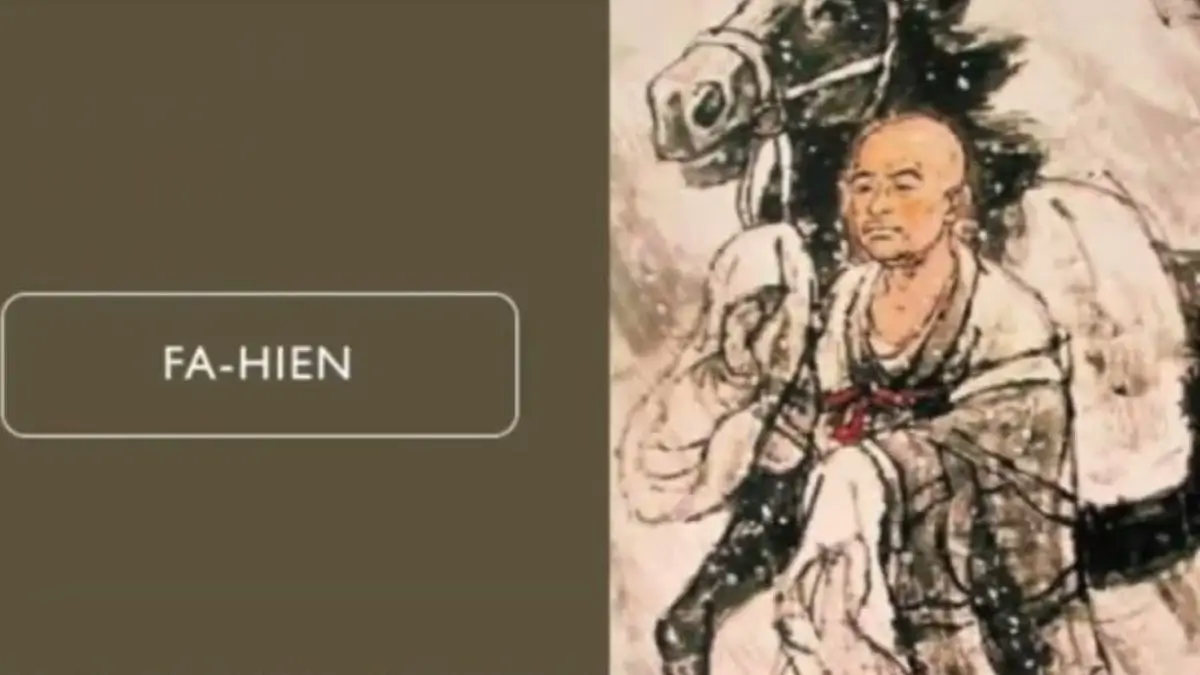
The correct answer is Chandragupta II (Vikramaditya). Fa-Hien, also known as Faxian, was a Chinese Buddhist monk and traveller who visited India between approximately 399 CE and 414 CE. His travel account provides one of the most authentic descriptions of India’s political, religious, social and economic conditions during the Gupta period.
Who Was Fa-Hien?
Fa-Hien was a renowned Chinese Buddhist pilgrim who travelled across Central Asia into India with the primary objective of collecting authentic Buddhist scriptures and visiting sacred Buddhist pilgrimage centres. His journey covered thousands of kilometres over difficult mountain passes and deserts.
Unlike ordinary travellers, Fa-Hien documented his observations carefully. His famous travelogue, Record of Buddhist Kingdoms (Fo-Kwo-Ki), remains an important historical source for understanding Gupta India.
During Which Gupta Ruler’s Reign Did Fa-Hien Visit India?
Fa-Hien visited India during the reign of Chandragupta II, popularly known as Vikramaditya.
Chandragupta II ruled during one of the most prosperous periods of the Gupta Empire. Under his leadership, trade flourished, literature developed significantly, scientific achievements expanded and religious tolerance became an important feature of governance.
Fa-Hien spent several years travelling through different regions of India including Pataliputra, Mathura, Bodh Gaya, Kapilavastu and other important Buddhist centres.
Purpose Behind Fa-Hien’s Visit
The major objectives of Fa-Hien’s visit included:
- Collecting original Buddhist manuscripts
- Visiting places associated with the life of Gautama Buddha
- Learning Buddhist monastic practices
- Interacting with Indian Buddhist scholars
- Bringing sacred scriptures back to China
His journey greatly contributed to the spread of Buddhism across East Asia.
Observations About Gupta India
Political Administration
Fa-Hien described the Gupta administration as peaceful and efficient. He noted that criminal punishments were comparatively mild and people enjoyed considerable freedom in their daily lives.
Economic Prosperity
According to Fa-Hien, India witnessed flourishing agriculture, active trade and prosperous urban centres. Roads connecting important cities were well maintained, facilitating commerce and pilgrimage.
Religious Life
Although Hinduism enjoyed royal patronage under the Guptas, Fa-Hien observed remarkable religious tolerance. Buddhism continued to flourish, particularly around monasteries and pilgrimage centres.
Education and Monasteries
Numerous monasteries functioned as educational institutions where monks studied Buddhist philosophy, literature and scriptures. These institutions attracted students from different parts of Asia.
Importance of Fa-Hien’s Travel Account
Historians consider Fa-Hien’s writings among the most valuable foreign accounts of ancient India. Since his observations were recorded during his travels, they offer direct evidence regarding administration, society, economy and religion during the Gupta period.
His work also complements archaeological discoveries and inscriptions from the Gupta era, helping historians reconstruct India’s ancient past.
Frequently Asked Examination Facts
Students should remember these facts:
- Fa-Hien was a Chinese Buddhist monk.
- He visited India between 399 CE and 414 CE.
- He travelled during Chandragupta II’s reign.
- His book is called Record of Buddhist Kingdoms (Fo-Kwo-Ki).
- His purpose was to collect Buddhist scriptures.
- He returned to China by sea after completing his pilgrimage.

B) Why This Topic is Important
Frequently Asked in Competitive Examinations
Questions on Fa-Hien are repeatedly asked in UPSC Civil Services, State PSCs, SSC, Banking, Railways, CDS, NDA, CAPF, CTET, REET and other competitive examinations. Candidates are commonly asked about the ruler during whose reign he visited India, the purpose of his visit and the significance of his travelogue.
Important Source of Ancient Indian History
Fa-Hien’s writings help historians understand the Gupta Empire without relying solely on inscriptions and archaeological evidence. His descriptions provide valuable insights into governance, religion, education, economy and everyday life.
Understanding the Gupta Golden Age
His observations reinforce why the Gupta period is often called the “Golden Age of Ancient India.” Prosperity, political stability, educational development and religious coexistence are reflected throughout his writings.
C) Historical Context
Rise of the Gupta Empire
The Gupta Empire emerged during the fourth century CE and became one of India’s greatest empires. Beginning with Chandragupta I, it expanded significantly under Samudragupta before reaching its cultural and political peak under Chandragupta II.
Growth of Buddhism
Although the Gupta rulers mainly supported Hinduism, Buddhism continued to receive patronage from merchants, monasteries and local rulers. This enabled pilgrims such as Fa-Hien to travel safely across northern India.
Foreign Travellers as Historical Sources
Several foreign travellers documented India across different periods. Among the most important are Fa-Hien during the Gupta period, Xuanzang during Harsha’s reign and Yijing during the later Buddhist period. Their writings remain valuable historical sources for reconstructing ancient Indian civilization.
D) Key Takeaways from This News
| S. No. | Key Takeaway |
|---|---|
| 1 | Fa-Hien (Faxian) visited India during the reign of Chandragupta II (Vikramaditya). |
| 2 | He travelled to India mainly to collect authentic Buddhist scriptures and visit holy Buddhist sites. |
| 3 | His famous travel account is Record of Buddhist Kingdoms (Fo-Kwo-Ki). |
| 4 | His writings provide valuable information on Gupta administration, economy, religion and society. |
| 5 | Questions related to Fa-Hien are frequently asked in UPSC, State PSC, SSC, Banking, Railways, Defence, Police and Teaching examinations. |
FAQs: Fa-Hien Visited India During the Reign of Which Gupta Dynasty Ruler?
1. During whose reign did Fa-Hien visit India?
Fa-Hien visited India during the reign of Chandragupta II (Vikramaditya) of the Gupta Empire between approximately 399 CE and 414 CE.
2. Who was Fa-Hien?
Fa-Hien (also known as Faxian) was a Chinese Buddhist monk, pilgrim, and traveler who came to India to collect Buddhist scriptures and visit sacred Buddhist sites.
3. What was the main purpose of Fa-Hien’s visit to India?
His primary objective was to collect authentic Buddhist texts, study Buddhist traditions, and visit important pilgrimage sites associated with Lord Buddha.
4. Which famous book was written by Fa-Hien?
Fa-Hien wrote Record of Buddhist Kingdoms (Fo-Kwo-Ki), one of the most valuable historical sources on ancient India.
5. Why is Fa-Hien’s account important for historians?
His travelogue provides first-hand information about the political administration, economy, religion, education, and social life during the Gupta period.
6. Which Gupta ruler is known as Vikramaditya?
Chandragupta II is popularly known as Vikramaditya and is regarded as one of the greatest rulers of the Gupta Empire.
7. Why is the Gupta period called the Golden Age of India?
The Gupta period witnessed remarkable achievements in literature, science, mathematics, art, architecture, trade, and cultural development, making it the “Golden Age” of ancient India.
8. Name two other famous Chinese travelers who visited India.
Apart from Fa-Hien, Xuanzang (Hiuen Tsang) and Yijing (I-Tsing) were notable Chinese travelers who documented India’s history and Buddhist traditions.
9. Which important places did Fa-Hien visit in India?
He visited Pataliputra, Bodh Gaya, Sarnath, Mathura, Kapilavastu, Kushinagar, Vaishali, and other major Buddhist pilgrimage centers.
10. Why is this topic important for competitive examinations?
Questions related to Fa-Hien, Chandragupta II, the Gupta Empire, Buddhist travelers, and ancient Indian history are frequently asked in UPSC, State PSC, SSC, Banking, Railways, Defence, Police, and Teaching examinations.
Some Important Current Affairs Links