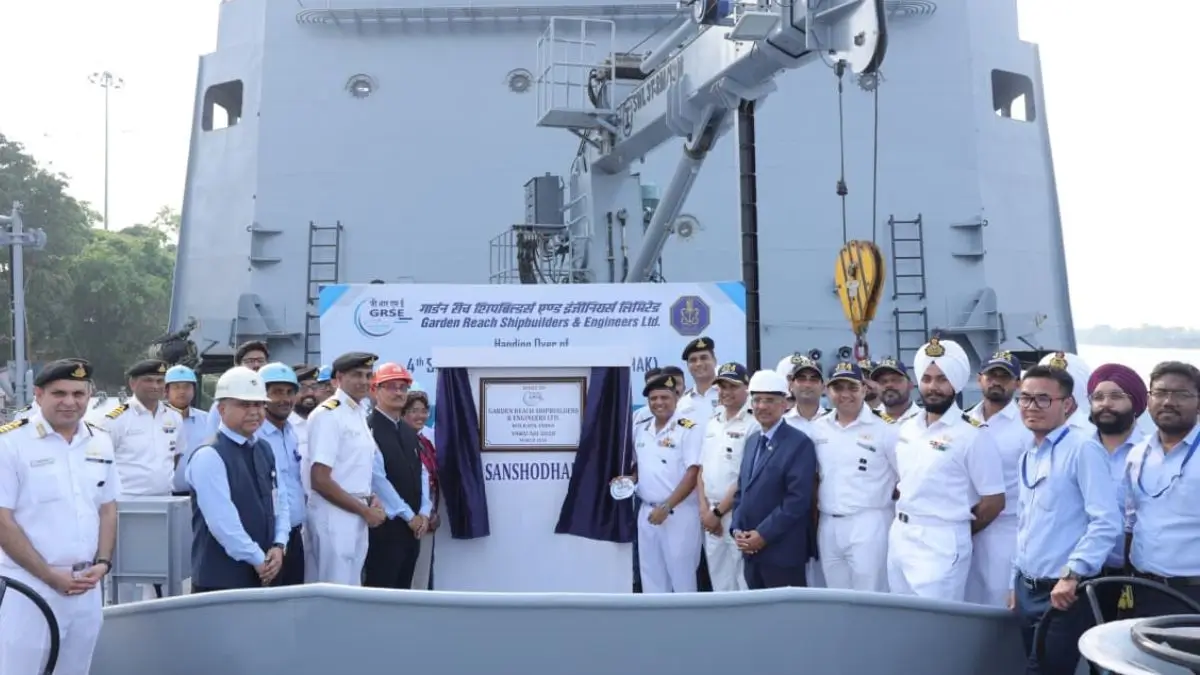
INS Sanshodhak survey vessel India strengthens maritime capabilities with advanced hydrographic technology and boosts Aatmanirbhar Bharat defence initiatives.
Introduction: Strengthening India’s Maritime Capabilities
India has taken a significant step in enhancing its maritime strength with the induction of INS Sanshodhak, the fourth and final Survey Vessel (Large) in its class. This development marks a major milestone in India’s push toward self-reliance in defence manufacturing under the Aatmanirbhar Bharat initiative. The vessel enhances India’s ability to conduct detailed oceanographic and hydrographic surveys, crucial for safe navigation and naval operations.
Completion of the Four-Ship Survey Vessel Project
The delivery of INS Sanshodhak on March 30, 2026, completes the Indian Navy’s ambitious four-ship Survey Vessel (Large) project, which was initiated in October 2018. The other ships in this series include INS Sandhayak, INS Nirdeshak, and INS Ikshak. With this induction, the Indian Navy now possesses a fully operational fleet of modern survey vessels designed for advanced maritime operations.
Indigenous Design and Construction
INS Sanshodhak has been designed by the Indian Navy’s Warship Design Bureau and constructed by Garden Reach Shipbuilders & Engineers (GRSE) in Kolkata. The vessel boasts more than 80% indigenous content, showcasing India’s growing capabilities in domestic shipbuilding and reducing reliance on foreign technology.
Advanced Technical Features and Specifications
The vessel has a displacement of approximately 3,400 tonnes and a length of around 110 meters. It is powered by twin diesel engines, enabling speeds of over 18 knots. INS Sanshodhak is equipped with state-of-the-art hydrographic systems such as autonomous underwater vehicles (AUVs), remotely operated vehicles (ROVs), digital side-scan sonar, and advanced data acquisition systems. These technologies enable precise mapping of seabeds and underwater environments.
Role in Hydrographic Surveys and Navigation
INS Sanshodhak plays a crucial role in conducting hydrographic surveys in both coastal and deep-sea areas. It helps map navigational routes, harbour approaches, and maritime zones, ensuring safer shipping operations. Additionally, it collects oceanographic and geophysical data, which is useful for both defence and civilian purposes, including environmental research and maritime trade.
Strategic Importance for Maritime Security
The induction of INS Sanshodhak significantly enhances India’s maritime domain awareness and operational readiness. By providing accurate data on underwater terrain and ocean conditions, the vessel supports naval missions, submarine operations, and coastal security. It also strengthens India’s presence in the Indian Ocean Region, which is strategically vital for global trade and security.

B) Why This News is Important
Boost to Aatmanirbhar Bharat in Defence
The induction of INS Sanshodhak highlights India’s success in achieving self-reliance in defence manufacturing. With over 80% indigenous content, the project demonstrates the capability of Indian shipyards and industries to build advanced naval platforms. This reduces dependency on foreign imports and strengthens domestic defence ecosystems.
Enhancing Maritime Security and Navigation
Hydrographic survey vessels like INS Sanshodhak are critical for ensuring safe navigation in maritime zones. Accurate mapping of seabeds and identification of navigational routes help prevent maritime accidents and improve operational efficiency. This is particularly important for a country like India, which has a vast coastline and significant maritime trade routes.
Strategic Advantage in the Indian Ocean Region
The Indian Ocean Region is a key geopolitical area. By improving its survey and mapping capabilities, India can strengthen its strategic position and monitor maritime activities more effectively. This enhances national security and supports regional stability.
C) Historical Context: Evolution of India’s Survey Vessels
Early Development of Hydrographic Capabilities
India has a long history of hydrographic surveying, with earlier vessels like INS Darshak and INS Sarvekshak contributing to maritime mapping and research. These ships laid the foundation for India’s survey capabilities.
Shift Towards Indigenous Shipbuilding
Over the years, India has transitioned from importing naval platforms to building them domestically. The Survey Vessel (Large) project, initiated in 2018, represents a significant leap in this direction, aligning with the Aatmanirbhar Bharat initiative.
Modernisation of the Indian Navy
The induction of INS Sanshodhak is part of a broader naval modernization program. Alongside warships, submarines, and support vessels, survey ships play a vital role in ensuring operational readiness and maritime dominance.
D) Key Takeaways from INS Sanshodhak News
| S.No. | Key Takeaway |
|---|---|
| 1 | INS Sanshodhak is the fourth and final Survey Vessel (Large) inducted into the Indian Navy |
| 2 | Built by GRSE Kolkata with over 80% indigenous content |
| 3 | Equipped with advanced hydrographic technologies like AUVs, ROVs, and sonar systems |
| 4 | Enhances maritime navigation safety and oceanographic data collection |
| 5 | Strengthens India’s maritime security and Aatmanirbhar Bharat initiative |
FAQs: Frequently Asked Questions for Exam Preparation
1. What is INS Sanshodhak?
INS Sanshodhak is the fourth and final Survey Vessel (Large) inducted into the Indian Navy, designed to conduct hydrographic and oceanographic surveys.
2. Which organization built INS Sanshodhak?
It was constructed by Garden Reach Shipbuilders & Engineers (GRSE) in Kolkata.
3. What is the main function of survey vessels like INS Sanshodhak?
These vessels are used for hydrographic surveys, seabed mapping, and collecting oceanographic data to ensure safe navigation and support naval operations.
4. What are some key technologies used in INS Sanshodhak?
It is equipped with advanced tools such as Autonomous Underwater Vehicles (AUVs), Remotely Operated Vehicles (ROVs), and modern sonar systems.
5. Under which initiative does this project promote self-reliance?
The project supports the Aatmanirbhar Bharat Abhiyan initiative.
6. What is the displacement and speed of INS Sanshodhak?
The vessel has a displacement of around 3,400 tonnes and can achieve speeds of over 18 knots.
7. Name the other vessels in the same class.
INS Sandhayak, INS Nirdeshak, and INS Ikshak are the other ships in the Survey Vessel (Large) class.
8. Why are hydrographic surveys important?
They help in safe navigation, identifying underwater hazards, and supporting maritime trade and defence planning.
9. When was the Survey Vessel (Large) project initiated?
The project was initiated in 2018.
10. How does INS Sanshodhak contribute to maritime security?
It enhances maritime domain awareness by providing accurate seabed and ocean data, supporting naval and submarine operations.
Some Important Current Affairs Links