





INS Agray INS Dunagiri INS Sanshodhak commissioning marks a major boost to India’s maritime security. Learn about the Indian Navy’s new indigenous warships, their roles, significance and exam-focused key facts.
India Strengthens Naval Power with Three New Indigenous Warships
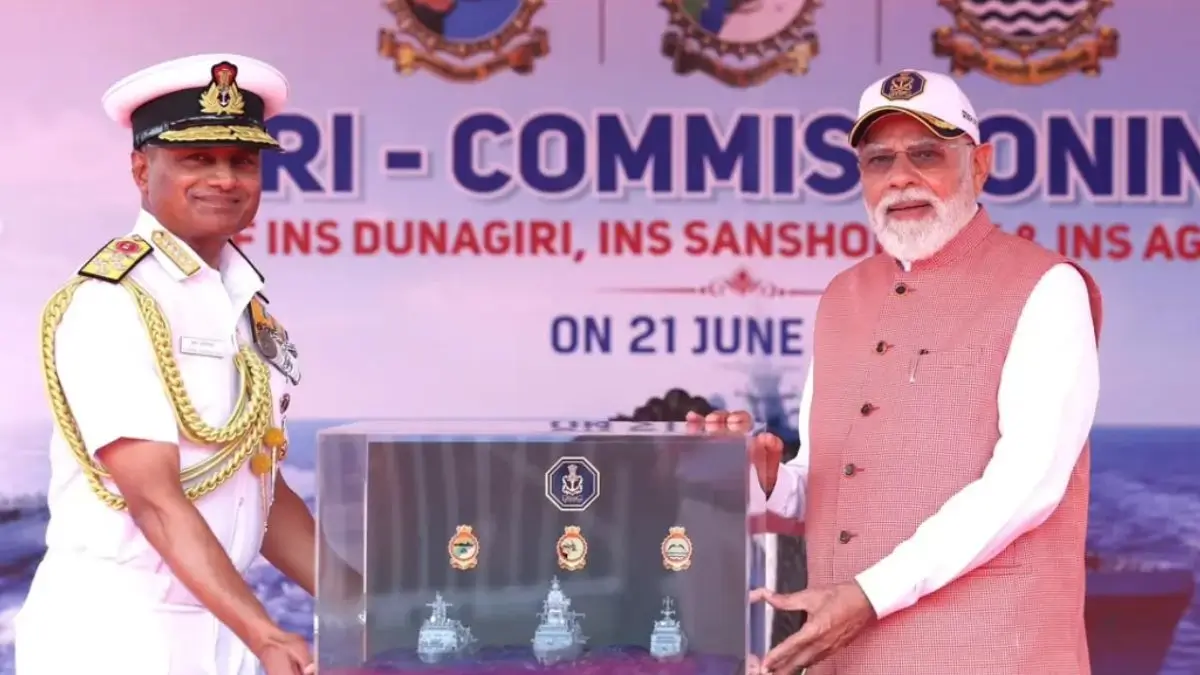
India achieved a significant milestone in maritime defence when Prime Minister Narendra Modi commissioned three indigenously built naval platforms—INS Agray, INS Dunagiri and INS Sanshodhak—into the Indian Navy. The commissioning ceremony was held in Kolkata and highlighted India’s growing capability in indigenous shipbuilding and defence manufacturing. The event reflects the government’s commitment to the vision of Aatmanirbhar Bharat and strengthening national security through domestic defence production.
Significance of the Triple Commissioning
The simultaneous induction of three different classes of naval vessels is a rare achievement. Each vessel has a specialized role, and together they significantly improve India’s maritime capabilities. Defence experts view this development as a major step toward creating a technologically advanced and self-reliant naval force capable of addressing modern security challenges in the Indian Ocean Region.
INS Dunagiri: The Advanced Stealth Frigate
INS Dunagiri is an advanced stealth frigate designed to perform multiple warfare roles. It is capable of engaging surface, aerial and underwater threats. The vessel incorporates modern stealth technologies that reduce radar detection and improve operational effectiveness. As a frontline combat platform, INS Dunagiri enhances India’s ability to safeguard maritime interests and respond to emerging threats.
INS Agray: Protecting India from Underwater Threats
INS Agray is an Anti-Submarine Warfare Shallow Water Craft (ASW-SWC). Its primary mission is to detect, track and neutralize enemy submarines operating in coastal and shallow waters. Equipped with advanced sonar systems and anti-submarine weaponry, the vessel strengthens India’s coastal defence network. The growing importance of underwater warfare in the Indo-Pacific region makes vessels like INS Agray crucial for national security.
INS Sanshodhak: The Ocean Mapping Specialist
INS Sanshodhak is a Survey Vessel (Large) designed for hydrographic surveys and oceanographic research. The ship maps the ocean floor, collects marine data and supports safe navigation. Such information is vital for naval operations, maritime trade, disaster management and scientific research. The vessel is often referred to as a floating ocean laboratory because of its sophisticated survey and research capabilities.
Indigenous Shipbuilding and Aatmanirbhar Bharat
One of the most important aspects of the commissioning is that all three vessels were designed and built in India. This demonstrates the progress made by India’s shipbuilding industry and defence ecosystem. Indigenous production reduces dependence on foreign suppliers, strengthens strategic autonomy and promotes domestic technological innovation. Prime Minister Modi emphasized that India is moving beyond being merely a purchaser of defence equipment and is emerging as a producer of advanced military platforms.
Strategic Importance in the Indian Ocean Region
The Indian Ocean is one of the world’s most important maritime regions. A large portion of global trade passes through these waters. With increasing geopolitical competition and security challenges, India is investing heavily in maritime capabilities. The addition of INS Agray, INS Dunagiri and INS Sanshodhak enhances maritime surveillance, anti-submarine operations and operational preparedness across the region.
Impact on National Security
The three vessels collectively improve India’s maritime domain awareness. While INS Sanshodhak provides accurate ocean mapping, INS Agray counters underwater threats and INS Dunagiri offers combat power. Their combined deployment creates a stronger and more integrated naval defence architecture. This significantly enhances India’s ability to protect sea lanes, secure economic interests and maintain regional stability.
Relevance for Competitive Examinations
The commissioning of these naval vessels is important for UPSC, State PSCs, SSC, CDS, NDA, CAPF, Railways, Banking and Teaching examinations. Questions may be asked about the names of the vessels, their functions, indigenous defence production, Aatmanirbhar Bharat initiatives and India’s maritime security strategy. Aspirants should remember the unique role played by each ship and the broader significance of indigenous naval modernization.

Importance for National Security
The commissioning of three specialized naval vessels significantly strengthens India’s maritime security framework. These ships improve surveillance, combat readiness and underwater defence capabilities.
Importance for Aatmanirbhar Bharat
The event demonstrates India’s success in designing and building advanced naval platforms domestically. It supports the government’s goal of reducing dependence on imported defence equipment and strengthening indigenous manufacturing.
Importance for the Indian Ocean Region
India’s strategic interests are closely linked to the Indian Ocean. The induction of these ships improves India’s ability to monitor critical sea routes and respond to regional security challenges.
Importance for Defence Modernization
The Indian Navy is undergoing rapid modernization. The addition of INS Agray, INS Dunagiri and INS Sanshodhak represents the integration of advanced technologies in anti-submarine warfare, hydrographic surveying and naval combat operations.
Importance for Competitive Exams
This news covers multiple examination topics including defence technology, Indian Navy, maritime security, indigenous defence manufacturing, strategic affairs and government initiatives. Such topics are frequently asked in UPSC, SSC, CDS, NDA and State PSC examinations.
Historical Context
Evolution of India’s Naval Modernization
Since the late twentieth century, India has steadily expanded and modernized its naval forces to protect maritime interests and secure sea routes. The Indian Navy has increasingly focused on indigenous shipbuilding to reduce dependence on foreign suppliers.
Growth of Indigenous Defence Production
Over the past decade, the Government of India has promoted self-reliance in defence manufacturing through initiatives such as Aatmanirbhar Bharat and Make in India. Indigenous warships, submarines and defence systems have become central to this strategy.
Previous Major Naval Commissionings
India has recently commissioned several important naval platforms, including advanced destroyers, frigates and submarines. These additions have strengthened the Navy’s operational capabilities and expanded its role in the Indo-Pacific region.
Rising Importance of Maritime Security
The Indian Ocean Region has gained strategic importance due to increasing trade, geopolitical competition and security concerns. This has encouraged India to invest heavily in maritime surveillance, anti-submarine warfare and naval modernization programs.
Key Takeaways from This News
| S.No. | Key Takeaway |
|---|---|
| 1 | Prime Minister Narendra Modi commissioned INS Agray, INS Dunagiri and INS Sanshodhak into the Indian Navy. |
| 2 | INS Dunagiri is an advanced stealth frigate designed for multi-role combat operations. |
| 3 | INS Agray is an Anti-Submarine Warfare Shallow Water Craft focused on detecting and neutralizing enemy submarines. |
| 4 | INS Sanshodhak is a Survey Vessel (Large) used for hydrographic surveys and oceanographic research. |
| 5 | The commissioning highlights India’s progress in indigenous defence manufacturing and the Aatmanirbhar Bharat initiative. |
FAQs: PM Modi Commissions INS Agray, INS Dunagiri and INS Sanshodhak
Q1. Which three naval vessels were commissioned by Prime Minister Narendra Modi?
Answer: Prime Minister Narendra Modi commissioned INS Agray, INS Dunagiri and INS Sanshodhak into the Indian Navy.
Q2. What type of vessel is INS Dunagiri?
Answer: INS Dunagiri is an advanced stealth frigate capable of conducting multi-role naval warfare operations against surface, aerial and underwater threats.
Q3. What is the primary role of INS Agray?
Answer: INS Agray is an Anti-Submarine Warfare Shallow Water Craft (ASW-SWC) designed to detect, track and neutralize enemy submarines in shallow coastal waters.
Q4. What is the purpose of INS Sanshodhak?
Answer: INS Sanshodhak is a Survey Vessel (Large) that conducts hydrographic surveys, ocean mapping and marine research activities.
Q5. Why is the commissioning of these ships important for India?
Answer: The commissioning strengthens India’s maritime security, enhances naval capabilities and promotes indigenous defence manufacturing under the Aatmanirbhar Bharat initiative.
Q6. Under which initiative is indigenous defence manufacturing being promoted in India?
Answer: Indigenous defence manufacturing is being promoted under the Aatmanirbhar Bharat and Make in India initiatives.
Q7. What is a stealth frigate?
Answer: A stealth frigate is a warship designed with technologies that reduce its radar, infrared and acoustic signatures, making it harder for enemies to detect.
Q8. What is anti-submarine warfare?
Answer: Anti-submarine warfare refers to military operations conducted to detect, track and destroy enemy submarines.
Q9. Why are hydrographic surveys important?
Answer: Hydrographic surveys help in navigation safety, naval operations, port development, marine resource management and disaster preparedness.
Q10. For which competitive examinations is this topic important?
Answer: This topic is important for UPSC, State PSC, CDS, NDA, CAPF, SSC, Railway, Banking, Defence and Teaching examinations.
Some Important Current Affairs Links