







India US Navy EOD Exercise 2026 concluded at Southern Naval Command in Kochi, strengthening India-US naval cooperation, EOD capabilities and interoperability.
India-US Navy EOD Exercise 2026 Concludes at Southern Naval Command
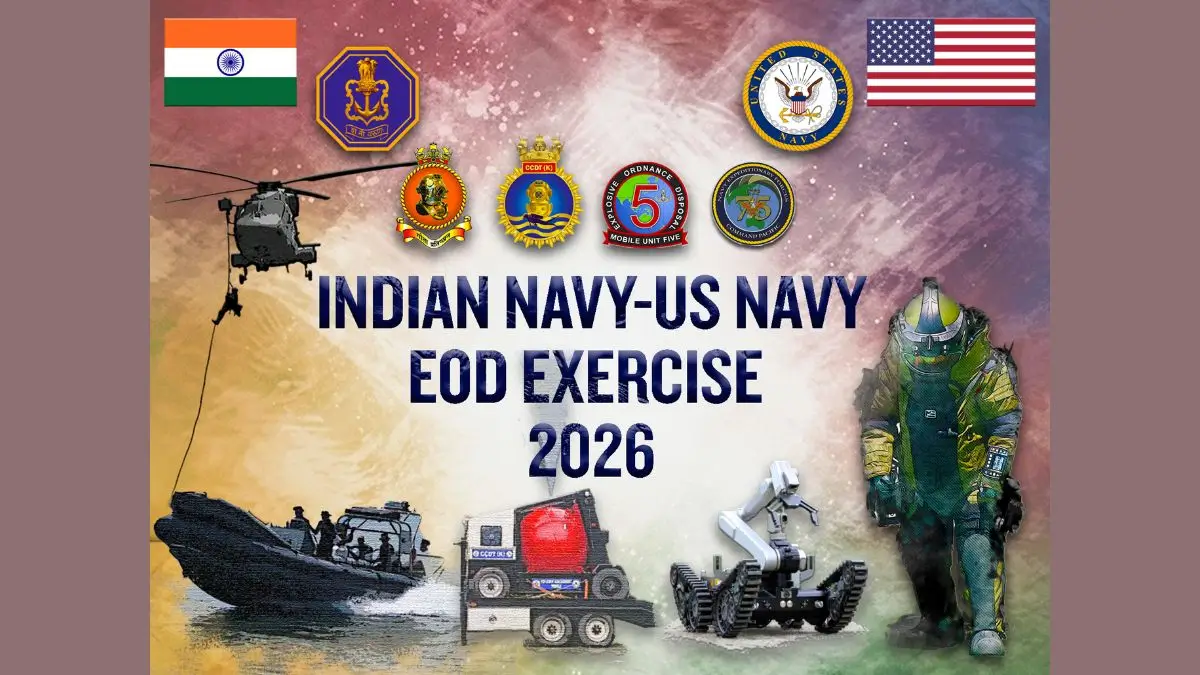
The eighth edition of the India-US Navy Explosive Ordnance Disposal (EOD) Exercise 2026 concluded at the Southern Naval Command in Kochi, Kerala, on 14 August 2026. The five-day bilateral engagement was conducted from 10 to 14 August and brought together specialist diving and EOD teams of the Indian Navy and the United States Navy. The exercise focused on strengthening professional cooperation, operational coordination and interoperability between the two navies.
India-US Naval Exercise Focused on Specialised EOD Operations
Explosive Ordnance Disposal is a specialised military field involving the detection, identification, assessment, rendering safe, recovery and disposal of explosive threats. In maritime operations, EOD specialists may deal with underwater mines, unexploded ordnance, improvised explosive devices and other hazardous materials. The Kochi exercise provided an important platform for the two navies to exchange expertise and improve their ability to respond to complex maritime explosive threats.
Subject Matter Expert Exchanges Strengthened Professional Knowledge
A major component of the exercise was the Subject Matter Expert Exchanges (SMEEs). These interactions covered contemporary operational challenges, including real-time threats from Improvised Explosive Devices (IEDs), render-safe procedures, mine neutralisation and the use of unmanned underwater systems. Such exchanges enable specialists from both countries to understand different operational approaches and share lessons and best practices.
Cross-Training Enhanced Diving and Salvage Skills
The exercise also included practical cross-training activities for diving teams. Participants conducted exercises related to wreck location and salvage, handling of specialist equipment and slithering operations. These activities were designed to expose personnel to different techniques and operational procedures used by the two navies. Practical training of this nature is important because maritime EOD operations frequently require personnel to work underwater and in difficult environments.
Unmanned Underwater Systems Featured in the Training
The employment of unmanned underwater systems was another important aspect of the professional exchanges. Such systems can support underwater surveillance, mine-related operations and reconnaissance while reducing the risks faced by personnel. Familiarity with emerging underwater technologies is increasingly significant for modern naval forces as maritime security challenges become more technologically complex.
Exercise Improved India-US Naval Interoperability
The exercise strengthened the ability of Indian and US naval personnel to understand and operate alongside each other. Interoperability is particularly important during multinational operations, humanitarian assistance, disaster response, maritime security missions and other situations requiring coordinated action. The joint training therefore contributes not only to specialised EOD capabilities but also to the broader India-US maritime partnership.
Long-Standing India-US EOD Cooperation
India and the United States have conducted joint Salvage and EOD exercises since 2005. The 2026 engagement was the eighth edition of this specialised bilateral training series. The continuity of these exercises demonstrates the long-term nature of professional cooperation between the two navies and their emphasis on exchanging operational expertise.
Importance of Kochi and Southern Naval Command
The exercise was conducted at the Southern Naval Command in Kochi, an important Indian Navy establishment associated with naval training and specialised maritime activities. Hosting the EOD engagement at Kochi provided a suitable environment for combining professional exchanges with practical diving and salvage training. For competitive examinations, candidates should remember the association between Kochi and the Southern Naval Command.
India-US Defence Cooperation and the Indo-Pacific
The EOD exercise forms part of the wider India-US defence relationship, which includes cooperation across maritime security, military exercises, technology and professional training. Regular interaction between specialised forces helps build trust and improve operational coordination. For government-exam aspirants, the exercise is relevant to questions concerning India-US relations, defence cooperation, Indian Navy exercises, maritime security and the Indo-Pacific region.

Why this News is Important
Relevance for Defence and Security Examinations
The conclusion of the India-US Navy EOD Exercise 2026 is important for government-exam aspirants because it combines several frequently tested subjects, including defence exercises, international relations, maritime security and the Indian Navy. Questions may ask about the participating countries, location, edition of the exercise, purpose and major areas covered during training.
Strengthening India-US Defence Partnership
The exercise demonstrates continuing defence cooperation between India and the United States. Regular specialised training allows personnel from both navies to exchange operational knowledge and improve their capacity to work together. This is particularly significant in the context of growing maritime-security requirements in the Indian Ocean and wider Indo-Pacific region.
Focus on Modern Maritime Threats
The training addressed contemporary threats such as IEDs, underwater mines and other explosive hazards. It also included discussions on unmanned underwater systems. These areas highlight how modern naval operations increasingly combine traditional military skills with advanced technology.
Importance of Interoperability
Interoperability is a key objective of bilateral and multilateral military exercises. By conducting joint training, Indian and US personnel can become familiar with each other’s procedures, equipment and operational concepts. This improves coordination when forces may need to cooperate during real-world missions.
Examination-Oriented Current Affairs
The exercise offers several factual points that can appear in defence and current-affairs sections: it was the eighth edition, took place at Southern Naval Command, Kochi, was conducted from 10 to 14 August 2026, and involved specialist EOD and diving teams of India and the United States. The exercise series dates back to 2005.
Historical Context: Background of India-US Naval EOD Cooperation
Beginning of Joint Salvage and EOD Exercises
India and the United States began conducting joint Salvage and Explosive Ordnance Disposal exercises in 2005. The cooperation developed around the need for specialist naval personnel to share expertise in areas such as underwater operations, salvage and the safe handling of explosive hazards.
Evolution of Specialised Maritime Cooperation
Over time, India-US naval cooperation has expanded beyond conventional maritime exercises. Specialised engagements such as EOD and salvage training provide opportunities for personnel to learn from each other’s operational experience. These interactions also support the development of common approaches and greater professional understanding.
Role of EOD Capabilities in Naval Operations
EOD capabilities are essential for protecting ships, ports, harbours, underwater infrastructure and maritime routes from explosive hazards. Naval EOD specialists may be required to identify and neutralise mines, unexploded ordnance and improvised explosive devices. The underwater environment makes such operations especially demanding because visibility, pressure and access can complicate the task.
Increasing Role of Underwater Technology
Modern naval forces increasingly use unmanned underwater systems for surveillance, reconnaissance and mine-related operations. Their inclusion in professional exchanges during the 2026 exercise reflects the growing importance of technology in maritime security.
Eighth Edition in 2026
The 2026 exercise represented the eighth edition of the bilateral EOD engagement. Conducted at Southern Naval Command in Kochi from 10 to 14 August, it combined Subject Matter Expert Exchanges, cross-training, equipment demonstrations and scenario-based practical activities. The exercise concluded with enhanced professional competence, mutual understanding and interoperability between the participating teams.
Key Takeaways from India-US Navy EOD Exercise 2026
| S. No. | Key Takeaway |
|---|---|
| 1 | The eighth India-US Navy EOD Exercise 2026 concluded at Southern Naval Command, Kochi, on 14 August 2026. |
| 2 | The exercise was conducted from 10 to 14 August 2026 and involved specialist diving and Explosive Ordnance Disposal teams from India and the United States. |
| 3 | Major areas included IED threats, render-safe procedures, mine neutralisation and unmanned underwater systems. |
| 4 | Practical cross-training covered wreck location and salvage, specialist equipment and slithering operations. |
| 5 | India and the US have conducted joint Salvage and EOD exercises since 2005, making the 2026 engagement part of a long-standing naval cooperation programme. |
FAQs
1. What is the India-US Navy EOD Exercise 2026?
The India-US Navy EOD Exercise 2026 is a bilateral naval exercise focused on Explosive Ordnance Disposal (EOD), diving, salvage operations and maritime security.
2. Where was the India-US Navy EOD Exercise 2026 conducted?
The exercise was conducted at the Southern Naval Command in Kochi, Kerala.
3. When was the India-US Navy EOD Exercise 2026 conducted?
The exercise was conducted from 10 August to 14 August 2026.
4. Which countries participated in the EOD Exercise 2026?
The exercise involved specialist teams from the Indian Navy and United States Navy.
5. Which edition of the India-US Navy EOD Exercise was held in 2026?
The 2026 exercise was the eighth edition of the India-US Navy EOD engagement.
6. What does EOD stand for?
EOD stands for Explosive Ordnance Disposal.
7. What was the main objective of the exercise?
The primary objective was to enhance professional cooperation, operational coordination, knowledge sharing and interoperability between Indian and US naval EOD and diving teams.
8. What topics were covered during the Subject Matter Expert Exchanges?
The exchanges covered contemporary operational challenges, including Improvised Explosive Devices (IEDs), render-safe procedures, mine neutralisation and unmanned underwater systems.
9. What practical activities were conducted during the exercise?
The practical activities included wreck location and salvage, cross-training, handling specialist equipment and slithering operations.
10. When did India and the United States begin joint Salvage and EOD exercises?
India and the United States began conducting joint Salvage and EOD exercises in 2005.
11. Why are EOD capabilities important for naval forces?
EOD capabilities help naval forces detect, identify and safely neutralise explosive threats such as mines, unexploded ordnance and IEDs, particularly in ports, harbours and underwater environments.
Some Important Current Affairs Links