









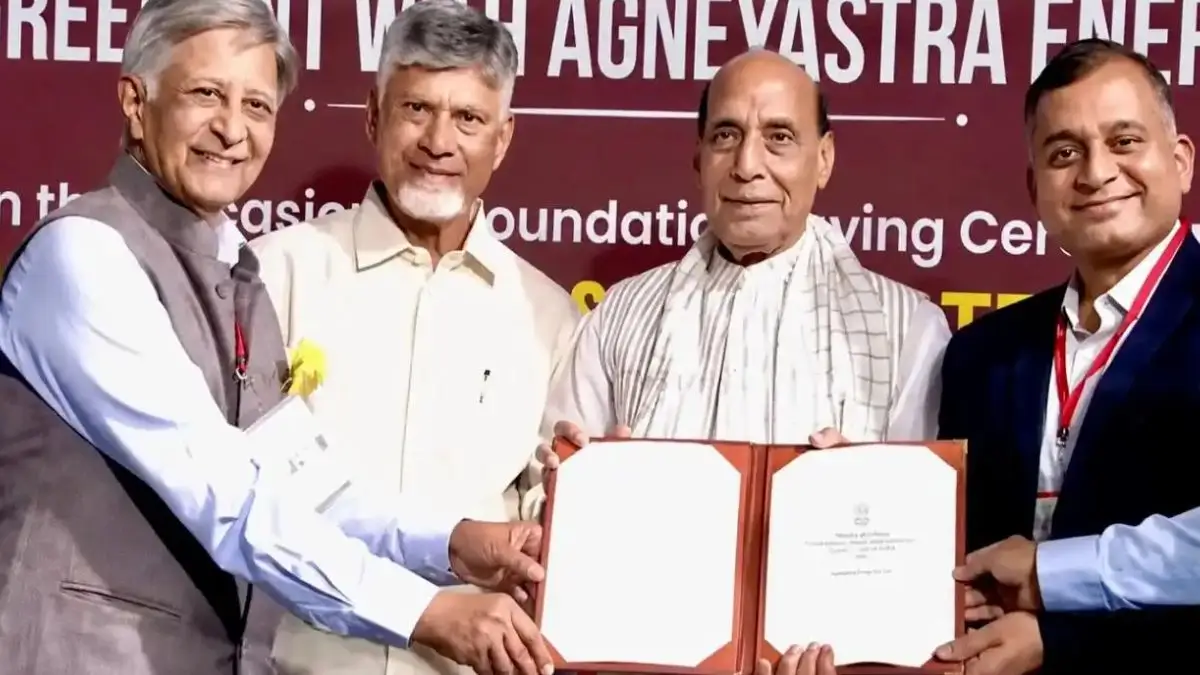
Bharat Forge marine gas turbine facility marks India’s first private defence engine project in Andhra Pradesh, boosting Atmanirbhar Bharat, Navy capabilities, and defence manufacturing with ₹900 crore investment.
Bharat Forge to Set Up India’s First Private Marine Gas Turbine Facility in Andhra Pradesh
Introduction to the Major Defence Project
India’s defence manufacturing sector has received a significant boost with Bharat Forge announcing plans to establish the country’s first private-sector Marine Gas Turbine (MGT) repair, overhaul, and indigenous development facility in Visakhapatnam. The project will be developed in collaboration with the Government of Andhra Pradesh and marks an important milestone in India’s push toward self-reliance in defence technology.
MoU Signed During Defence Investment Conclave
The Memorandum of Understanding (MoU) for the project was signed during the Aerospace and Defence Investment Conclave held in Puttaparthy in the presence of Rajnath Singh and N. Chandrababu Naidu. The project demonstrates increasing cooperation between the government and private industry in strengthening India’s defence ecosystem.
Strategic Importance of the Facility
The proposed facility will be established over nearly 80 acres within the Andhra Pradesh Defence Manufacturing Corridor. It will be strategically co-located near the Naval Dockyard, INS Eksila, and the Eastern Naval Command headquarters in Visakhapatnam. This location is crucial because marine gas turbines are extensively used in Indian Navy warships and frontline naval vessels.
Currently, India depends heavily on foreign suppliers for maintenance and overhaul of marine gas turbines. The new facility aims to reduce this dependence by creating domestic capabilities for repairing, servicing, and eventually developing indigenous gas turbine engines.
Phased Development of the Project
The project will be implemented in two major phases.
Phase One: Repair and Overhaul Complex
The first phase will focus on setting up a complete marine gas turbine repair and overhaul complex. It will include:
- Hot section restoration facilities
- Manufacturing of turbine components
- Non-destructive evaluation laboratories
- A 72-hour turnaround maintenance capability for naval requirements
This phase is expected to significantly improve the maintenance efficiency of Indian naval propulsion systems.
Phase Two: Indigenous Development and Assembly
The second phase will focus on indigenous development and assembly of marine gas turbines. It will include:
- Marine gas turbine assembly hall
- Full-scale hot test cell
- Indigenous turbine engine development and qualification systems
This phase is especially important because India has long aimed to build advanced propulsion systems domestically under the “Atmanirbhar Bharat” initiative.
Investment and Employment Opportunities
According to reports, the project will involve an investment of more than ₹900 crore. It is also expected to create nearly 750 direct and indirect jobs in the region. The project is likely to strengthen Andhra Pradesh’s role as an emerging defence manufacturing hub in India.
Role of Marine Gas Turbines in Naval Operations
Marine gas turbines are advanced propulsion systems used in warships and naval combat vessels. These engines are preferred because they provide:
- High power-to-weight ratio
- Faster acceleration
- Compact design
- Better operational efficiency
Modern naval vessels require reliable propulsion systems for long-duration maritime operations. Developing indigenous expertise in this field is therefore strategically important for national security.
Boost to Atmanirbhar Bharat in Defence
The project aligns strongly with the Government of India’s “Atmanirbhar Bharat” mission, which focuses on reducing import dependence in critical sectors such as defence manufacturing. By enabling private-sector participation in advanced naval propulsion systems, the initiative could help India become more self-reliant in strategic defence technologies.
Importance for Government Exam Aspirants
This development is important for students preparing for examinations such as UPSC, State PSCs, SSC, Banking, Railways, CDS, NDA, CAPF, and other competitive exams because it relates to:
- Defence manufacturing
- Make in India initiative
- Atmanirbhar Bharat
- Marine technology
- Public-private partnerships
- Strategic infrastructure
- National security
Questions related to defence corridors, indigenous technology, Bharat Forge, Andhra Pradesh industrial development, and naval modernization may appear in current affairs and General Studies papers.

Why This News is Important
Strengthening India’s Defence Self-Reliance
The establishment of India’s first private marine gas turbine facility is a major step toward strengthening self-reliance in defence manufacturing. For decades, India has depended on foreign countries for the repair and maintenance of critical naval propulsion systems. By building domestic capabilities, India can reduce strategic vulnerabilities during geopolitical tensions and supply chain disruptions.
Expansion of Private Sector Participation
Traditionally, defence manufacturing in India was dominated by public sector undertakings and government research organizations. This project highlights the increasing role of private companies like Bharat Forge in advanced defence technologies. It reflects the government’s policy shift toward encouraging private participation in strategic sectors.
Strategic Importance for the Indian Navy
Marine gas turbines are essential for powering modern naval vessels. Indigenous repair and overhaul capabilities can reduce downtime for warships and improve the operational readiness of the Indian Navy. This becomes especially important in the context of India’s growing maritime security responsibilities in the Indian Ocean region.
Economic and Employment Benefits
The ₹900 crore investment is expected to generate employment opportunities and support local industries in Andhra Pradesh. The project will also encourage the development of ancillary industries related to aerospace, metallurgy, and defence manufacturing.
Historical Context
Evolution of India’s Defence Manufacturing Policy
India has historically relied on imports for advanced defence systems and propulsion technologies. After facing challenges during various geopolitical crises and defence procurement delays, India started focusing on indigenous production capabilities.
The government launched initiatives such as:
- Make in India
- Defence Industrial Corridors
- Atmanirbhar Bharat
- Strategic Partnership Model
These policies were aimed at boosting domestic defence manufacturing and encouraging private sector involvement.
Development of Defence Corridors
The Andhra Pradesh Defence Manufacturing Corridor is part of India’s broader strategy to create specialized defence production ecosystems. States such as Uttar Pradesh and Tamil Nadu also host defence corridors designed to attract investment and create integrated manufacturing clusters.
Visakhapatnam has emerged as a strategically important defence city due to the presence of the Eastern Naval Command, naval dockyards, and shipbuilding facilities.
India’s Indigenous Engine Development Efforts
India has long attempted to develop indigenous engine technologies through programs such as the Kaveri engine project. Although several challenges delayed progress, recent developments in aerospace and marine propulsion technologies indicate renewed efforts toward indigenous engine development.
Key Takeaways from This News
| S.No. | Key Takeaway |
|---|---|
| 1 | Bharat Forge will establish India’s first private-sector marine gas turbine facility in Visakhapatnam, Andhra Pradesh. |
| 2 | The project will focus on repair, overhaul, and indigenous development of marine gas turbines for naval use. |
| 3 | The facility will be built over nearly 80 acres within the Andhra Pradesh Defence Manufacturing Corridor. |
| 4 | The project aligns with the Atmanirbhar Bharat initiative and aims to reduce India’s dependence on foreign defence technologies. |
| 5 | The ₹900 crore project is expected to create around 750 direct and indirect employment opportunities. |
FAQs (Frequently Asked Questions)
1. What is the Bharat Forge marine gas turbine project?
It is India’s first private-sector facility for repair, overhaul, and indigenous development of marine gas turbines for naval warships, to be set up in Visakhapatnam, Andhra Pradesh.
2. Why is this project significant for India’s defence sector?
The project reduces India’s dependence on foreign countries for critical naval propulsion systems and strengthens defence self-reliance under the Atmanirbhar Bharat initiative.
3. Where will the facility be established?
The facility will be developed in Visakhapatnam within the Andhra Pradesh Defence Manufacturing Corridor.
4. What is the investment and expected employment generation?
The project involves an investment of around ₹900 crore and is expected to generate approximately 750 direct and indirect jobs.
5. Which sector will benefit most from this facility?
The Indian Navy will be the primary beneficiary, as marine gas turbines are widely used in warships and advanced naval vessels.
6. What are marine gas turbines used for?
Marine gas turbines are used as propulsion systems in naval ships due to their high power-to-weight ratio, compact design, and operational efficiency.
7. How does this project support Make in India?
It promotes indigenous defence manufacturing and private-sector participation in high-technology naval systems under the Make in India initiative.
Some Important Current Affairs Links