







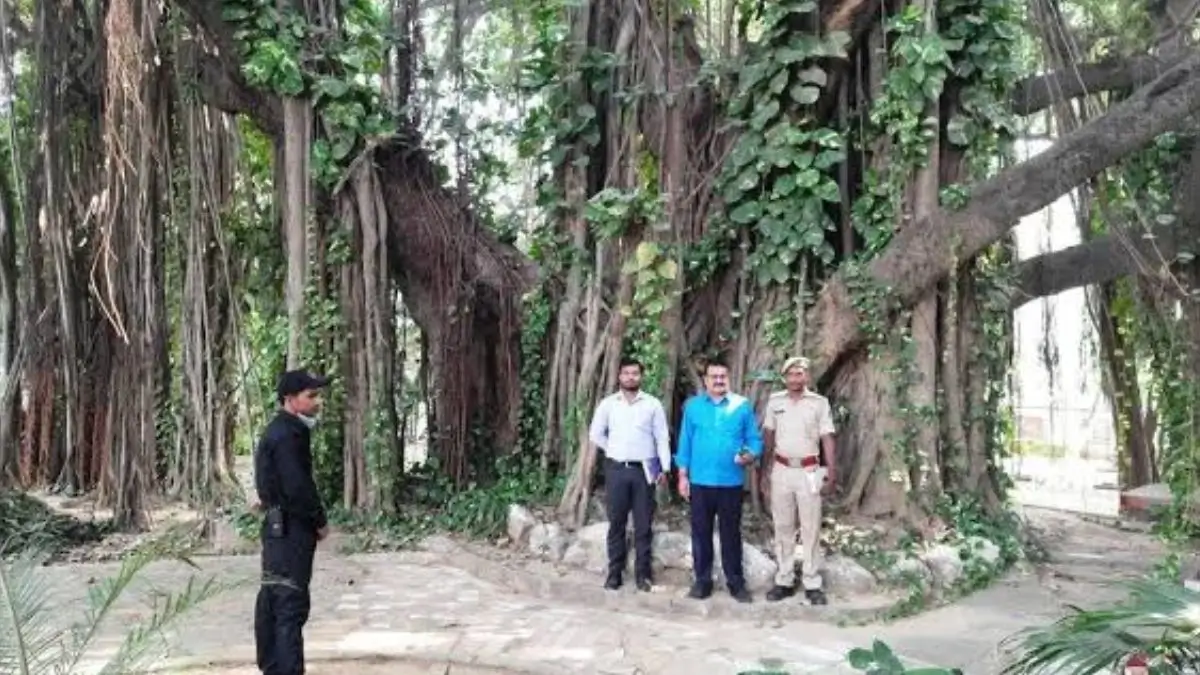
700-year-old Munger banyan tree becomes the world’s oldest scientifically dated banyan. Learn its location, radiocarbon dating method, ecological importance, historical background, key facts, MCQs, FAQs, and exam relevance for UPSC, SSC, Banking, Railways, Defence, and State PSC preparation.
A Landmark Discovery in India’s Natural Heritage
India has added another remarkable achievement to its rich natural heritage after scientists confirmed that a banyan tree located in Munger district of Bihar is approximately 700 years old. The discovery makes it the world’s oldest accurately and scientifically dated banyan tree. Unlike earlier estimates that relied on folklore, legends, or historical records, researchers used advanced radiocarbon dating techniques to determine the tree’s age with scientific precision. This breakthrough has attracted national and international attention and represents an important milestone in botanical research and heritage conservation.
Location of the Historic Banyan Tree
The ancient banyan tree is situated within the ITC campus in Munger district, Bihar. Munger has historically been known for its cultural significance and ancient settlements. The presence of this centuries-old banyan further strengthens the district’s importance as a destination for both ecological and historical studies. The tree has survived changing climates, political transitions, and rapid urbanization over nearly seven centuries.
Scientific Method Used to Determine the Age
For decades, estimating the age of banyan trees remained difficult because tropical trees generally do not develop distinct annual growth rings like many temperate trees. Scientists overcame this challenge by applying high-precision radiocarbon dating to carefully collected wood samples. By targeting the oldest portions of the tree, researchers estimated its age to be around 700 years.
This scientific approach is considered far more reliable than traditional methods based on oral history or visual estimates. The study also establishes a standard methodology for dating other tropical heritage trees across the world.
Why This Discovery Matters
The discovery is significant because it changes how scientists evaluate the age of tropical trees. Many famous banyan trees in India are believed to be much older, but their ages have never been confirmed scientifically.
The Munger banyan therefore becomes the oldest accurately dated banyan tree rather than merely the oldest believed or estimated banyan. This distinction is important in scientific research because verified evidence provides stronger foundations for conservation policies and biodiversity studies.
Importance for Biodiversity Conservation
Ancient trees serve as living ecosystems. A mature banyan supports hundreds of species including birds, insects, reptiles, mammals, fungi, and microorganisms. The tree’s extensive canopy and aerial roots create habitats that contribute significantly to local biodiversity.
Conserving such heritage trees helps preserve ecological balance while providing opportunities for environmental education and scientific research. As climate change threatens old-growth trees worldwide, identifying and protecting ancient specimens has become increasingly important.
Contribution to Climate Research
Large and ancient trees store significant quantities of carbon, making them valuable natural carbon sinks. Scientists believe that studying centuries-old trees can improve understanding of long-term climate patterns, ecological resilience, and carbon sequestration.
The Munger banyan offers researchers a rare opportunity to examine how tropical trees have survived changing environmental conditions over several centuries.
Cultural Importance of Banyan Trees in India
The banyan tree (Ficus benghalensis) occupies a special place in Indian civilization. It symbolizes longevity, wisdom, shelter, and continuity. Across villages, temples, and pilgrimage sites, banyan trees often serve as community gathering spaces.
Several Hindu traditions associate the banyan with immortality and prosperity. Festivals such as Vat Savitri Vrat celebrate the spiritual significance of the tree, making its conservation important from both ecological and cultural perspectives.
Research Opens New Possibilities
The successful application of radiocarbon dating demonstrates that scientists can now accurately determine the ages of tropical heritage trees worldwide. This could help governments identify and officially protect more ancient trees as national heritage monuments.
The research also provides valuable insights for botanists, archaeologists, conservationists, and environmental policymakers.
Relevance for Competitive Examinations
This development is highly relevant for UPSC, State PSCs, SSC, Banking, Railways, Defence, Forest Services, and teaching examinations. Questions may focus on:
- Radiocarbon dating
- Ficus benghalensis (Banyan Tree)
- Heritage tree conservation
- Biodiversity conservation
- Carbon sequestration
- Scientific achievements of India
- Environmental protection
- Climate resilience
- Important discoveries in botany

B) Why this News is Important
Scientific Significance
The discovery represents a major advancement in botanical science because it is the first time that a banyan tree’s age has been established using rigorous scientific methods rather than folklore or historical assumptions. This improves the accuracy of environmental and ecological research.
Environmental Importance
Ancient trees are valuable biodiversity hotspots and natural carbon reservoirs. Protecting them supports wildlife conservation, climate change mitigation, and ecosystem stability. Governments may now place greater emphasis on preserving scientifically verified heritage trees.
Examination Relevance
For government examination aspirants, the topic combines multiple syllabus areas including environment, ecology, biodiversity, geography, climate change, scientific methods, current affairs, and Indian heritage. Questions may appear in prelims, mains, interviews, or descriptive papers.
Policy and Conservation Relevance
The research demonstrates how modern scientific techniques can support heritage conservation. It may encourage authorities to identify, document, and legally protect more ancient trees across India using evidence-based approaches.
C) Historical Context
Ancient Banyan Trees in Indian Civilization
The banyan tree has been revered in India for thousands of years. It is the national tree of India and appears in numerous religious texts, folk traditions, and historical records. Villages traditionally developed around large banyan trees, which served as meeting places, educational centres, and symbols of community life.
Historically, the ages of famous banyan trees such as the Great Banyan Tree in Kolkata were estimated using oral traditions or historical documentation rather than scientific analysis. The Munger banyan changes this approach by becoming the first accurately dated heritage banyan through radiocarbon dating. This achievement establishes a new benchmark for studying tropical trees and strengthens conservation efforts based on scientific evidence rather than legend.
D) Key Takeaways from This News
| S. No. | Key Takeaway |
|---|---|
| 1 | Scientists identified a banyan tree in Munger, Bihar, as the world’s oldest accurately dated banyan tree. |
| 2 | The tree’s age is estimated at approximately 700 years using high-precision radiocarbon dating. |
| 3 | The discovery establishes a scientific method for accurately dating tropical heritage trees. |
| 4 | The banyan tree belongs to the species Ficus benghalensis, India’s national tree. |
| 5 | The finding strengthens biodiversity conservation, heritage preservation, and climate research while holding high relevance for UPSC, PSC, SSC, Banking, Railways, Defence, and other competitive examinations. |
Frequently Asked Questions (FAQs)
Q1. Why is the Munger banyan tree in Bihar in the news?
Answer: The Munger banyan tree has been identified as the world’s oldest scientifically dated banyan tree. Using high-precision radiocarbon dating, scientists estimated its age to be around 700 years, making it a significant discovery in botanical and environmental research.
Q2. Where is the 700-year-old banyan tree located?
Answer: The banyan tree is located in the ITC campus in Munger district, Bihar, India.
Q3. Which scientific method was used to determine the age of the banyan tree?
Answer: Researchers used high-precision radiocarbon (Carbon-14) dating to scientifically estimate the age of the tree.
Q4. What is the scientific name of the banyan tree?
Answer: The scientific name of the banyan tree is Ficus benghalensis.
Q5. Which is the National Tree of India?
Answer: The Banyan Tree (Ficus benghalensis) is the National Tree of India.
Q6. Why is radiocarbon dating important in this discovery?
Answer: Radiocarbon dating provides a scientifically accurate estimate of the tree’s age, unlike traditional estimates based on historical records or local legends.
Q7. Why are ancient banyan trees important for biodiversity?
Answer: Ancient banyan trees provide habitat and food for numerous species of birds, mammals, insects, reptiles, fungi, and microorganisms, making them biodiversity hotspots.
Q8. How do old trees contribute to climate change mitigation?
Answer: Large and old trees act as carbon sinks, absorbing and storing atmospheric carbon dioxide for centuries, thereby helping reduce greenhouse gases.
Q9. Which competitive examinations can include questions on this topic?
Answer: This topic is important for UPSC, State PSCs, SSC, Banking, Railways, Defence, Forest Services, Teaching Exams, CUET, and other competitive examinations, particularly under Environment, Ecology, Biodiversity, Science & Technology, and Current Affairs.
Q10. What is the significance of the Munger banyan discovery for conservation?
Answer: The discovery provides a scientific basis for identifying and protecting heritage trees across India and encourages evidence-based biodiversity conservation policies.
Some Important Current Affairs Links