







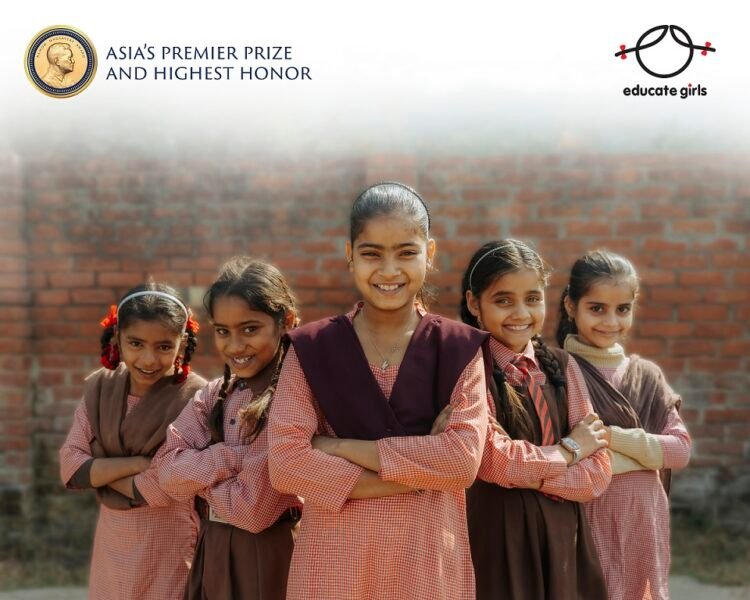
Educate Girls Ramon Magsaysay Award 2025: Indian NGO Educate Girls becomes the first non-profit from India to win Asia’s Nobel Prize for its work in girls’ education, impacting over 2 million girls across 30,000 villages.
Educate Girls Makes History by Winning the 2025 Ramon Magsaysay Award
Transforming Girls’ Education Through Grassroots Action
On August 31, 2025, Educate Girls—officially known as the Foundation to Educate Girls Globally—made history by becoming the first Indian non-profit to win the esteemed Ramon Magsaysay Award, often called “Asia’s Nobel Prize” Originating in remote rural parts of Rajasthan, the NGO was established in 2007 by Safeena Husain, a London School of Economics alumna who chose to return from San Francisco to tackle the entrenched issue of female illiteracy in India
A Reach Spanning 30,000 Villages and Over 2 Million Girls
In its nearly two-decade journey, Educate Girls has operated in more than 30,000 villages, achieving the monumental feat of enrolling over 2 million girls into formal education while delivering remedial learning support to over 2.4 million children
Innovative and Inclusive Programs: Vidya & Pragati
The organization’s impact is driven by two core programs:
- Vidya: Focuses on enrolling girls up to age 14 into government schools.
- Pragati: Offers a “second chance” to adolescent girls and women (15–29 years), improving their education and employability
Mobilizing Local Champions: Team Balika Volunteers
A defining strength of Educate Girls is its network of Team Balika volunteers—over 23,000 grassroots workers across Rajasthan. These volunteers identify out-of-school girls and leverage government infrastructure to facilitate their return to education
National and Global Recognition for Equity in Education
The Ramon Magsaysay Award Foundation recognized Educate Girls for its “commitment to addressing cultural stereotyping through the education of girls and young women, liberating them from the bondage of illiteracy and infusing them with skills, courage, and agency” The award ceremony will occur on November 7, 2025, at the Metropolitan Theatre in Manila
A Movement with a Vision: Reaching 10 Million Learners
Safeena Husain expressed that this recognition places a global spotlight on India’s people-powered movement for girls’ education and emphasized that when “one girl is educated, she takes others with her, multiplying change across families, generations, and nations” Educate Girls now aims to reach 10 million learners in the next decade, leveraging its proven community-based model
Why This News Is Important
Catalyzing Gender Equity and Social Mobility
The recognition of Educate Girls underscores the critical role of education in empowering girls, dismantling centuries of patriarchal norms and opening pathways for socioeconomic mobility. For aspirants of civil service, teaching, banking, police work, railway services, and defence positions, understanding such social transformation initiatives is essential because they reflect government policy directions, societal priorities, and grassroots-level challenges.
Inspiring Innovative Governance and NGO-Government Synergies
Educate Girls exemplifies how non-profits can work effectively with government systems through public–private partnerships, local volunteers, and scalable programs. This model is particularly relevant to exam-focused students, highlighting how policy implementation and innovative models can work hand-in-hand to deliver impactful results.
Strengthening Global and National Recognition Mechanisms
Winning the Ramon Magsaysay Award—the highest honor in Asia—puts a spotlight on India’s achievements in transformative social work. It’s a contemporary example of how Indian initiatives are gaining global acclaim, adding depth to the aspirant’s understanding of India’s soft power and international recognition in the development sector.
Exam Relevance: UPSC, SSC, RBI, and Other Government Exams
Current affairs related to education, women’s empowerment, social innovations, and award recognitions frequently surface in general studies papers, essay writing, and interviews. This news provides rich content for questions under ethical governance, social justice, gender inclusiveness, and non-profit engagement with development policies.
Historical Context
The Legacy of the Ramon Magsaysay Award
Established in 1957, the Ramon Magsaysay Award was inspired by former Philippine President Ramon Magsaysay, whose leadership symbolized integrity and serviceOften regarded as Asia’s Nobel Prize, the award honors individuals and organizations showing remarkable leadership and social change across Asia. It is announced every August 31, Magsaysay’s birth anniversary, and culminates in a formal ceremony in Manila every November
Notable Indian Awardees
India’s illustrious past recipients include:
- Mother Teresa (1962), Jayaprakash Narayan (1965),
- Satyajit Ray (1967), Arvind Kejriwal (2006),
- Ravish Kumar (2019), Sonam Wangchuk (2018), Aruna Roy (2000), and Kiran Bedi (1994)
Educate Girls’ Inspirational Journey
Founded in 2007, Educate Girls began modestly in Rajasthan with a pilot covering 50 village schools. Despite operating in regions resistant to girls’ education, it scaled up to 30,000+ villages across India, enrolling over 2 million girls with retention rates above 90%
Key Takeaways from “Educate Girls Wins the 2025 Ramon Magsaysay Award”
| No. | Key Takeaway |
|---|---|
| 1 | Educate Girls is the first Indian non-profit to ever win the Ramon Magsaysay Award in 2025. |
| 2 | Founded in 2007 by Safeena Husain, the NGO tackles female illiteracy through grassroots interventions. |
| 3 | It has impacted education in 30,000+ villages, enrolling over 2 million girls and supporting 2.4 million with remedial learning. |
| 4 | Runs two flagship programs—Vidya (girls’ enrollment up to age 14) and Pragati (second-chance education for 15–29-year-olds)—backed by 23,000+ Team Balika volunteers. |
| 5 | The award highlights their successful engagement model and their ambition to reach 10 million learners in the next decade, spotlighting scalable impact through community–government collaboration. |
FAQs: Frequently Asked Questions
Q1. What is the Ramon Magsaysay Award and why is it significant?
The Ramon Magsaysay Award, often called “Asia’s Nobel Prize,” was established in 1957 to honor individuals and organizations in Asia who demonstrate integrity, selfless service, and transformative leadership.
Q2. Who founded Educate Girls and in which year?
Educate Girls was founded in 2007 by Safeena Husain, a social entrepreneur and graduate of the London School of Economics.
Q3. How many villages has Educate Girls worked in so far?
Educate Girls has worked in more than 30,000 villages across India.
Q4. What are the two flagship programs of Educate Girls?
The two flagship programs are Vidya (for enrollment of girls up to age 14) and Pragati (a second-chance program for adolescent girls and women aged 15–29).
Q5. When will the 2025 Ramon Magsaysay Award ceremony be held?
The ceremony will take place on November 7, 2025, at the Metropolitan Theatre in Manila, Philippines.
Q6. How many girls have been enrolled by Educate Girls till 2025?
The organization has enrolled more than 2 million girls into schools.
Q7. What role do Team Balika volunteers play?
Team Balika volunteers, numbering over 23,000, identify out-of-school girls and mobilize community support to reintegrate them into formal education.
Q8. Why is this award important for India?
It highlights India’s grassroots innovation in education, gender equity, and global recognition of its social transformation models.
Q9. Who are some notable Indians who previously received the Ramon Magsaysay Award?
Past awardees include Mother Teresa, Jayaprakash Narayan, Aruna Roy, Kiran Bedi, Ravish Kumar, and Sonam Wangchuk.
Q10. What is Educate Girls’ target for the future?
The NGO aims to reach 10 million learners in the next decade.
Some Important Current Affairs Links