





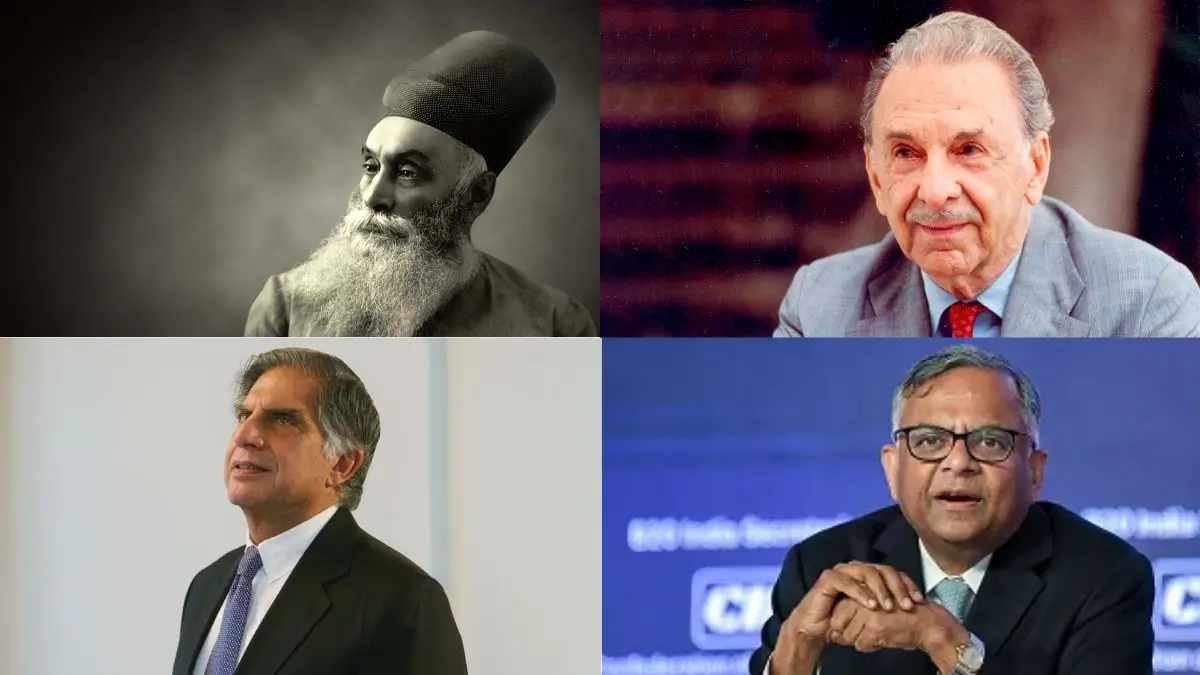
Tata Group chairmen list from Jamsetji Tata to N. Chandrasekaran, including key leadership periods, important facts and exam-oriented current affairs for competitive exams.
Tata Group Leadership and Its Historical Significance
The Tata Group is one of India’s oldest and most influential business conglomerates, with a history spanning more than a century. Its leadership journey reflects the transformation of Indian industry from the colonial era to a globally competitive economy. For government exam aspirants, the list of Tata Group chairmen is important for questions related to Indian business history, corporate governance, industrialisation and prominent personalities.
Jamsetji Tata: The Founder of the Tata Legacy
Jamsetji Nusserwanji Tata laid the foundation of the Tata business legacy and is widely regarded as the founder of the Tata Group. His vision went beyond commercial success and focused on industrial development, scientific research, education and social welfare. Among his major dreams were a world-class hotel, an iron and steel enterprise and a scientific research institution. The Taj Mahal Hotel opened in Mumbai in 1903, while his vision for steel and scientific research was realised after his lifetime.
Sir Dorabji Tata: Continuing the Founder’s Vision
After Jamsetji Tata passed away in 1904, his elder son Sir Dorabji Tata took charge of the group. He played a crucial role in converting his father’s ambitious ideas into major institutions. Tata Iron and Steel Company, later known as Tata Steel, was established in 1907 under his leadership. His period was important in establishing the industrial foundation of the Tata Group.
Sir Nowroji Saklatvala: Focus on Employees and Welfare
Sir Nowroji Saklatvala became chairman of the Tata Group in 1932 after Sir Dorabji Tata. He was known for his emphasis on employee welfare and responsible management. His leadership represented an important phase in the development of Tata’s philosophy of combining business with social responsibility.
J.R.D. Tata: The Longest and Most Transformative Era
Jehangir Ratanji Dadabhoy Tata, popularly known as J.R.D. Tata, became one of the most influential figures in Indian corporate history. He guided the Tata Group for more than half a century and played a major role in expanding its industrial and commercial activities. J.R.D. Tata also pioneered civil aviation in India by launching an airline in 1932, which later became Air India.
Ratan Tata: Global Expansion and Modernisation
Ratan Naval Tata became chairman during a period when India’s economy was moving away from the Licence Raj and towards liberalisation and greater global integration. He worked to make the diversified Tata companies more cohesive and encouraged international expansion. Under his leadership, the group became associated with major global acquisitions and strengthened its international presence.
Cyrus Mistry: A Brief Leadership Period
Cyrus P. Mistry succeeded Ratan Tata as chairman of Tata Sons in 2012. His tenure, however, was relatively short and ended in 2016 when he was removed from the position following disagreements involving the group’s leadership and governance. The episode became an important case study in Indian corporate governance and the relationship between a holding company, its board and controlling stakeholders.
N. Chandrasekaran: Technology-Led Leadership
Natarajan Chandrasekaran was appointed Executive Chairman of Tata Sons in January 2017 and took charge on February 21, 2017. Before becoming chairman, he had spent his professional career at Tata Consultancy Services, joining the company in 1987 and becoming its CEO and Managing Director in 2009. His appointment was significant because he became the first non-Parsi chairman of Tata Sons.
Chandrasekaran’s Contribution to the Tata Group
During Chandrasekaran’s leadership, the Tata Group continued to diversify into sectors such as aviation, electronics, semiconductors and digital businesses while strengthening its existing operations. When he took charge, he identified closer coordination among group companies, stronger operating performance and disciplined capital allocation as key strategic priorities.
Important Current Development in Tata Leadership
In August 2026, N. Chandrasekaran announced that he would step down as Tata Sons chairman when his current term ends on February 20, 2027. The announcement has opened a new succession phase for the Tata Group. Recent reports indicate that Tata Trusts and Tata Sons will have an important role in the selection of the next chairman.
Tata Group Chairmen: Exam-Oriented Chronology
For competitive examinations, aspirants should remember the broad sequence of leadership: Jamsetji Tata, Sir Dorabji Tata, Sir Nowroji Saklatvala, J.R.D. Tata, Ratan Tata, Cyrus Mistry and N. Chandrasekaran. The sequence is particularly useful for questions concerning Indian industrial history, major business leaders and corporate governance.
Why Tata Chairmen Are Important for Government Exams
The Tata Group leadership story connects several subjects frequently tested in competitive examinations. These include Indian industrialisation, entrepreneurship, corporate governance, economic liberalisation, globalisation and the development of major Indian business houses. Questions may also focus on personalities, chronological order, important appointments and the contribution of Tata leaders to India’s economic development.

Why This News is Important
Importance for Current Affairs Preparation
The leadership history of the Tata Group is relevant to current affairs because N. Chandrasekaran’s planned departure in February 2027 marks an important transition at one of India’s most prominent corporate groups. His tenure since 2017 represents a significant phase of Tata’s modernisation and diversification.
Relevance to Corporate Governance
The Tata Group provides an important example of corporate governance in India. The relationship between Tata Sons, Tata Trusts and the leadership of the group has influenced several major leadership decisions. The succession process following Chandrasekaran’s planned departure is therefore relevant for students studying business administration, economics and governance.
Importance for Indian Economic History
The Tata Group’s history is closely connected with India’s industrial development. From Jamsetji Tata’s industrial vision to the establishment of Tata Steel and the group’s later international expansion, the organisation illustrates the evolution of Indian enterprise over more than a century.
Relevance for Competitive Examinations
Questions about Tata chairmen can appear in General Awareness, Current Affairs, Banking Awareness, Business and Economy sections of examinations such as UPSC, State PCS, SSC, Banking, Railways, Defence and teaching recruitment examinations. Candidates should particularly remember the chronology of chairmen and the important contribution associated with each leadership period.
Leadership Transition and Future Significance
The forthcoming leadership transition is important because Tata Sons is the principal investment holding company of the Tata Group. The selection of Chandrasekaran’s successor could influence the strategic direction of the conglomerate in areas such as aviation, technology, manufacturing, electronics and other emerging sectors.
Historical Context: Evolution of Tata Group Leadership
Foundation of the Tata Enterprise
Jamsetji Tata established the foundation of a business philosophy that linked entrepreneurship with nation-building. His plans for steel, scientific research and hospitality became important milestones in India’s industrial history. Several of his major projects were completed by successors after his death.
Early Industrial Development
Sir Dorabji Tata carried forward his father’s vision and helped establish Tata Iron and Steel Company in 1907. This period marked an important stage in India’s movement towards modern industrial production. Tata’s early industrial ventures also demonstrated an emphasis on employee welfare and community development.
J.R.D. Tata and Post-Independence Expansion
J.R.D. Tata guided the group through a major portion of India’s pre- and post-Independence history. His leadership helped expand the group into different sectors, while his contribution to Indian civil aviation remains particularly notable.
Ratan Tata and Globalisation
Ratan Tata’s chairmanship coincided with India’s economic liberalisation and increasing integration with the global economy. He sought to make the group more cohesive and encouraged international expansion and acquisitions, helping transform Tata into a global business brand.
From Cyrus Mistry to N. Chandrasekaran
Cyrus Mistry’s tenure from 2012 to 2016 was followed by N. Chandrasekaran’s appointment in 2017. Chandrasekaran brought a technology-sector background to the top leadership position after his long career at TCS. His appointment represented a significant shift in Tata’s leadership tradition and made him the first non-Parsi chairman of Tata Sons.
Key Takeaways from Tata Group Chairmen History
| S. No. | Key Takeaway |
|---|---|
| 1 | Jamsetji Tata is regarded as the founder of the Tata Group and established its long-term industrial and philanthropic vision. |
| 2 | Sir Dorabji Tata succeeded Jamsetji Tata and played a major role in establishing Tata Iron and Steel Company in 1907. |
| 3 | J.R.D. Tata guided the group for more than half a century and pioneered civil aviation in India. |
| 4 | Ratan Tata led the group during India’s economic liberalisation and expanded its global presence through international growth and acquisitions. |
| 5 | N. Chandrasekaran became Tata Sons chairman in 2017 and is set to step down when his current term ends on February 20, 2027. |
FAQs
1. Who founded the Tata Group?
Jamsetji Nusserwanji Tata is regarded as the founder of the Tata Group. He established the foundation of the Tata business legacy and promoted industrialisation, scientific research, education and social development.
2. Who succeeded Jamsetji Tata?
Sir Dorabji Tata succeeded Jamsetji Tata and played a major role in turning several of his father’s industrial visions into reality, including the establishment of Tata Iron and Steel Company in 1907.
3. Who was the longest-serving chairman of the Tata Group?
J.R.D. Tata was one of the longest-serving leaders of the Tata Group. He served as chairman for more than five decades and played a major role in expanding the group across multiple sectors.
4. Who was the first non-Parsi chairman of Tata Sons?
N. Chandrasekaran became the first non-Parsi chairman of Tata Sons when he was appointed in 2017.
5. When did N. Chandrasekaran become Chairman of Tata Sons?
N. Chandrasekaran was appointed Executive Chairman of Tata Sons in January 2017 and assumed office on February 21, 2017.
6. Who was chairman of Tata Sons before N. Chandrasekaran?
Cyrus P. Mistry was the chairman of Tata Sons immediately before N. Chandrasekaran. Mistry served as chairman from 2012 until 2016.
7. What is Tata Sons?
Tata Sons is the principal investment holding company and promoter of the Tata Group. It plays a central role in coordinating the group’s businesses and strategic interests.
8. Which Tata chairman was associated with the development of Indian civil aviation?
J.R.D. Tata played a pioneering role in Indian civil aviation. He founded Tata Airlines in 1932, which later became Air India.
9. When was Tata Iron and Steel Company established?
Tata Iron and Steel Company, now known as Tata Steel, was established in 1907. Sir Dorabji Tata played an important role in bringing the project into existence.
10. When is N. Chandrasekaran expected to step down as Tata Sons chairman?
N. Chandrasekaran has announced that he will step down when his current term ends on February 20, 2027.
Some Important Current Affairs Links