









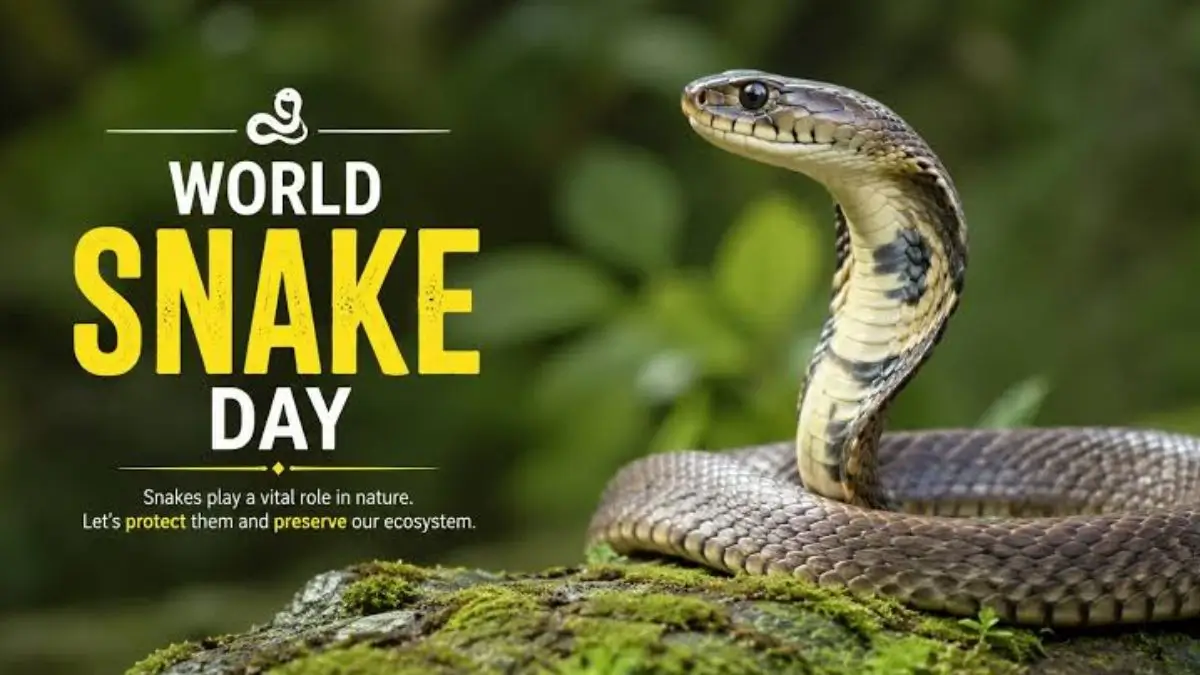
World Snake Day 2026 date history significance explained with important facts, ecological importance of snakes, conservation efforts and exam-relevant points for UPSC, PCS, SSC, Banking and other government exams.
World Snake Day 2026: Promoting Awareness About Nature’s Misunderstood Reptiles
World Snake Day is observed every year on 16 July to spread awareness about snakes, their ecological importance, and the need to conserve these often misunderstood reptiles. The observance encourages people to replace fear and myths with scientific understanding and appreciation. Although snakes are commonly associated with danger, only a small proportion of snake species are venomous, while the majority play a vital role in maintaining ecological balance by controlling rodent populations.
Date and Theme of World Snake Day 2026
World Snake Day 2026 was observed on 16 July 2026 across the globe. Various wildlife organizations, conservation groups, zoos, educational institutions and environmental agencies organized awareness campaigns highlighting snake conservation and biodiversity. While there is no universally adopted official annual theme for the observance, the celebrations focused on promoting coexistence with snakes, conservation of threatened species, and public awareness regarding their ecological importance.
History of World Snake Day
World Snake Day was established to educate people about the importance of snakes and to dispel misconceptions surrounding them. For centuries, snakes have been feared because of venomous species and cultural myths. However, scientists and conservationists emphasize that snakes are indispensable members of natural ecosystems.
The observance has gradually gained international recognition through wildlife organizations, museums, zoos, environmental groups and educational institutions conducting exhibitions, awareness programmes and conservation campaigns every year.
Ecological Importance of Snakes
Snakes occupy an essential position in food chains. They regulate populations of rodents and other small animals that can damage crops and spread diseases. At the same time, snakes themselves serve as prey for birds of prey, mammals and other predators, maintaining ecological balance.
Several snake species also contribute to medical science. Research on snake venom has led to the development of medicines used for treating hypertension, blood clotting disorders and other medical conditions. Scientists continue to study snake venom for future pharmaceutical applications.
Snake Diversity Around the World
There are more than 3,900 known species of snakes worldwide, inhabiting deserts, forests, wetlands, grasslands, mountains and even marine environments. India alone is home to more than 300 snake species, making it one of the world’s richest regions in snake diversity. Among the most well-known Indian species are the King Cobra, Indian Cobra, Russell’s Viper, Common Krait and Indian Rock Python.
Fascinating Facts About Snakes
Snakes possess remarkable adaptations that make them unique among reptiles.
- They detect scents using their forked tongue and Jacobson’s organ.
- Many species can swallow prey much larger than their heads because of flexible jaws.
- Some snakes can sense body heat using specialized heat-sensitive organs.
- Not all snakes lay eggs; several species give birth to live young.
- Only a minority of snake species are venomous and dangerous to humans.
Importance for Government Examination Aspirants
World Snake Day is important from the perspective of UPSC, State PCS, SSC, Banking, Railways, Defence and teaching examinations. Questions are frequently asked on international observance days, biodiversity, wildlife conservation, ecological balance, endangered species and environmental awareness. Candidates should remember the date (16 July), the objective of the day, ecological significance of snakes and India’s rich snake diversity.

B) Why This News is Important
Relevance in Competitive Examinations
International observance days form an important part of the General Awareness and Current Affairs sections of almost every government examination. Questions regarding World Snake Day may appear in UPSC, State PSC, SSC, Banking, Railways, Defence, CTET and other recruitment examinations. Candidates should remember the observance date, its objectives and its relation to biodiversity conservation.
Importance for Environmental Conservation
The observance highlights the importance of conserving reptiles and protecting biodiversity. Snakes are essential for maintaining healthy ecosystems by naturally controlling pest populations and supporting food chains. Increasing awareness reduces unnecessary killing of snakes and promotes coexistence between humans and wildlife.
Support for Sustainable Development
World Snake Day also aligns with global conservation efforts by encouraging habitat protection, scientific research and public education. It reminds policymakers and citizens that preserving wildlife contributes to sustainable ecosystems, agriculture and public health. Such topics are increasingly relevant in environmental governance and climate-related discussions, making them valuable for competitive examinations.
C) Historical Context
Evolution of Wildlife Awareness Campaigns
Global awareness days dedicated to wildlife have become an important tool for promoting biodiversity conservation. World Snake Day emerged as an educational initiative to challenge myths about snakes and encourage scientific understanding of these reptiles.
Changing Public Perception
Historically, snakes have been associated with fear, mythology and superstition across many cultures. Modern conservation efforts seek to replace misconceptions with factual knowledge about their ecological roles. Wildlife organizations, zoos and educational institutions now use World Snake Day to promote conservation, rescue awareness and habitat protection.
D) Key Takeaways from “World Snake Day 2026”
| S. No. | Key Takeaway |
|---|---|
| 1 | World Snake Day is observed annually on 16 July. |
| 2 | The observance promotes awareness, conservation and appreciation of snakes. |
| 3 | Snakes play a crucial ecological role by controlling rodent populations and maintaining food chains. |
| 4 | India is home to more than 300 snake species, including the King Cobra, Indian Cobra and Russell’s Viper. |
| 5 | World Snake Day is important for UPSC, PCS, SSC, Banking, Railways, Defence and other competitive examinations because questions on international observance days and biodiversity are frequently asked. |
Frequently Asked Questions (FAQs) on World Snake Day 2026
1. When is World Snake Day observed every year?
World Snake Day is observed every year on 16 July to create awareness about snakes, their ecological importance and the need for their conservation.
2. What is the main objective of World Snake Day?
The main objective of World Snake Day is to spread awareness about the role of snakes in ecosystems, remove misconceptions about snakes and encourage wildlife conservation.
3. Why are snakes important for the environment?
Snakes help maintain ecological balance by controlling populations of rodents and other small animals. They are an important part of food chains and contribute to biodiversity conservation.
4. Is every snake dangerous to humans?
No, all snakes are not dangerous. Only a small percentage of snake species are venomous, while most snakes are harmless and avoid human contact.
5. What is the role of snakes in agriculture?
Snakes help farmers by controlling rodent populations that can damage crops and spread diseases. Their presence supports natural pest control.
6. How many snake species are found worldwide?
There are more than 3,900 known snake species found across different habitats around the world.
7. How many snake species are found in India?
India has more than 300 snake species, including venomous and non-venomous species.
8. Name some important snake species found in India.
Important Indian snake species include the King Cobra, Indian Cobra, Common Krait, Russell’s Viper and Indian Rock Python.
9. What is the scientific importance of snake venom?
Snake venom is studied by scientists for developing medicines related to blood pressure, blood clotting disorders and other medical treatments.
10. Why is World Snake Day important for competitive examinations?
World Snake Day is important for UPSC, State PCS, SSC, Banking, Railways, Defence and teaching examinations because questions are often asked about important days, biodiversity, wildlife conservation and environmental issues.
Some Important Current Affairs Links