







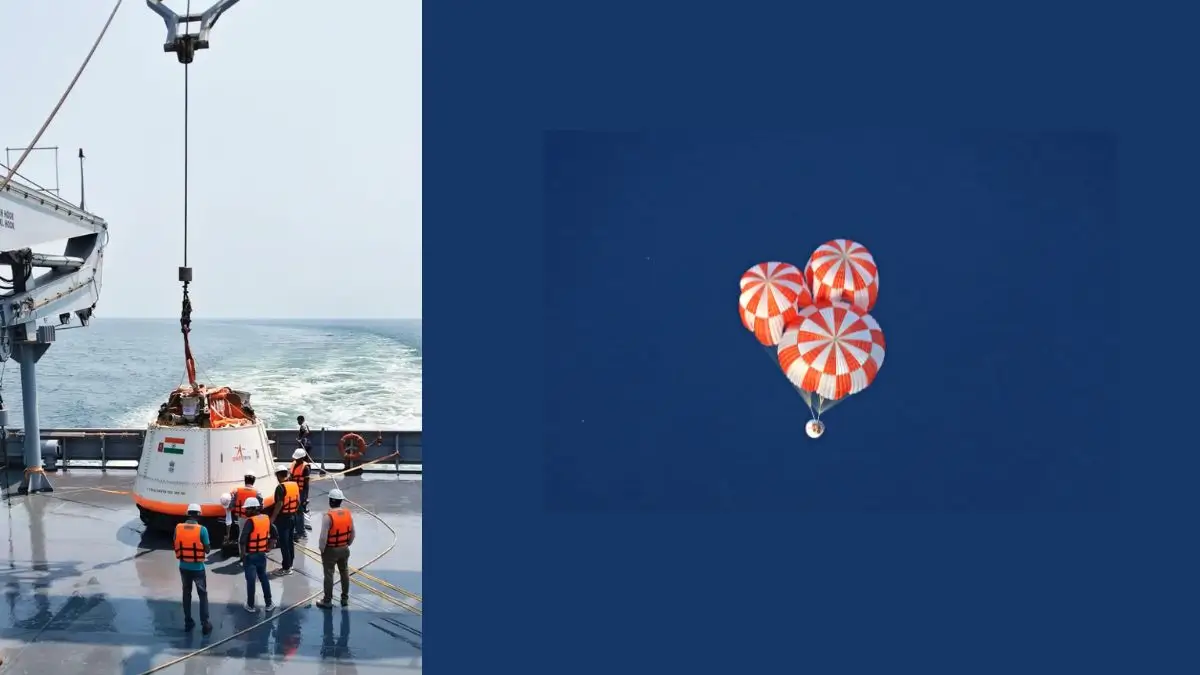
Gaganyaan IADT-02 test explained in detail—learn ISRO air drop test highlights, parachute system, and its importance for UPSC, SSC, and defence exams.
Gaganyaan IADT-02 Test: ISRO Achieves Major Milestone in India’s Human Spaceflight Mission
Introduction to Gaganyaan Mission
The Indian Space Research Organisation (ISRO) is progressing rapidly towards launching India’s first human spaceflight mission, Gaganyaan. This ambitious mission aims to send Indian astronauts (Gaganyatris) into low Earth orbit and bring them safely back to Earth. The mission represents a significant leap in India’s space capabilities and will make India one of the few nations with independent human spaceflight capability.
What is IADT-02 Test?
The Integrated Air Drop Test (IADT-02) is a crucial experiment conducted as part of the Gaganyaan mission. On April 10, 2026, ISRO successfully carried out this test at the Satish Dhawan Space Centre in Sriharikota. The primary aim of this test was to evaluate the crew module’s descent and landing systems, particularly the parachute-based deceleration system.
How the IADT-02 Test Was Conducted
During the test, a simulated crew module weighing about 5.7 tonnes was lifted to an altitude of approximately 3 km using an Indian Air Force Chinook helicopter. The module was then released over a designated sea zone near the coast. As it descended, multiple parachutes deployed in a specific sequence to slow down the module for a safe splashdown in the sea.
Role of Parachute System in Crew Safety
The parachute system is the most critical component of the crew module’s safety mechanism. In the IADT-02 test, 10 parachutes of four different types were deployed in sequence to ensure a controlled descent. These parachutes reduce the speed of the module significantly, ensuring a safe landing even under emergency conditions. This system also includes redundancy, meaning it can function even if one parachute fails.
Recovery Operations and Coordination
After splashdown, the simulated crew module was successfully recovered by the Indian Navy. This test demonstrated effective coordination between multiple agencies, including ISRO, the Indian Air Force, the Indian Navy, and DRDO. Such coordination is essential for real mission scenarios where astronaut safety is paramount.
Significance for Upcoming Missions
The success of IADT-02 marks a significant step towards the Gaganyaan G1 uncrewed mission and eventually the crewed mission. It validates the reliability of the crew module’s landing system, bringing India closer to achieving its human spaceflight goals.

Why This News is Important
Boost to India’s Space Ambitions
The successful completion of the IADT-02 test strengthens India’s position in the global space race. It showcases the country’s technological advancement and readiness to undertake complex human space missions.
Ensuring Astronaut Safety
Human spaceflight missions involve high risks, especially during re-entry and landing. This test ensures that astronauts can return safely, making it one of the most critical components of the mission.
Strategic and Technological Significance
The Gaganyaan mission is not just a scientific endeavor but also a strategic achievement. It enhances India’s technological self-reliance and contributes to advancements in aerospace engineering, materials science, and safety systems.
Multi-Agency Collaboration
The test highlights the importance of coordination among various defense and scientific agencies. This collaboration is vital for the success of complex missions like Gaganyaan.
Relevance for Competitive Exams
For aspirants of UPSC, SSC, Banking, Defence, and State PCS exams, this development is crucial under Science & Technology current affairs, especially topics related to space missions, ISRO achievements, and technological advancements.
Historical Context of the Gaganyaan Mission
Origins of India’s Human Spaceflight Programme
India’s human spaceflight ambitions were formalized under the Indian Human Spaceflight Programme, approved in 2018. The goal was to send a crew of 2–3 astronauts into space for a short-duration mission.
Early Testing and Developments
ISRO has conducted several critical tests over the years:
- Pad Abort Test (2018): Validated crew escape systems.
- Test Vehicle Abort Missions (2023–2025): Demonstrated emergency escape under different conditions.
- IADT-01 (2025): First integrated air drop test validating parachute deployment.
Progress Towards Human Spaceflight
The Gaganyaan programme includes multiple uncrewed missions (G1, G2) before the final crewed mission. These tests ensure that all systems, including life support, propulsion, and recovery, function reliably.
Global Context
With Gaganyaan, India aims to join the elite group of nations like the USA, Russia, and China that have successfully conducted human space missions, marking a major milestone in its scientific journey.
Key Takeaways from This News
| S.No | Key Takeaway |
|---|---|
| 1 | ISRO successfully conducted the IADT-02 test on April 10, 2026. |
| 2 | The test validated the parachute-based deceleration and landing system of the crew module. |
| 3 | A 5.7-tonne simulated crew module was dropped from 3 km altitude using a Chinook helicopter. |
| 4 | Multiple parachutes ensured safe descent and splashdown, highlighting redundancy in safety systems. |
| 5 | The test marks a crucial step towards India’s first human spaceflight mission under Gaganyaan. |
FAQs: Important Questions for Exam Preparation
1. What is the Gaganyaan Mission?
The Gaganyaan Mission is India’s first human spaceflight programme launched by Indian Space Research Organisation (ISRO) to send astronauts into low Earth orbit and safely return them.
2. What does IADT-02 stand for?
IADT-02 stands for Integrated Air Drop Test-02, a key test conducted to evaluate the crew module’s parachute-based landing system.
3. Why is the IADT-02 test important?
It validates the safe descent and splashdown capability of the crew module, ensuring astronaut safety during the final phase of the mission.
4. How was the IADT-02 test conducted?
A simulated crew module was dropped from a height of about 3 km using a Chinook helicopter, and multiple parachutes deployed to ensure safe landing in the sea.
5. Which agencies participated in the test?
The test involved coordination between ISRO, the Indian Air Force, the Indian Navy, and DRDO.
6. What is the role of parachutes in Gaganyaan?
Parachutes reduce the speed of the crew module during descent and ensure a safe splashdown in the ocean.
7. What are Gaganyatris?
Gaganyatris are the astronauts selected for India’s Gaganyaan mission.
8. What is the next step after IADT-02?
The next steps include uncrewed missions (G1, G2) before the final crewed mission.
9. Where was the test conducted?
The test was conducted near Satish Dhawan Space Centre.
10. Which countries have human spaceflight capability?
Currently, countries like the USA, Russia, and China have achieved human spaceflight, and India aims to join this group.
Some Important Current Affairs Links