









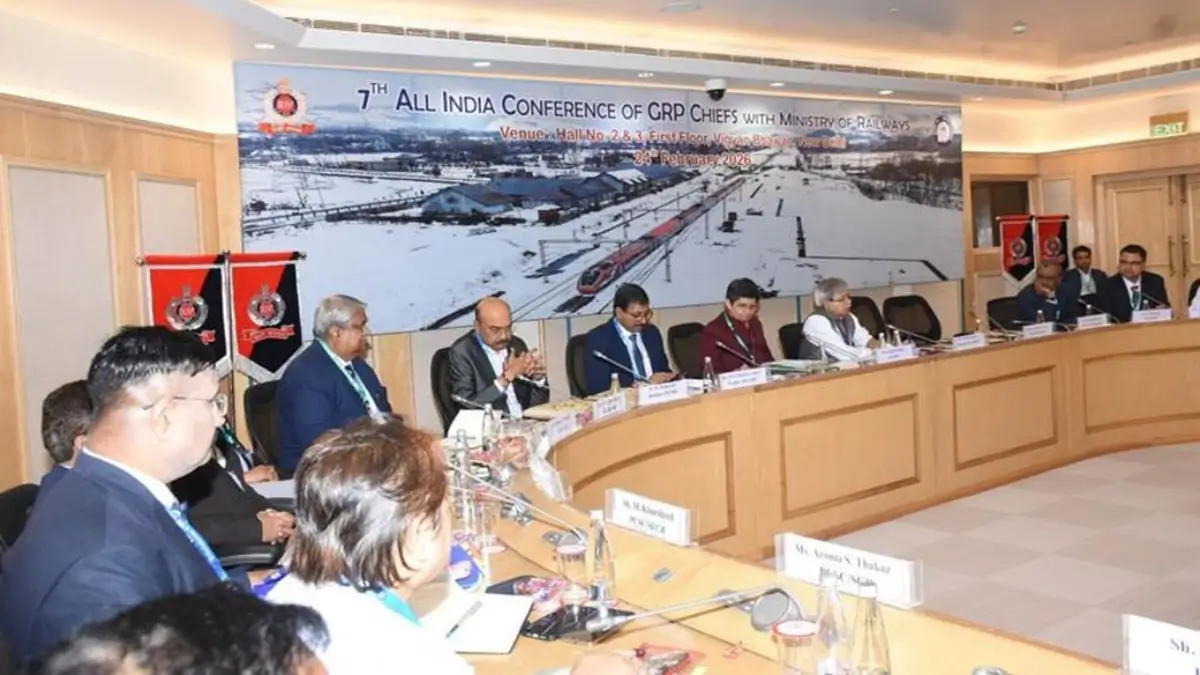
All India GRP Conference 2026 highlights key decisions from the 7th Railway Security Meet at Vigyan Bhawan, focusing on AI surveillance, GRP-RPF coordination, and passenger safety reforms important for UPSC, SSC, Railways and State PSC exams.
7th All India Conference of GRP Chiefs Concludes at Vigyan Bhawan
The 7th All India Conference of Government Railway Police (GRP) Chiefs successfully concluded at Vigyan Bhawan, New Delhi. Organized by the Railway Protection Force (RPF), this high-level national conference brought together senior police officers from across India. The event was presided over by Ms Sonali Mishra, Director General of RPF, and attended by Directors General of Police (DGPs), Additional DGs of Police (ADGPs) and senior Railway Police officials representing various State Governments and Union Territories. The conference was also graced by Shri Satish Kumar, Chairman-cum-CEO of the Railway Board, along with other Railway Board Members, underlining the collaborative nature of the security initiative.
The primary goal of the conference was to strengthen passenger safety and railway infrastructure security in the face of rapidly evolving security challenges. With Indian Railways being one of the world’s largest rail networks — characterized by extensive geographical spread, high passenger traffic, and an open-access system — the platform was used to deliberate on cohesive and coordinated security strategies. Experts highlighted vulnerabilities such as organised crime networks, drug trafficking, vandalism, stone pelting, sabotage, theft, and other law-and-order challenges as major threat vectors that demand integrated responses.
Technology-Driven Security Measures
One of the standout themes of the conference was the rapid adoption of advanced surveillance technologies to enhance surveillance and crime prevention. Delegates emphasized the use of facial recognition system (FRS)-enabled CCTV cameras, AI-powered video analytics, and drone surveillance as key technological tools. These modern tools are expected to assist security forces in real-time threat detection, criminal identification, and pattern analysis across high-density railway zones.
Strategic Action Against Drug Trafficking
Given the scale and connectivity of Indian Railways, it was recognized that narcotics and drug networks often exploit railway corridors for transportation and distribution. The conference formulated a special roadmap to counter drug trafficking through enhanced inter-agency intelligence sharing and proactive surveillance. A senior officer from the Narcotics Control Bureau (NCB) provided insights into the importance of real-time data exchange and coordinated operations to dismantle these networks.
Emphasis on Emergency Preparedness and Community Engagement
Another significant outcome was the recommendation to conduct regular mock drills and scenario-based training exercises focusing on first response, evacuation, crowd control, and incident management protocols. Participants underscored that such preparedness activities are vital for rapid and coordinated responses during emergencies. Additionally, the conference stressed the importance of community outreach programs to raise awareness in vulnerable areas and promote civilian involvement in railway safety.
Collaborative Security Framework
Overall, the conference served as a vital platform for aligning strategies between State Police Forces and the Railway Protection Force. It enabled knowledge sharing, mutual learning, and commitment to a coordinated security framework. The outcomes are expected to contribute significantly to a more resilient, responsive, and technology-enabled railway security system, enhancing overall safety for millions of railway passengers nationwide.

Why This News Is Important for Exam Aspirants
Enhances Understanding of Internal Security Mechanisms
Security of the Indian Railways is a critical component of national internal security and law-and-order management, making this conference an important topic in the General Studies section of competitive exams such as UPSC Civil Services, SSC CGL, State PSCs, Railways, and Police Recruitment Exams. The discussions around technological integration, coordinated frameworks, and inter-agency cooperation provide insights into how security challenges are addressed at the national level.
Technology in Policing and Public Safety
The emphasis on advanced surveillance technologies like AI, facial recognition, and drones reflects India’s shift towards digital policing. Questions related to modern law enforcement tools and innovation in public safety are increasingly asked in exams. Understanding these developments helps aspirants prepare for technology-driven current affairs topics.
Relevance to Public Policy and Governance
The conference underlines how the government formulates policy responses to emerging threats, including organised crime and drug trafficking, which are core themes in Governance and Social Issues sections of exams. Recognizing the strategies used by law enforcement agencies enhances conceptual clarity in public administration topics.
Importance for Railway Sector Exams
Railway security is directly relevant for exams under Railway Recruitment Boards and allied services. Knowledge of national conferences, policy initiatives, and security frameworks solidifies aspirants’ grasp on important institutional developments.
Broader Societal Impact
Finally, the conference’s focus on community engagement and emergency preparedness highlights the societal dimensions of policing, which are often examined under Ethics and Integrity in competitive exams.
Historical Context: Railway Security in India
Railways have long been the backbone of India’s transport network, carrying millions of passengers daily across remote and urban regions. The Government Railway Police (GRP) was established as a specialized state police function to maintain law and order on railway premises. With a massive and open-access railway system, security challenges have evolved over decades, from basic crime control to countering organised networks, sabotage risks, and terror threats. Over time, the Railway Protection Force (RPF) and GRP have increasingly adopted modern policies, inter-agency linkages, and technology to address dynamic security concerns. Vigyan Bhawan in New Delhi has historically been the venue for many significant national conferences, policy meetups, and government events due to its role as a premier government conference centre.
Key Takeaways from 7th All India Conference of GRP Chiefs
| S.No | Key Takeaway |
|---|---|
| 1 | The conference was held at Vigyan Bhawan, New Delhi, under the convenorship of the Railway Protection Force. |
| 2 | A coordinated framework was discussed to enhance passenger and railway infrastructure security. |
| 3 | Modern technologies like AI, FRS-enabled CCTV, and drones were highlighted for surveillance. |
| 4 | A roadmap was formulated to counter drug trafficking via enhanced inter-agency intelligence sharing. |
| 5 | Emphasis was placed on regular mock drills, emergency preparedness, and community outreach. |
FAQs for Government Exam Preparation
1. What was the purpose of the 7th All India Conference of GRP Chiefs?
The conference aimed to strengthen railway security across India by enhancing coordination between State Government Railway Police (GRP) and the Railway Protection Force. It focused on passenger safety, infrastructure protection, and combating organised crime.
2. Where was the 7th All India Conference of GRP Chiefs held?
The conference was held at Vigyan Bhawan in New Delhi, a premier venue for national-level government meetings and policy discussions.
3. Who organizes the All India Conference of GRP Chiefs?
The conference is organized by the Railway Protection Force in coordination with State Police and Railway authorities.
4. What are the main responsibilities of the Government Railway Police (GRP)?
The GRP is responsible for maintaining law and order on railway premises, preventing crimes against passengers, and handling criminal investigations occurring within railway jurisdiction.
5. What technological measures were discussed in the conference?
The conference emphasized AI-based surveillance systems, facial recognition-enabled CCTV cameras, drone monitoring, and data analytics to improve crime detection and response.
6. Why is railway security important for competitive exams?
Railway security falls under internal security, governance, law enforcement reforms, and infrastructure protection — key areas in UPSC, State PSC, SSC, Banking, Railways, Defence, and Police recruitment exams.
7. How does GRP differ from RPF?
The GRP functions under State Police departments and handles law and order, while the RPF functions under the Ministry of Railways and focuses primarily on protection of railway property and passenger safety.
8. Which ministry oversees railway security in India?
Railway security is primarily overseen by the Ministry of Railways, with coordination from the Ministry of Home Affairs for internal security matters.
Some Important Current Affairs Links