








India France air exercise Garuda 25 enhances aerial defence cooperation as the Indian Air Force deploys Su-30MKI jets, refuellers and transport aircraft for joint combat training in France.
Exercise Garuda 25: India–France Deepen Aerial Defence Ties
IAF Deploys to France
The Indian Air Force (IAF) has deployed a contingent to Mont-de-Marsan Air Base in France for the 8th edition of the bilateral air exercise Garuda 25, running from 16 to 27 November 2025. The IAF team landed in France on 10 November 2025, demonstrating its capacity for long-range deployment.
Key Aircraft & Support Assets
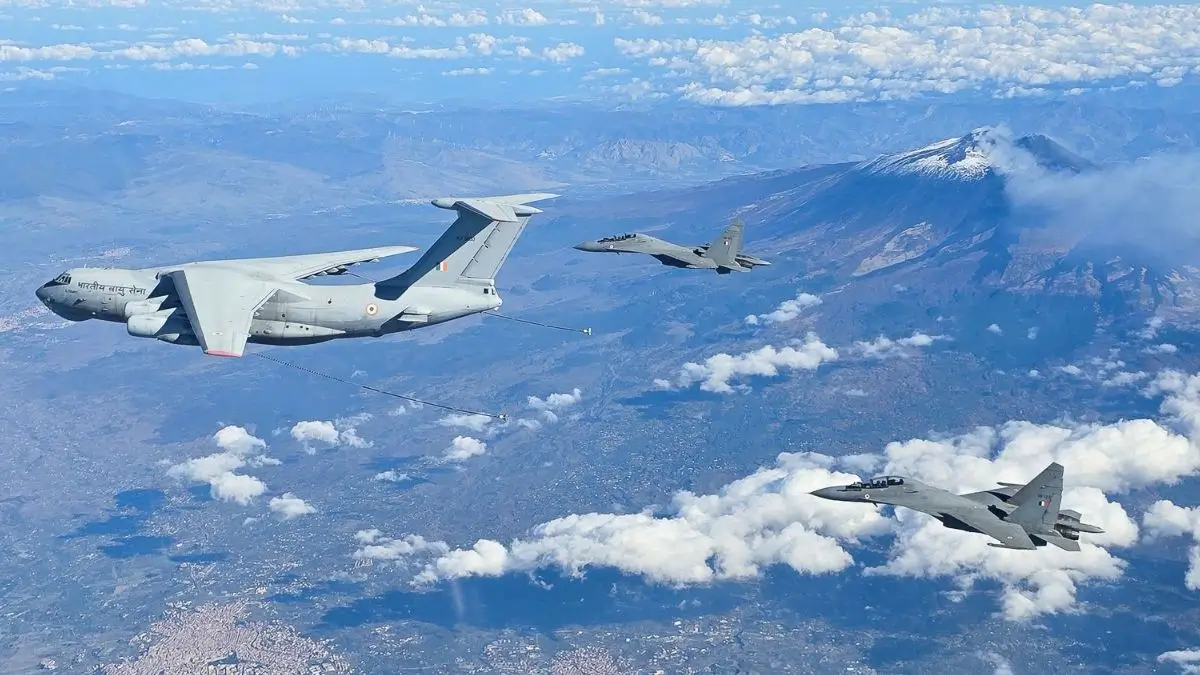
India has sent its Su-30MKI multirole fighter jets, which are capable of both air superiority and strike roles. The deployment is supported by:
- C-17 Globemaster III transport aircraft for induction and de-induction.
- IL-78 mid-air refuelling tankers, extending the operational endurance and reach of the Su-30MKIs.
Exercise Focus Areas
Garuda 25 is structured around realistic simulated combat scenarios. The drills include:
- Air-to-air engagements — dogfight-style combat.
- Air defence operations — defending against aerial threats.
- Joint strike missions — coordinated offensive missions involving both air forces.
These exercises are designed to mirror high-threat environments, pushing both air forces to test tactics, refine coordination, and operate jointly under complex conditions.
Interoperability & Learning
A major objective is to enhance interoperability — the ability of Indian and French air forces to operate together seamlessly. Through these drills, pilots, technical staff, and mission planners from both nations will exchange best practices, tactical doctrines, and operational philosophies. This professional exchange helps deepen mutual trust and builds a stronger defence partnership.
Strategic Significance
- Reinforces the India–France strategic defence relationship, which spans technology sharing, joint operations, and long-term military cooperation.
- Strengthens India’s air power projection capability, demonstrating that IAF can conduct long-range, complex missions abroad.
- Supports network-centric warfare doctrine by enabling both forces to integrate communications, mission planning, and real-time operations in a joint environment.

Why This News Is Important for Government Exam Aspirants
Strategic & Defence Perspective
For civil service exams (like UPSC) and defence-related roles, Garuda 25 shows how India is deepening military cooperation with a key European partner — France. This is not just about training: it’s a signal of strategic alignment, trust, and geopolitical partnership in an increasingly multipolar world.
Operational Readiness & Modernisation
The use of Su-30MKI jets and mid-air refuellers underlines India’s commitment to modern and long-range air operations. Students preparing for exams should note how India is enhancing its force projection and readiness.
Interoperability & Joint Doctrine
The exercise highlights interoperability — a critical concept in modern defence strategy. India is not only building its own capabilities but also ensuring it can operate seamlessly with other advanced air forces. For exam aspirants, especially those targeting jobs in defence or strategic affairs, understanding such joint exercises is key for current affairs.
Military Diplomacy
Exercises like Garuda 25 are important tools of defence diplomacy. They help build trust, share best practices, and foster cooperation — all relevant to international relations and security studies in civil service syllabus.
Relevance to National Security Questions
In exams, questions on India’s foreign policy, defence partnerships, and military readiness are common. Garuda 25 offers a concrete example of how India strengthens its ties through practical operational engagement, which can be used in essays, interviews, or Mains answers.
Historical Context: Background of Garuda & India–France Defence Ties
Origins of Exercise Garuda
- The Garuda bilateral air exercise between India and France began in 2003.
- It was conceived as a platform for both air forces to train together, exchange tactical doctrines, and build mutual confidence.
- Over the years, the exercise has alternated between Indian and French air bases.
Evolving India–France Defence Relationship
- India and France have maintained a strategic partnership that goes beyond defence — including technology cooperation, nuclear and space sectors.
- They engage in multiple bilateral exercises: air (Garuda), land (Shakti), and maritime (Varuna).
- Over decades, this cooperation has grown more sophisticated, moving from basic training to complex, networked joint operations.
Modern Significance
- In recent years, India has emphasized military diplomacy to secure its interests in the Indo-Pacific region.
- Exercises like Garuda 25 are part of this broader strategy — projecting power, building interoperability, and enhancing India’s global role.
- The participation of advanced aircraft and refuelling support in Garuda signals both countries’ commitment to high-end, realistic training.
Key Takeaways from This News (Garuda 25)
FAQs – Frequently Asked Questions
1. What is Exercise Garuda?
Exercise Garuda is a bilateral air exercise conducted between the Indian Air Force (IAF) and the French Air & Space Force to enhance interoperability, share best practices, and strengthen defence ties.
2. How many editions of Exercise Garuda have been held?
Garuda 25 is the 8th edition of the exercise.
3. Where is Garuda 25 being conducted?
It is being held at Mont-de-Marsan Air Base, a major operational base of the French Air & Space Force.
4. What aircraft has India deployed for Garuda 25?
India has sent Su-30MKI fighter jets, supported by C-17 Globemaster III for transport and IL-78 mid-air refuellers.
5. Why is mid-air refuelling important in military exercises?
Mid-air refuelling significantly increases an aircraft’s endurance, range, and capability to conduct long-duration missions without landing.
6. What are the main training areas covered in the exercise?
Training includes air-to-air combat, air defence operations, and joint strike missions simulating realistic battlefield conditions.
7. Why is Exercise Garuda important for India?
It strengthens India’s operational readiness, showcases long-range deployment capability, and enhances strategic military cooperation with France.
8. How does this exercise help exam aspirants?
Government exams often ask about India’s defence exercises, international relations, military diplomacy, and strategic partnerships—topics directly linked to Garuda 25.
9. When did India first participate in Exercise Garuda?
Exercise Garuda began in 2003, marking two decades of Indo-French air cooperation.
10. What broader defence ties exist between India and France?
Both countries engage in multiple bilateral exercises like Varuna (naval) and Shakti (army), along with cooperation in technology, aerospace, and strategic sectors.
Some Important Current Affairs Links