




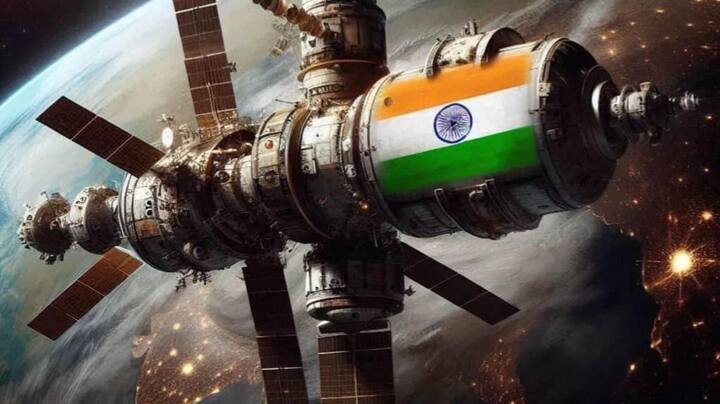
ISRO space station 2035 plan and India’s Moon mission by 2040 explained: Gaganyaan human spaceflight timeline, BAS-1 module, NGLV, SPADEX docking tech, and policy reforms (IN-SPACe) for exam-ready insights.
ISRO’s Bold Roadmap: Space Station by 2035, Moon Mission by 2040
India’s Next Galactic Leap
India’s space agency, ISRO, under the new chairperson V. Narayanan, has unveiled a transformative roadmap: launching its first Bharatiya Antariksha Station (space station) by 2035, followed by a crewed Moon mission aiming to land an Indian astronaut by 2040 The first module of the orbital laboratory is scheduled for a 2028 launch, paving the way for full deployment by 2035
Gaganyaan: India’s Trailblazer to Human Spaceflight
Preparations are ongoing for the Gaganyaan program, India’s inaugural human spaceflight initiative. Key milestones include:
- Human-rated LVM3 rocket, crew module, and escape system have undergone rigorous testing
- First uncrewed test flight (G1) is scheduled imminently
- Ground infrastructure, mission control, and training systems are being finalized
This foundational groundwork is essential not only for LEO missions but also for the long-duration stay aboard the specially designed space station.
Chandrayaan & Lunar Plans
ISRO plans to launch Chandrayaan-4, a sample-return mission in 2027, aiming to bring back extraterrestrial material from the lunar South PoleThe follow-up in the sequence is a crewed lunar landing by 2040, ultimately culminating in a Moon-orbiting station by the mid-2040s
Technological Strength for Future Missions
Infrastructure and technology development are in full swing:
- Next-Gen Launch Vehicle (NGLV) is under construction, featuring semi-cryogenic engines, methane-LOX propulsion, and partial reusability
- SPADEX mission launched two satellites to test docking technology—vital for station assembly
- International cooperation across 61 countries encompasses NASA-ISRO NISAR Earth observation, TRISHNA thermal imaging, and joint ventures with JAXA for lunar polar exploration
A Vision Across Competitive Exam Sectors
- Civil services/Defence: strategic and leadership significance of space infrastructure
- Banking/Economics: economic potential of space market expansion
- Railways/Teaching/Police: national prestige, scientific literacy, and civil awareness
- PCS/IAS: policy, governance frameworks, international cooperation

Why This News Matters
Strategic & Economic Importance
India’s space vision goes beyond prestige. It positions the country as a serious contender in the global multi-trillion-dollar space economy, expanding its market share from ~$8 bn to $44 bn, targeting $1 trn by 2030 Collaborations with global giants like NASA and CNES (France) enhance scientific diplomacy and economic potential.
Policy & Governance Highlights
Managing human spaceflight and orbital stations demands sophisticated policy frameworks. The shift from fully government-led missions to hybrid models—marked by IN-SPACe guidelines, private-sector funding, and international accords—reflects India’s emerging multi-stakeholder governance strategy
Technological Innovation
Advancements like reusable rockets, methane engines, and docking tech mark leaps in indigenous R&D—aligning India with the world’s leading space nations. These also fuel progress in high-end engineering, materials science, and software systems.
Educational & Career Impact
ISRO’s pipeline inspires STEM careers and supports skill development. The direct impact on aspirants across fields—from policy aspirants to technical exam takers—lies in understanding India’s trajectory in space, and how exam syllabi increasingly incorporate space science, international collaboration, and budgetary analysis.
Historical Context
ISRO’s Journey from PSLV to Moon Orbit
Founded in 1969, ISRO’s early success with PSLV paved the way for ambitious missions:
- Chandrayaan-1 (2008): India’s first Moon orbiter
- Mangalyaan (2014): Mars orbiter achieved on the first attempt
- Chandrayaan-3 (2023): Soft landing on lunar South Pole
Human Spaceflight & Space Station Tech
In 2019, ISRO announced the Bharatiya Antariksha Station plan, targeting deployment 5–7 years after Gaganyaan The SPADEX mission in 2024 validated docking tech. 2028 will see the launch of BAS-1, the first module—marking India’s ambition to sustain orbital human presence.
From Robotic Missions to Human and Planetary
The lunar roadmap is structured:
- Robot missions (Chandrayaan-4, 2027)
- Crewed Mission (Moon landing, 2040)
- Moon-orbiting station (mid-2040s)
This reflects an evolutionary progression in mission complexity and ambition.
Key Takeaways from ISRO’s Space Ambitions
| S. No. | Key Takeaway |
|---|---|
| 1 | India plans Bharatiya Antariksha Station in low-Earth orbit by 2035, with the first module launching in 2028 |
| 2 | Aiming for an Indian astronaut on the Moon by 2040, culminating in a lunar space station by the 2040s |
| 3 | Gaganyaan: First human spaceflight mission is under advanced preparation, with uncrewed tests nearing launch |
| 4 | Development of NGLV with semi-cryogenic, LOX‑methane propulsion, partial reusability—critical for future deep-space missions |
| 5 | Active international collaborations (NASA, JAXA, CNES), and private‑sector integration via IN‑SPACe, bolster India’s space capabilities |
FAQs (Exam-Oriented)
1. What is the targeted year for India’s own space station?
ISRO aims to deploy the Bharatiya Antariksha Station (BAS) by 2035.
2. By when does India plan to land an astronaut on the Moon?
The target year is 2040.
3. What is Gaganyaan?
Gaganyaan is India’s first human spaceflight mission, designed to send Indian astronauts (Vyomnauts) to Low Earth Orbit (LEO).
4. Which launch vehicle is being human-rated for Gaganyaan?
The LVM3 (Launch Vehicle Mark-3), previously known as GSLV Mk III.
5. What is NGLV and why is it important?
Next Generation Launch Vehicle (NGLV) is ISRO’s upcoming partially reusable rocket with semi-cryogenic / LOX–methane propulsion, aimed at cost-effective heavy-lift and deep-space missions.
6. What is BAS-1?
BAS-1 refers to the first module of the Bharatiya Antariksha Station, expected to be launched around 2028 as a pathfinder for the full station.
7. Which Indian mission is planned as a lunar sample-return?
Chandrayaan-4 is envisaged as a sample-return mission, tentatively planned for 2027.
8. What is SPADEX and why is it relevant to a space station?
SPADEX (Space Docking Experiment) is an ISRO tech-demonstration mission to validate autonomous docking, a critical capability for assembling and operating a space station.
9. What policy reform enables private sector participation in India’s space ecosystem?
The creation of IN-SPACe (Indian National Space Promotion and Authorization Centre) to facilitate and regulate private participation.
10. Name one major Indo-foreign collaboration relevant to Earth observation.
NASA–ISRO NISAR mission (a joint Earth observation satellite).
11. Which ISRO mission achieved a soft landing on the lunar south pole?
Chandrayaan-3 (2023).
12. How is human-rating different from normal launch vehicle qualification?
Human-rating imposes stricter safety, redundancy, reliability, and abort requirements to protect crew.
13. What are the strategic benefits of India’s space station for defence and civil services?
Enhanced strategic autonomy, situational awareness, technology leadership, and a platform for dual-use (civil & defence) technologies.
14. How does a national space station help India’s STEM ecosystem?
It accelerates R&D, enables microgravity experiments, fosters high-end manufacturing, and inspires workforce development.
15. What governance challenges accompany human spaceflight programs?
They demand robust regulatory frameworks, crew safety standards, international coordination, space debris mitigation, and sustainable funding models.
16. Why is a semi-cryogenic engine significant for ISRO?
It offers higher efficiency, lower cost, cleaner propellants, and supports reusability targets.
17. What is the likely orbit regime for the Bharatiya Antariksha Station?
Low Earth Orbit (LEO).
18. How does Chandrayaan-4 complement the 2040 crewed lunar mission?
It builds operational experience, tests complex sample-return technologies, and reduces risk for future crewed missions.
19. Which sectors in competitive exams should track ISRO’s roadmap closely?
Civil Services/PCS, Defence, Banking & Economy, Railways, Teaching, Police, and all science & tech oriented exams.
20. What is the broader economic target India is eyeing in the global space economy?
To significantly upscale its market share in the rapidly growing global space economy (often projected to reach trillions of dollars in the coming decades).
Some Important Current Affairs Links




