







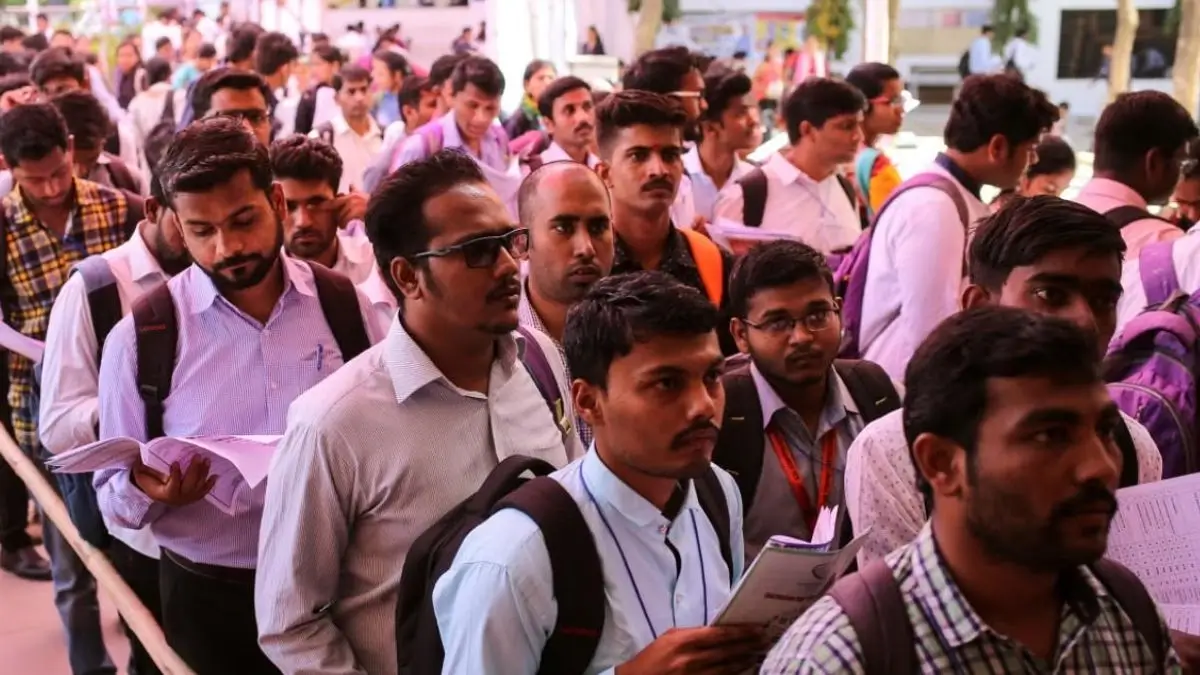
India unemployment rate 2025 reaches an eight-year low of 3.1% according to the latest PLFS report. Learn key highlights, labour force statistics, historical background, government initiatives, exam-focused analysis, FAQs, and MCQs for UPSC, SSC, Banking, Railways, Defence, Police, and State PSC exams.
India’s Labour Market Shows Positive Momentum
India has recorded its lowest unemployment rate in eight years, marking a significant milestone for the country’s labour market. According to the latest findings of the Periodic Labour Force Survey (PLFS), the unemployment rate among persons aged 15 years and above declined to 3.1% in 2025, compared with 3.2% in 2024 and 3.6% in 2022. The data reflects gradual improvements in employment opportunities, labour force participation, and wage growth across both rural and urban India.
What the Latest PLFS Data Reveals
The PLFS, conducted by the Ministry of Statistics and Programme Implementation (MoSPI), indicates that India’s labour market has continued to strengthen despite global economic uncertainties.
Key highlights include:
- Overall unemployment rate declined to 3.1%.
- Educated unemployment (secondary level and above) reduced from 7.0% in 2024 to 6.5% in 2025.
- Urban female unemployment also witnessed improvement.
- Labour Force Participation Rate (LFPR) and Worker Population Ratio (WPR) continued to improve, indicating greater workforce participation.
Rural Employment Continues to Remain Strong
The report highlights sustained employment generation in rural India. Agriculture, allied sectors, rural infrastructure projects, and government employment programmes have contributed to keeping rural unemployment relatively low.
Improved rural employment has also supported household incomes and consumption, helping strengthen the overall economy.
Urban Employment Also Improves
Urban labour markets showed gradual improvement as sectors such as manufacturing, construction, logistics, information technology, financial services, hospitality, and digital businesses expanded hiring.
Although urban unemployment remains relatively higher than rural unemployment, the gap has narrowed over the past few years.
Women’s Participation in the Workforce
One encouraging trend is the gradual rise in female labour force participation.
Government initiatives promoting skill development, entrepreneurship, self-help groups, digital employment, and financial inclusion have encouraged more women to enter the workforce.
However, experts believe that further policy support is necessary to improve quality employment for women, especially in urban areas.
Educated Unemployment Still Needs Attention
Despite the decline in unemployment, educated youth continue to face challenges.
Many graduates struggle because of:
- Skill mismatch
- Limited high-quality formal jobs
- Increasing competition
- Rapid technological changes
This makes skill development programmes and vocational education increasingly important.
Government Policies Supporting Employment
Several government initiatives have contributed to improving employment opportunities:
- Skill India Mission
- Digital India
- Make in India
- PM Gati Shakti
- Startup India
- Production Linked Incentive (PLI) Scheme
- Infrastructure expansion
- Rural employment programmes
These initiatives have created both direct and indirect employment opportunities across multiple sectors.
Impact on the Indian Economy
Lower unemployment generally leads to:
- Higher household income
- Increased consumer spending
- Better tax collections
- Stronger economic growth
- Improved investor confidence
A growing workforce also enhances India’s long-term economic potential.
Challenges That Still Remain
Despite positive trends, policymakers continue to face important challenges:
- Youth unemployment
- Quality of employment
- Informal sector dominance
- Regional disparities
- Automation and AI-related job transitions
- Skill mismatch between education and industry
Addressing these issues will remain critical for sustaining employment growth.
Importance for Government Examination Aspirants
This development is highly relevant for UPSC, State PSC, SSC, Banking, Railways, Defence, Police, Teaching, and other competitive examinations.
Students should remember:
- Periodic Labour Force Survey (PLFS)
- Ministry of Statistics and Programme Implementation (MoSPI)
- Labour Force Participation Rate (LFPR)
- Worker Population Ratio (WPR)
- Unemployment Rate (UR)
- Government employment initiatives
- Sustainable Development Goal (SDG) 8 – Decent Work and Economic Growth

B) Why this News is Important
Importance from an Economic Perspective
The decline in India’s unemployment rate represents an important indicator of improving economic health. Employment generation directly contributes to increased household income, stronger domestic demand, and higher productivity. Lower unemployment also signals better labour market conditions and greater economic resilience.
Importance for Government Examinations
Questions on unemployment, labour force participation, PLFS, employment indicators, and government schemes frequently appear in UPSC, State PSCs, SSC, Banking, Railways, and other competitive examinations.
Candidates should understand:
- Difference between unemployment rate and labour force participation rate.
- Role of MoSPI in labour statistics.
- Importance of PLFS.
- Employment-related government schemes.
- Sustainable Development Goals related to employment.
Importance for Public Policy
Employment remains one of India’s biggest policy priorities. A lower unemployment rate reflects positive policy outcomes but also highlights the continuing need to improve job quality, reduce educated unemployment, increase female participation, and create formal sector employment. Policymakers will continue focusing on inclusive and sustainable employment generation.
C) Historical Context
Evolution of Employment Surveys in India
Before 2017, India primarily relied on quinquennial employment surveys conducted by the National Sample Survey Office (NSSO). These surveys were not frequent enough to capture rapidly changing labour market conditions.
Introduction of the Periodic Labour Force Survey
The Periodic Labour Force Survey (PLFS) was introduced in 2017 by the Ministry of Statistics and Programme Implementation to provide annual and periodic labour market estimates. It has since become India’s primary official source of employment and unemployment statistics.
Impact of the COVID-19 Pandemic
The COVID-19 pandemic caused one of the sharpest employment disruptions in India’s history during 2020. Millions of workers, especially those in the informal sector, lost jobs due to lockdowns.
Subsequent economic recovery, government support measures, infrastructure investment, digital expansion, and manufacturing growth gradually improved employment conditions over the following years.
Current Labour Market Trends
The latest PLFS data indicates that India’s labour market has steadily recovered, with improving labour force participation, declining unemployment, and rising workforce participation across several sectors. However, policymakers continue to focus on creating high-quality jobs for educated youth and increasing women’s participation in the workforce.
D) Key Takeaways from This News
| S. No. | Key Takeaway |
|---|---|
| 1 | India’s unemployment rate declined to 3.1% in 2025, the lowest level in eight years. |
| 2 | The data has been released through the Periodic Labour Force Survey (PLFS) conducted by MoSPI. |
| 3 | Educated unemployment declined from 7.0% in 2024 to 6.5% in 2025. |
| 4 | Labour Force Participation Rate (LFPR) and Worker Population Ratio (WPR) showed continued improvement, indicating stronger workforce participation. |
| 5 | Employment generation remains a key priority under initiatives such as Skill India, Startup India, Digital India, Make in India, and infrastructure development programmes. |
Frequently Asked Questions (FAQs)
1. What is India’s unemployment rate according to the latest PLFS 2025 report?
According to the latest Periodic Labour Force Survey (PLFS) 2025, India’s unemployment rate among persons aged 15 years and above declined to 3.1%, the lowest level recorded in the last eight years.
2. Which organization conducts the Periodic Labour Force Survey (PLFS)?
The National Statistics Office (NSO) under the Ministry of Statistics and Programme Implementation (MoSPI) conducts the Periodic Labour Force Survey (PLFS).
3. What is the primary objective of the PLFS?
The PLFS aims to provide reliable and timely estimates on employment, unemployment, labour force participation, worker population ratio, and other labour market indicators across India.
4. When was the Periodic Labour Force Survey (PLFS) introduced?
The PLFS was introduced in 2017 to replace the earlier quinquennial Employment-Unemployment Surveys conducted by the National Sample Survey Office (NSSO).
5. What is the Labour Force Participation Rate (LFPR)?
Labour Force Participation Rate (LFPR) refers to the percentage of the working-age population that is either employed or actively seeking employment.
6. What is the Worker Population Ratio (WPR)?
The Worker Population Ratio (WPR) measures the percentage of the working-age population that is currently employed.
7. What is the difference between the unemployment rate and the Labour Force Participation Rate?
The unemployment rate measures the percentage of people in the labour force who are unemployed but actively seeking work, whereas the Labour Force Participation Rate measures the proportion of the working-age population participating in the labour market.
8. Which government schemes are contributing to employment generation in India?
Major employment-oriented initiatives include Skill India Mission, Startup India, Make in India, Digital India, PM Gati Shakti, Production Linked Incentive (PLI) Scheme, PMEGP, and MGNREGA.
9. Why is the decline in unemployment important for the Indian economy?
Lower unemployment increases household income, boosts consumer spending, improves tax revenues, enhances productivity, strengthens economic growth, and attracts greater domestic and foreign investment.
10. Why is this topic important for competitive examinations?
Questions related to PLFS, unemployment rate, LFPR, WPR, labour statistics, employment schemes, and economic indicators are frequently asked in UPSC, State PSC, SSC, Banking, Railways, Defence, Police, Teaching, and other government recruitment examinations.
Some Important Current Affairs Links