


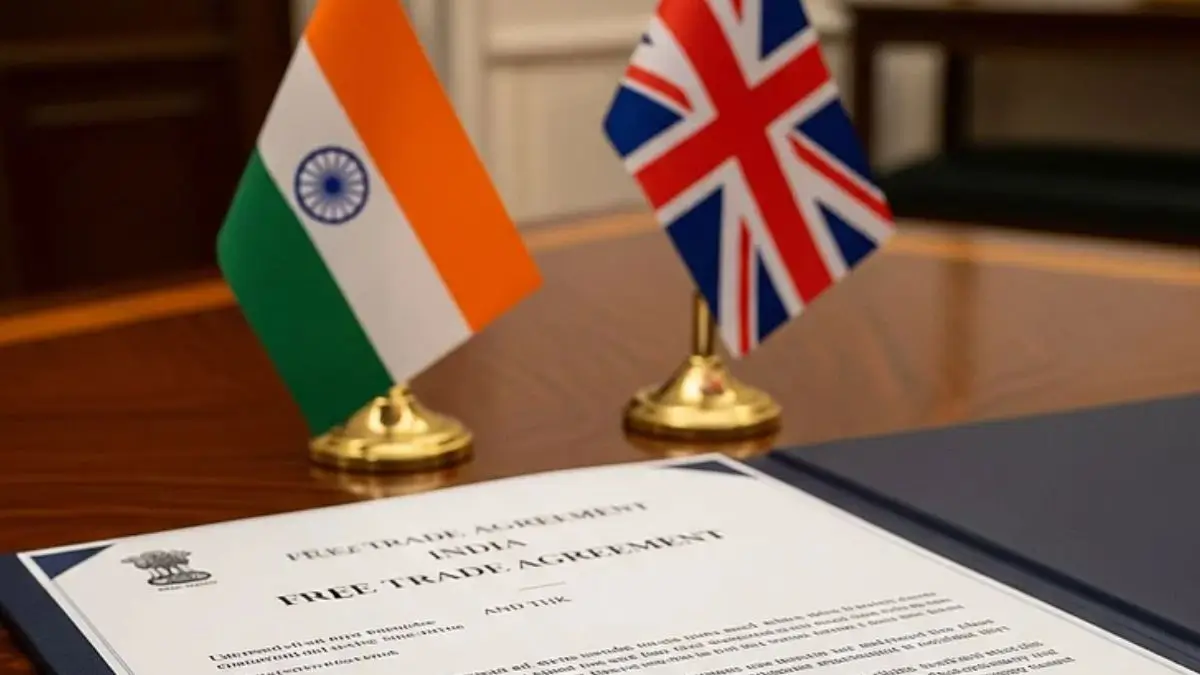
India UK Free Trade Agreement officially comes into effect with a bilateral trade target of USD 100 billion by 2030. Learn its key features, benefits, historical background, exam relevance, FAQs, and MCQs for UPSC, PCS, SSC, Banking, Railways, and Defence exams.
India and UK Enter a New Era of Economic Partnership
India and the United Kingdom have officially brought their landmark Free Trade Agreement (FTA) into force, marking a significant milestone in bilateral economic relations. The agreement is expected to strengthen trade, investment, employment, and strategic cooperation between the two countries. Both nations have set an ambitious goal of increasing bilateral trade to USD 100 billion by 2030, almost doubling the current trade volume. The agreement comes after several years of negotiations and is regarded as one of India’s most comprehensive trade pacts in recent years.
What is the India–UK Free Trade Agreement?
A Free Trade Agreement (FTA) is a pact between two countries that reduces or eliminates tariffs, customs duties, and other trade barriers on goods and services. The India–UK FTA aims to facilitate easier market access for businesses, promote investments, improve supply chains, and increase economic cooperation.
Under the agreement, a vast majority of Indian exports will enjoy duty-free access to the UK market, while India will gradually reduce tariffs on several British products over a phased period. This balanced approach seeks to benefit producers, exporters, consumers, and investors in both countries.
Major Benefits for Indian Exporters
The agreement is expected to significantly boost India’s exports in labour-intensive sectors such as textiles, leather products, footwear, gems and jewellery, engineering goods, marine products, pharmaceuticals, processed food, and chemicals. Reduced tariffs will make Indian products more competitive in the UK market, encouraging higher exports and greater employment generation.
Micro, Small and Medium Enterprises (MSMEs), which contribute substantially to India’s exports, are also expected to benefit from improved market access and lower trade costs.
Opportunities for Services and Professionals
Apart from trade in goods, the agreement enhances opportunities in services such as Information Technology (IT), financial services, education, legal services, and professional consulting. Indian professionals will benefit from easier mobility and improved access to the UK market under specific provisions included in the agreement.
The pact also includes social security arrangements that reduce the burden of double social security contributions for eligible short-term Indian workers in the UK, thereby lowering employment costs for businesses.
Benefits for UK Businesses and Indian Consumers
British companies will receive better market access in sectors including automobiles, financial services, insurance, education, and premium consumer products. Over time, Indian consumers may benefit from lower prices on imported products such as premium automobiles and certain consumer goods due to phased tariff reductions.
At the same time, India has protected several sensitive sectors by excluding specific products from tariff concessions, ensuring domestic industries remain safeguarded.
Strategic Importance Beyond Trade
The FTA reflects the growing strategic partnership between India and the UK. Besides expanding trade, it strengthens cooperation in technology, innovation, clean energy, education, and investment. The agreement also supports India’s objective of integrating more deeply into global value chains while promoting the ‘Make in India’ initiative.
As global supply chains continue to diversify, the agreement positions India as a reliable manufacturing and export hub while expanding business opportunities for companies in both countries.

B) Why this News is Important
Important for India’s Economy
The India–UK Free Trade Agreement is important because it is expected to substantially increase bilateral trade, boost exports, attract foreign investment, and create employment opportunities across multiple sectors. It also strengthens India’s position as an emerging global manufacturing and services hub.
Significant for Competitive Examinations
The agreement is highly relevant for UPSC, State PCS, Banking, SSC, Railways, Defence, and other government examinations. Questions may be asked on:
- Free Trade Agreements (FTAs)
- India’s international trade policy
- Bilateral relations between India and the UK
- Export promotion measures
- Economic diplomacy
- International organisations and global trade
Strengthening India’s Global Trade Strategy
The agreement demonstrates India’s increasing focus on expanding trade partnerships through bilateral agreements. It complements India’s broader strategy of enhancing exports, diversifying markets, and improving resilience against global economic uncertainties.
Students should understand the objectives, sectors benefiting from the agreement, and its long-term impact on India’s economic growth and foreign policy.
C) Historical Context
Evolution of India–UK Trade Relations
India and the United Kingdom have maintained strong economic ties since India’s independence. Over the decades, both countries have emerged as important trade and investment partners. Bilateral cooperation expanded significantly after the launch of the India–UK Roadmap 2030 and the Enhanced Trade Partnership in 2021.
Journey Towards the Free Trade Agreement
Formal negotiations for the India–UK Free Trade Agreement began in 2022. After multiple rounds of negotiations covering goods, services, investments, intellectual property, digital trade, labour mobility, and government procurement, the agreement was signed in 2025 and officially came into force on 15 July 2026 following ratification by both countries. The agreement is expected to play a major role in achieving the bilateral trade target of USD 100 billion by 2030.
D) Key Takeaways from “India–UK Free Trade Agreement”
| S. No. | Key Takeaway |
|---|---|
| 1 | The India–UK Free Trade Agreement officially came into effect on 15 July 2026. |
| 2 | India and the UK aim to increase bilateral trade to USD 100 billion by 2030. |
| 3 | Indian exporters will benefit from extensive duty-free access to the UK market across major sectors. |
| 4 | The agreement enhances opportunities for Indian professionals, services, MSMEs, and investments while expanding cooperation in multiple sectors. |
| 5 | The FTA is an important topic for UPSC, PCS, SSC, Banking, Railways, Defence, and other competitive examinations due to its economic and international relations significance. |
FAQs: India–UK Free Trade Agreement (FTA) 2026
1. What is the India–UK Free Trade Agreement (FTA)?
The India–UK Free Trade Agreement is a bilateral trade pact that aims to reduce or eliminate tariffs, improve market access, promote investments, and strengthen economic cooperation between India and the United Kingdom.
2. When did the India–UK Free Trade Agreement come into effect?
The agreement officially came into effect on 15 July 2026 after both countries completed their ratification process.
3. What is the bilateral trade target under the India–UK FTA?
India and the United Kingdom have set a target of increasing bilateral trade to USD 100 billion by 2030.
4. What is a Free Trade Agreement (FTA)?
A Free Trade Agreement is an agreement between two or more countries to reduce or eliminate customs duties, tariffs, and other barriers to trade in goods and services.
5. Which Indian sectors are expected to benefit the most from the FTA?
Major beneficiary sectors include:
- Textiles and garments
- Leather and footwear
- Gems and jewellery
- Pharmaceuticals
- Engineering goods
- Marine products
- Processed food
- Chemicals
- Information Technology (IT) services
6. How will Indian MSMEs benefit from the agreement?
The agreement provides better access to the UK market, reduces export costs, increases competitiveness, and creates new business opportunities for Micro, Small and Medium Enterprises (MSMEs).
7. How does the India–UK FTA help Indian professionals?
The agreement facilitates easier mobility for professionals in sectors such as IT, finance, education, and consulting. It also includes provisions related to social security contributions for eligible short-term workers.
8. Why is the India–UK FTA important for competitive examinations?
The agreement is important for UPSC, State PCS, SSC, Banking, Railways, Defence, CAPF, CDS, NDA, and other government examinations because it covers topics related to international trade, India’s foreign policy, bilateral relations, economic development, and trade agreements.
9. Which sectors have been protected by India under the FTA?
India has excluded or provided phased tariff reductions for several sensitive sectors to protect domestic industries while opening markets in a balanced manner.
10. Which ministry is primarily responsible for negotiating Free Trade Agreements in India?
The Ministry of Commerce and Industry, Government of India, is responsible for negotiating and implementing Free Trade Agreements on behalf of India.
Some Important Current Affairs Links




