








India launches heaviest comsat CMS-03 on LVM3-M5 rocket from Sriharikota on 2 November 2025. Learn about ISRO’s milestone mission, satellite details, strategic importance, and exam-relevant facts for UPSC, SSC, and defence aspirants.
India Achieves Milestone with Launch of Heaviest Comsat on LVM3-M5 Rocket
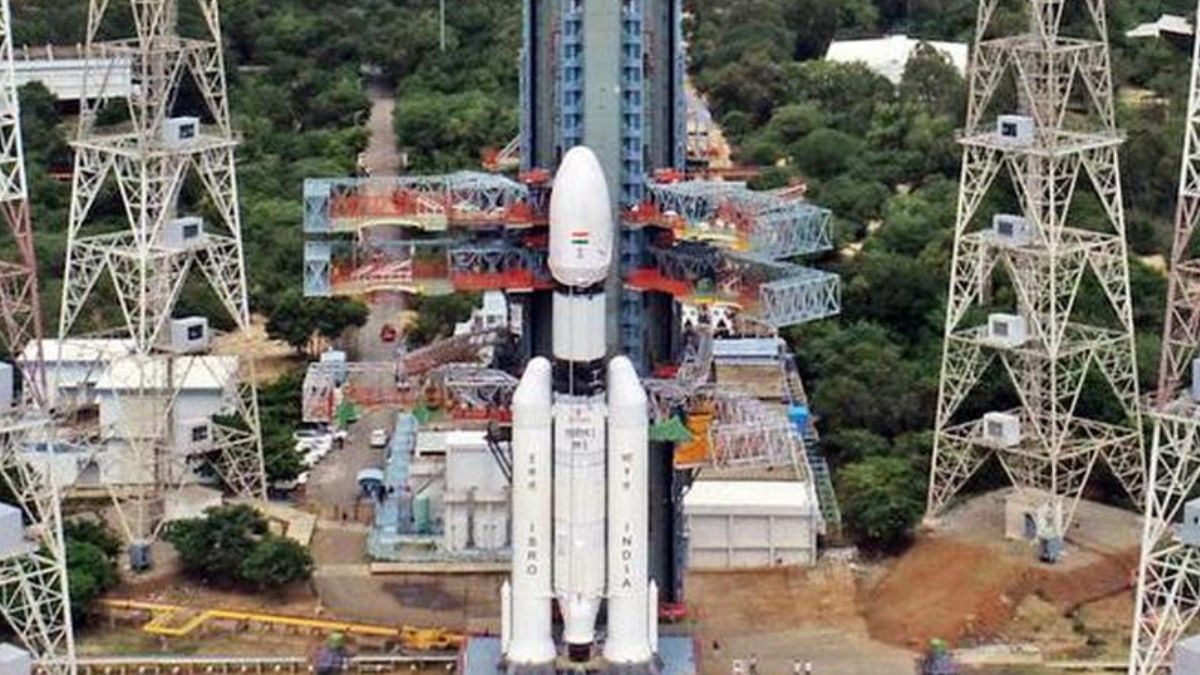
In a defining moment for India’s space ambitions, the Indian Space Research Organisation (ISRO) successfully launched the communication satellite CMS‑03 — the heaviest comsat ever placed into geosynchronous transfer orbit (GTO) from India — on 2 November 2025. The mission used the heavy-lift launch vehicle LVM3‑M5 (also referred to as GSLV-Mk3), lifting off from the Second Launch Pad at Satish Dhawan Space Centre, Sriharikota in Andhra Pradesh.
Mission Design and Execution
The CMS-03 satellite weighed approximately 4,410 kg and was placed into a GTO having an apogee of roughly 29,970 km and perigee near 170 km. The launch vehicle had a liftoff mass of 642 tonnes and stood 43.5 metres tall. The flight sequence involved ignition of the first stage solid boosters (S200) and successive staging of the liquid stage (L110) and cryogenic upper stage (C25) before satellite separation around 965.94 seconds after lift-off at an altitude of ~179.8 km.
Strategic Importance of the Launch
By placing such a heavy communication satellite into orbit using an indigenous launch vehicle, India has signalled a new degree of self-reliance in space launch capability. Historically, satellites of this mass class required reliance on foreign launch services. With the success of this mission, ISRO strengthens its standing in both civilian and strategic communications domains. Moreover, the LVM3-M5 platform, which has been used for earlier missions including lunar exploration and crew‐module tests, has demonstrated its capacity for heavier payloads.
What’s Next for India’s Space Programme?
Looking ahead, ISRO is planning further enhancements to its launch vehicle family. Among the upgrades mentioned are the introduction of a new cryogenic upper stage (C32) and a semi-cryogenic second stage (kerosene + liquid oxygen) which will significantly boost payload-to-orbit capability. A future launch vehicle module, the Lunar Module Launch Vehicle (LMLV), is being studied with estimates of lifting up to 80,000 kg to Low Earth Orbit (LEO), aligning with India’s ambitions for lunar and human spaceflight missions.
Implications for India’s Communication Infrastructure
CMS-03 is described as a multi-band communication satellite, designed to serve both civilian and strategic communication needs — including faster internet and data services, enhanced broadcast coverage, and support for remote region connectivity. The deployment of such a satellite enhances India’s own infrastructure and reduces reliance on foreign assets for critical communications.

Why This News Is Important
Empowering India’s Self-Reliance in Space
The successful launch of CMS-03 marks a major step in India’s journey toward indigenous space capability. For government exam aspirants — whether preparing for banking, railways, defence, teaching or civil services — understanding this milestone highlights India’s growing technological strength and vision for space. This news underlines key attributes often valued in examinations: national capability, innovation, and strategic autonomy.
Relevance Across Exam Sectors
From the perspective of defence and civil services, the ability to launch heavy communications satellites strengthens national security and technology leadership. For banking and economic sectors, it reflects investment in high-tech sectors and potential commercial spin-offs in satellite communications and broadband services. In railways or teaching domains, the expanded connectivity and digital infrastructure enabled by such missions link to themes of digital inclusion, technology in education, and infrastructure growth. Knowing such stories helps candidates to draw connections in current affairs, general studies and sector-specific contexts.
Exam-Relevant Theme of ‘Technology & Innovation’
Government examinations increasingly emphasise knowledge of technological developments, their national implications, and global context. This news offers a concrete example of India’s advanced space capabilities, helps support answers in essay or long-form descriptive questions, and provides a contemporary example to cite in general studies sections. Understanding the mission details, its significance, and future implications enhances both the content and analysis aspects of exam responses.
Historical Context
India’s journey in space-launch capabilities has evolved significantly since the early days. The ISRO’s LVM3 (formerly GSLV-Mk3) family was developed to provide heavy-lift launch capability from within India. Earlier, for very heavy satellites, India relied on foreign launch services. With missions like Chandrayaan‑3 (launched on LVM3 on 14 July 2023) and other operational flights, India built confidence in the LVM3 platform. The successful CMS-03 mission therefore continues this pattern of milestone launches.
Developments in cryogenic and semi-cryogenic stages have been central to ISRO’s capability growth — enabling higher payloads, more efficient launches, and greater orbit insertion precision. In parallel, India’s communications satellite fleet has grown to serve both civilian and strategic needs, underpinning digital services, broadcasting and connectivity in remote areas. This launch of CMS-03 thus stands on the shoulders of decades of research, engineering, policy support and strategic vision.
Key Takeaways from “India Launches Heaviest Comsat CMS-03 on LVM3-M5 Rocket”
| # | Key Takeaway |
|---|---|
| 1 | The satellite CMS-03 weighed approximately 4,410 kg — the heaviest communication satellite launched from India. |
| 2 | The launch vehicle was LVM3-M5 (GSLV-Mk3 class), with a liftoff mass of about 642 tonnes and height of 43.5 m. |
| 3 | The launch date was 2 November 2025 from the Second Launch Pad at Satish Dhawan Space Centre, Sriharikota. |
| 4 | The mission demonstrates India’s indigenous capacity to place heavy satellites into geosynchronous transfer orbit (GTO), reducing dependence on foreign launch services. |
| 5 | Future upgrades planned by ISRO include introduction of a C32 cryogenic upper stage and a semi-cryogenic second stage, paving the way for larger payloads, human spaceflight and lunar missions. |
FAQs: Frequently Asked Questions
1. What is the CMS-03 satellite?
CMS-03 is India’s heaviest communication satellite, weighing about 4,410 kg, launched by ISRO using the LVM3-M5 rocket. It aims to enhance India’s telecommunication, internet, and broadcasting services.
2. When was the CMS-03 satellite launched?
The CMS-03 was successfully launched on 2 November 2025 from the Satish Dhawan Space Centre (SDSC-SHAR) in Sriharikota, Andhra Pradesh.
3. What is the LVM3-M5 rocket?
LVM3-M5 (also known as GSLV-Mk3) is India’s most powerful three-stage heavy-lift launch vehicle capable of carrying payloads up to 4 tonnes to GTO and over 8 tonnes to LEO.
4. Why is this launch significant for India?
It marks India’s increasing self-reliance in space technology, enabling the country to independently launch heavy satellites without relying on foreign launchers, strengthening both civilian and defence communication systems.
5. What are the future upgrades planned for LVM3?
ISRO plans to introduce a C32 cryogenic upper stage and a semi-cryogenic second stage to improve payload capacity and prepare for future human spaceflight missions.
6. What is the orbit into which CMS-03 was placed?
The satellite was placed into a Geosynchronous Transfer Orbit (GTO) with a perigee of around 170 km and an apogee of about 29,970 km.
7. How does this launch benefit India’s communication infrastructure?
It enhances broadband connectivity, disaster management support, and digital communication for rural and remote regions, contributing to the Digital India initiative.
8. Which previous missions have used the LVM3 rocket?
Notable missions include Chandrayaan-2 (2019), Chandrayaan-3 (2023), and Gaganyaan test missions.
9. What does “CMS” stand for in the satellite’s name?
“CMS” stands for Communication Satellite, part of India’s series of advanced communication satellites replacing older INSAT and GSAT series.
10. How can this topic appear in government exams?
Questions can be framed under Science & Technology, Space Research, or Current Affairs sections of exams like UPSC, SSC, Banking, Defence, and State PSCs.
Some Important Current Affairs Links