








India Canada Security Pact Talks 2026 focus on GSOIA agreement and CEPA trade deal finalisation by 2026, boosting trade, security cooperation, and strategic relations between both nations.
India-Canada Strategic Engagement Gains Momentum
India and Canada have taken a significant step toward strengthening their bilateral relations by agreeing to launch negotiations on a General Security of Information Agreement (GSOIA) while simultaneously accelerating efforts to conclude a long-pending Comprehensive Economic Partnership Agreement (CEPA) by the end of 2026. The decision reflects a renewed strategic partnership between the two countries, focusing on trade, defence, energy, and security cooperation.
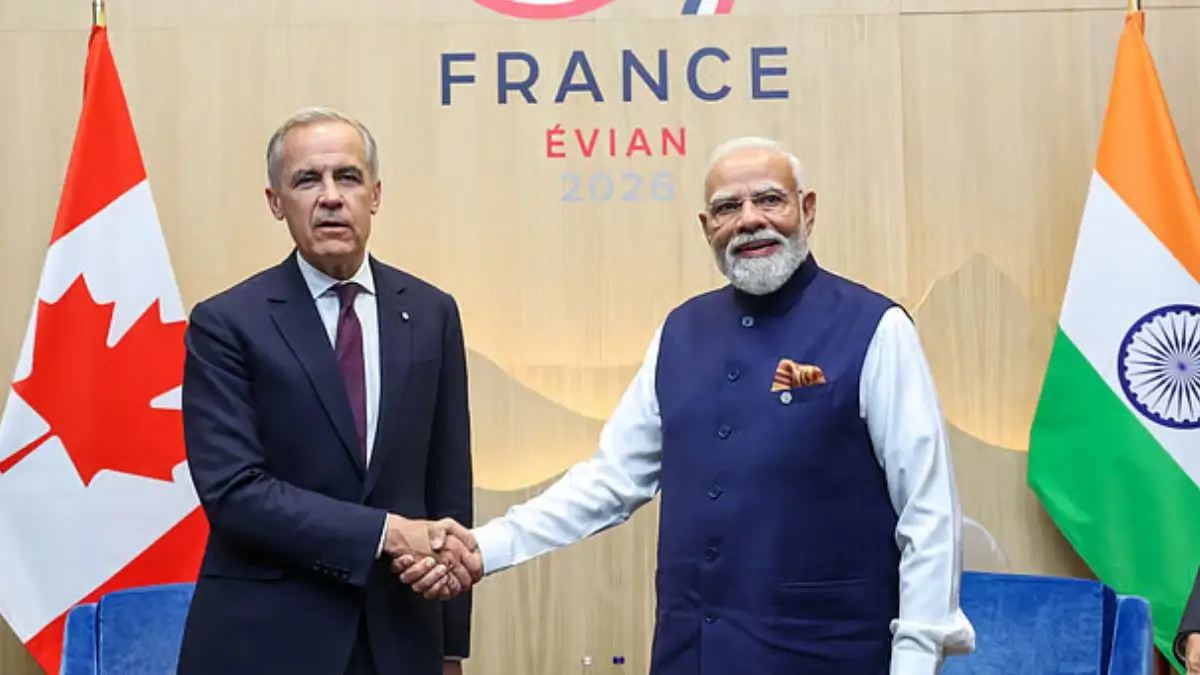
The development came after a high-level meeting between Prime Minister Narendra Modi and Canadian Prime Minister Mark Carney on the sidelines of the G7 Summit held in Evian-les-Bains, France. Both leaders reviewed the progress of bilateral relations and emphasized building a more stable and structured framework of cooperation.
Launch of Security Pact Talks (GSOIA)
One of the most important outcomes of the meeting is the decision to begin negotiations on the General Security of Information Agreement (GSOIA). This agreement is expected to improve intelligence sharing, strengthen national security cooperation, and enhance coordination in tackling transnational threats such as terrorism, cybercrime, and organized crime networks.
For India, this agreement is crucial as it expands security collaboration with a major G7 nation. For Canada, it provides stronger mechanisms to address security challenges linked to global networks and cross-border threats.
Progress on India-Canada CEPA Trade Agreement
Alongside security cooperation, both countries have reaffirmed their commitment to concluding the Comprehensive Economic Partnership Agreement (CEPA) by 2026. The proposed trade pact aims to significantly enhance bilateral trade and investment flows between India and Canada.
The CEPA is expected to:
- Reduce trade barriers
- Expand market access for goods and services
- Boost investment opportunities in key sectors such as clean energy, technology, and agriculture
- Strengthen supply chain integration between the two economies
This agreement is also seen as a key driver for increasing bilateral trade targets in the coming years.
Broader Strategic Cooperation
India and Canada also reviewed cooperation in multiple strategic areas, including:
- Defence collaboration
- Energy security partnerships
- Critical minerals supply chains
- Technology and innovation exchange
The discussions reflect a broader attempt to rebuild trust and deepen engagement after a period of diplomatic strain in recent years.

Why This News is Important
Strengthening India’s Global Strategic Position
The India-Canada security and trade negotiations are important for India’s expanding role in global geopolitics. As India strengthens ties with G7 nations, it enhances its strategic influence in international forums and global decision-making processes. The security pact also provides India access to improved intelligence-sharing mechanisms, which is critical for national security and counter-terrorism efforts.
Boost to Economic Growth and Trade Expansion
The CEPA agreement, once finalized, will play a major role in boosting India’s exports and attracting foreign investment. Canada is a key partner in sectors like education, energy, and technology. A structured trade agreement will help Indian businesses access North American markets more efficiently while creating new employment and investment opportunities.
Historical Context
India and Canada share a long-standing diplomatic relationship that has evolved over decades, primarily focused on trade, education, and diaspora connections. However, bilateral ties experienced significant strain in 2023 due to political and security-related disagreements, leading to suspension of certain negotiations.
In 2024–2025, both countries gradually resumed diplomatic engagement, focusing on rebuilding trust through structured dialogues. By early 2026, negotiations for CEPA were officially relaunched, marking a reset in bilateral relations.
The latest 2026 development at the G7 Summit represents a continuation of this normalization process, now extending cooperation into sensitive areas such as national security and intelligence sharing.
Key Takeaways from India-Canada Security Pact Talks 2026
| S. No. | Key Takeaway |
|---|---|
| 1 | India and Canada agreed to launch negotiations on a General Security of Information Agreement (GSOIA). |
| 2 | The pact aims to strengthen intelligence sharing and national security cooperation. |
| 3 | Both countries reaffirmed commitment to finalising CEPA trade agreement by 2026. |
| 4 | CEPA will focus on boosting trade, investment, and economic integration between both nations. |
| 5 | The talks were held during the G7 Summit meeting between PM Narendra Modi and PM Mark Carney. |
FAQs (Frequently Asked Questions)
Q1. What is the main objective of India and Canada’s latest talks?
The main objective is to strengthen bilateral relations through a security pact (GSOIA) and to finalise a Comprehensive Economic Partnership Agreement (CEPA) by 2026.
Q2. What is GSOIA in the India-Canada context?
GSOIA stands for General Security of Information Agreement, which facilitates secure exchange of classified information and enhances cooperation in intelligence and national security.
Q3. Why is CEPA important for India and Canada?
CEPA aims to boost trade, reduce tariffs, improve market access, and increase investment flows between both countries, benefiting sectors like technology, energy, and agriculture.
Q4. Where did the India-Canada leaders meet for these discussions?
The discussions were held on the sidelines of the G7 Summit in Evian-les-Bains, France.
Q5. How does this agreement impact India’s global position?
It strengthens India’s strategic partnerships with G7 nations, enhances security cooperation, and expands economic opportunities globally.
Q6. Which sectors are expected to benefit from India-Canada CEPA?
Key sectors include clean energy, information technology, agriculture, education, and critical minerals.
Q7. Has India-Canada relations improved recently?
Yes, after a period of diplomatic strain, both countries have resumed dialogue and are actively working toward rebuilding trust and cooperation.
Some Important Current Affairs Links