


Pradhan Mantri Surya Sarovar Yojana aims to develop 5000 MW floating solar capacity with a ₹5070 crore investment. Know objectives, benefits, features, and exam-relevant facts about PM-SSY for UPSC, PCS, Banking, Railways and other government exams.
Union Cabinet Launches a Major Floating Solar Initiative
The Union Cabinet has approved the Pradhan Mantri Surya Sarovar Yojana (PM-SSY), a landmark renewable energy initiative aimed at significantly increasing India’s floating solar power capacity. The scheme has a financial outlay of ₹5,070 crore and targets the installation of 5,000 MW of Floating Solar Photovoltaic (FSPV) capacity across reservoirs, lakes, dams, and other suitable water bodies in the country. The initiative represents another major step in India’s transition towards clean energy and energy security.
What is the Pradhan Mantri Surya Sarovar Yojana?
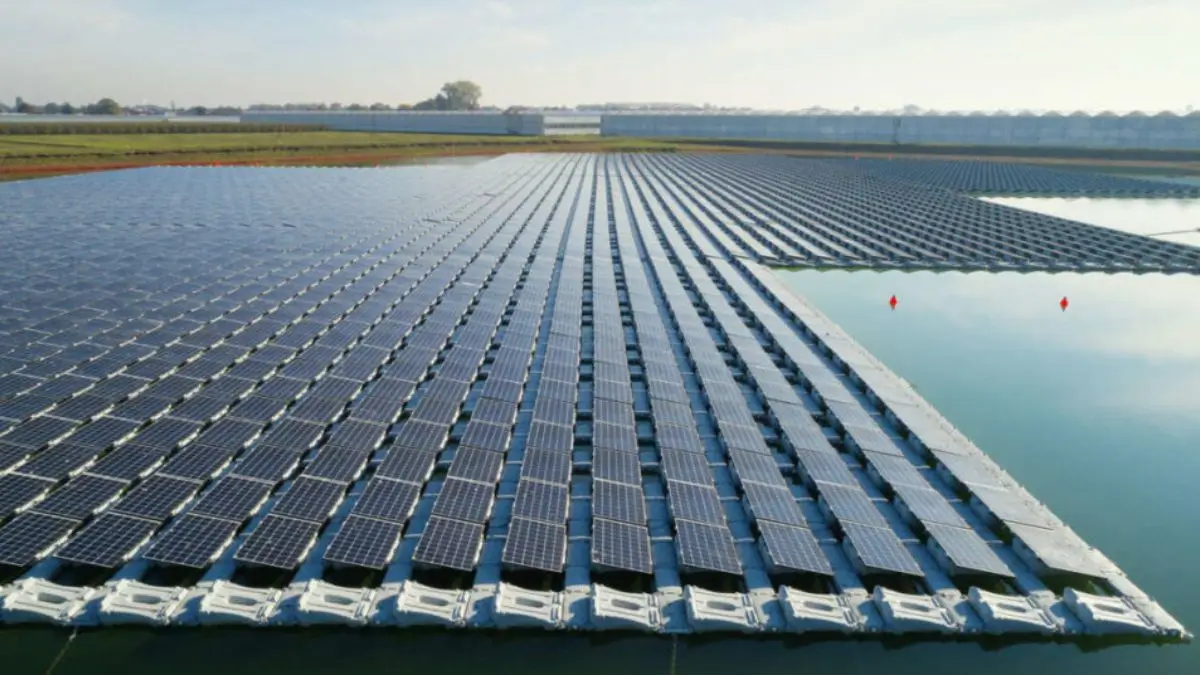
The PM-SSY is designed to promote the installation of solar panels on water bodies instead of agricultural or forest land. Floating solar plants utilize unused water surfaces to generate electricity, thereby reducing pressure on land resources. The scheme is expected to support India’s renewable energy targets while improving the efficient utilization of reservoirs and other water bodies.
Key Features of the Scheme
The government has allocated ₹5,070 crore to support the development of floating solar projects integrated with modern energy storage systems wherever feasible. The programme aims to develop 5,000 MW of floating solar capacity, contributing substantially to India’s renewable energy mix. These projects are expected to improve grid stability, reduce dependence on fossil fuels, and strengthen energy infrastructure.
Advantages of Floating Solar Power
Floating solar technology offers several environmental and economic benefits. Since solar panels are installed on water bodies, valuable land remains available for agriculture, industry, or conservation. Water beneath the panels naturally cools the photovoltaic modules, improving their efficiency and extending their operational life. Additionally, floating solar installations help reduce water evaporation from reservoirs, an important benefit for water conservation in drought-prone regions.
Contribution to India’s Renewable Energy Goals
India has committed to significantly expanding its renewable energy capacity to reduce greenhouse gas emissions and achieve long-term climate goals. The PM-SSY complements existing initiatives promoting rooftop solar, agricultural solar pumps, and decentralized renewable energy generation. By diversifying solar deployment through floating installations, India can utilize previously underused water resources while accelerating the clean energy transition.
Economic and Environmental Impact
The implementation of floating solar projects is expected to generate employment in engineering, construction, manufacturing, operation, and maintenance. Increased domestic renewable energy generation will reduce dependence on imported fossil fuels, strengthen energy security, and contribute to India’s green economy. The initiative also supports sustainable development by lowering carbon emissions and promoting environmentally responsible infrastructure.
Relevance for Government Exam Aspirants
The Pradhan Mantri Surya Sarovar Yojana is important for aspirants preparing for UPSC, State PCS, SSC, Banking, Railways, Defence, and teaching examinations. Questions may focus on the scheme’s objectives, budget allocation, target capacity, floating solar technology, renewable energy policies, climate commitments, and India’s clean energy initiatives. It is also relevant under topics such as Environment, Ecology, Economy, Government Schemes, Sustainable Development, and Science & Technology.

B) Why this News is Important
Strengthening India’s Renewable Energy Mission
The approval of the PM Surya Sarovar Yojana demonstrates India’s commitment to expanding renewable energy while addressing land constraints. Floating solar technology enables clean electricity generation without occupying cultivable land, making it an innovative solution for a densely populated country.
Important for Competitive Examinations
Government examinations frequently include questions on newly launched schemes, renewable energy targets, climate action, and sustainable infrastructure. Aspirants should remember the scheme’s ₹5,070 crore outlay, 5,000 MW target, and focus on floating solar photovoltaic projects. These facts are highly relevant for UPSC, State PCS, Banking, SSC, Railways, Defence, and teacher recruitment examinations.
Supports Climate and Energy Security Goals
The scheme supports India’s broader objective of reducing carbon emissions, increasing renewable energy capacity, improving energy security, conserving land resources, and utilizing water bodies efficiently. It also aligns with India’s commitments toward sustainable development and climate resilience.
C) Historical Context
Evolution of India’s Solar Energy Programme
India has steadily expanded its renewable energy sector through initiatives such as the National Solar Mission, PM-KUSUM for agricultural solarization, and PM Surya Ghar: Muft Bijli Yojana for rooftop solar installations. These programmes aim to diversify clean energy generation, reduce dependence on conventional fuels, and increase domestic electricity production.
Emergence of Floating Solar Technology
Floating solar power has gained global popularity because it overcomes land availability challenges while improving solar panel efficiency through natural cooling. Several Indian states have already implemented pilot floating solar projects on reservoirs and dams. The PM Surya Sarovar Yojana represents India’s largest national push to mainstream floating solar technology and integrate it into the country’s renewable energy strategy.
Key Takeaways from PM Surya Sarovar Yojana
| S. No. | Key Takeaway |
|---|---|
| 1 | Union Cabinet approved the Pradhan Mantri Surya Sarovar Yojana (PM-SSY). |
| 2 | Total financial outlay of the scheme is ₹5,070 crore. |
| 3 | The scheme targets installation of 5,000 MW of floating solar capacity. |
| 4 | Floating solar projects will utilize reservoirs and other water bodies, reducing pressure on land resources. |
| 5 | The initiative supports India’s renewable energy expansion, energy security, and climate goals. |
Frequently Asked Questions (FAQs) on Pradhan Mantri Surya Sarovar Yojana (PM-SSY)
1. What is the Pradhan Mantri Surya Sarovar Yojana (PM-SSY)?
The Pradhan Mantri Surya Sarovar Yojana (PM-SSY) is a government initiative approved by the Union Cabinet to promote floating solar power projects in India. The scheme focuses on installing solar panels on water bodies such as reservoirs, lakes, and dams to increase renewable energy generation.
2. What is the main objective of PM Surya Sarovar Yojana?
The primary objective of PM-SSY is to increase India’s floating solar energy capacity, promote clean energy generation, reduce dependence on fossil fuels, and utilize unused water surfaces for electricity production.
3. What is the total financial outlay of the PM Surya Sarovar Yojana?
The Union Cabinet has approved a financial allocation of ₹5,070 crore for implementing the Pradhan Mantri Surya Sarovar Yojana.
4. What is the target capacity under the PM-SSY scheme?
The scheme aims to establish 5,000 MW of Floating Solar Photovoltaic (FSPV) capacity across suitable water bodies in India.
5. What is floating solar power technology?
Floating solar power technology involves installing photovoltaic solar panels on floating structures placed on water bodies. These systems generate electricity without requiring large areas of land.
6. What are the major benefits of floating solar projects?
Floating solar projects help conserve land resources, reduce water evaporation, improve solar panel efficiency due to natural cooling from water, and support renewable energy generation.
7. Which ministry is responsible for renewable energy schemes in India?
The Ministry of New and Renewable Energy (MNRE) is the nodal ministry responsible for implementing renewable energy programmes and policies in India.
8. Why is floating solar energy important for India?
Floating solar energy is important because India faces challenges related to land availability. Water bodies provide an alternative space for solar installations while supporting India’s clean energy transition.
9. How is PM Surya Sarovar Yojana related to India’s climate goals?
The scheme supports India’s climate commitments by increasing renewable energy capacity, reducing greenhouse gas emissions, and promoting sustainable development.
10. Which government examinations can include questions related to PM-SSY?
Questions related to PM-SSY can appear in UPSC Civil Services, State PCS, SSC, Banking, Railways, Defence, Teaching Recruitment, and other government examinations under topics such as Government Schemes, Environment, Renewable Energy, and Science & Technology.
Some Important Current Affairs Links