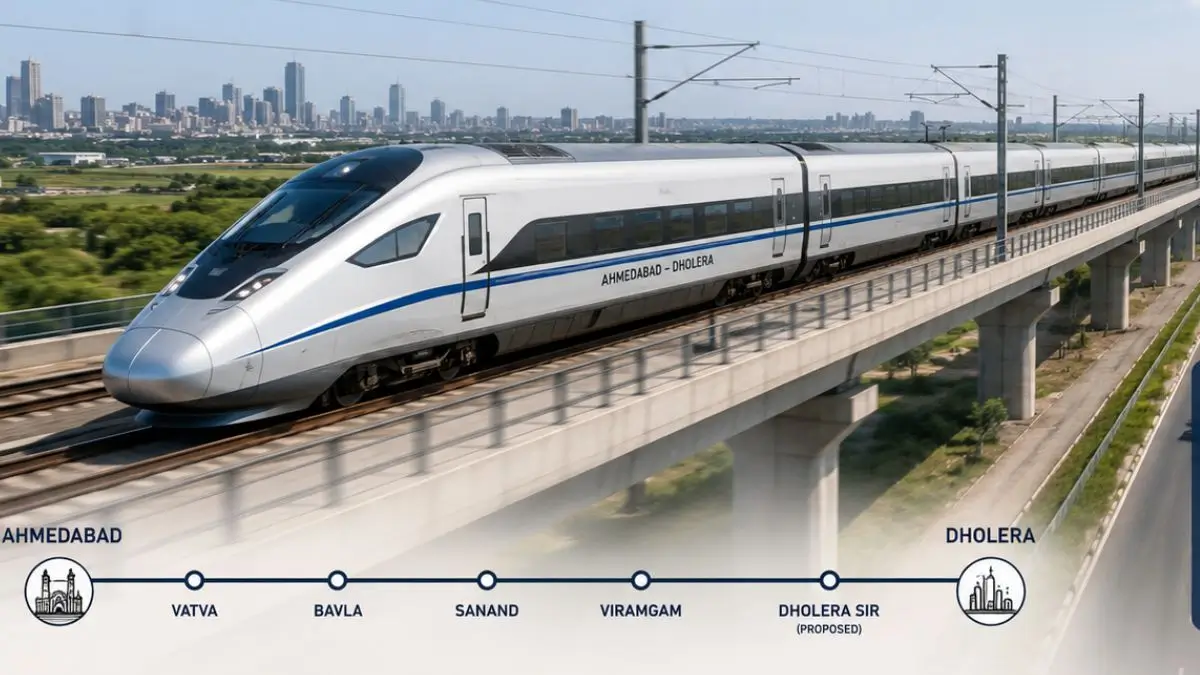
Ahmedabad Dholera Rail Project approved by the Union Cabinet with an investment of ₹20,667 crore. Know route details, speed, PM Gati Shakti connection, Dholera Smart City importance, MCQs, FAQs, and key exam points for UPSC, SSC, Banking, Railways, and PSC exams.
Introduction to the Mega Rail Corridor
The Union Cabinet has approved the Ahmedabad (Sarkhej)–Dholera Semi High-Speed Double Line Rail Project with an estimated investment of ₹20,667 crore. The ambitious railway project is being considered a landmark infrastructure initiative aimed at strengthening connectivity between Ahmedabad and the rapidly developing Dholera region in Gujarat.
The project has been approved by the Cabinet Committee on Economic Affairs (CCEA) chaired by Prime Minister Narendra Modi. It is expected to become India’s first indigenous semi high-speed rail corridor developed under the Namo Bharat framework.
Key Features of the Ahmedabad–Dholera Rail Project
The railway corridor will cover nearly 134 kilometers and will connect Sarkhej in Ahmedabad to Dholera Special Investment Region (SIR). The trains on this route are expected to run at speeds up to 220 kmph, while the operational speed may remain around 200 kmph.
The corridor will include around 13 stations and will significantly reduce travel time between Ahmedabad and Dholera. According to reports, travel between Sabarmati and Dholera may take only around 48 minutes after completion.
The project is expected to be completed by 2030–31 and will add nearly 134 km to the Indian Railways network in Gujarat.
Importance of Dholera Special Investment Region
The rail corridor is strategically important because it will connect major economic and industrial zones including the Dholera Special Investment Region, the upcoming Dholera International Airport, and the Lothal National Maritime Heritage Complex.
Dholera is being developed as one of India’s largest smart industrial cities under the Delhi–Mumbai Industrial Corridor (DMIC). The new rail project is expected to accelerate industrial development, improve logistics efficiency, and promote investment in manufacturing and infrastructure sectors.
The rail connectivity will also support freight movement and improve passenger transportation for businesses, workers, and tourists visiting the region.
Role of PM Gati Shakti National Master Plan
The Ahmedabad–Dholera project has been approved under the PM Gati Shakti National Master Plan, which aims to integrate roads, railways, airports, ports, and logistics systems into a unified infrastructure network.
The project is expected to create seamless multimodal connectivity in Gujarat and improve transportation efficiency across industrial corridors. It will also complement other major infrastructure projects like the Ahmedabad–Dholera Expressway.
Economic and Employment Benefits
The government expects the project to generate large-scale employment opportunities during both the construction and operational phases. The corridor will encourage industrial growth in the Dholera region and improve business opportunities for local communities.
The project will also benefit around 284 villages and nearly five lakh people by improving regional mobility and access to economic centers.
Apart from employment generation, the semi high-speed corridor is expected to reduce dependence on road transport and help lower carbon emissions and fuel consumption. Reports suggest the project could save large quantities of fuel and contribute to sustainable transportation goals.

Why This News is Important
Important for Infrastructure Development
The Ahmedabad–Sarkhej–Dholera Rail Project is important because it represents a major advancement in India’s railway modernization efforts. It is India’s first indigenous semi high-speed rail corridor and demonstrates the government’s push toward advanced transport infrastructure.
For competitive examinations, questions may be asked about the project cost, route length, operational speed, and associated industrial regions. Aspirants preparing for UPSC, SSC, Banking, Railways, and State PSC examinations should understand the significance of such infrastructure projects in economic development.
Important for Economic and Industrial Growth
The project is closely linked with the development of Dholera SIR, which is one of India’s most ambitious industrial smart city projects. Better rail connectivity is expected to attract industries, improve logistics, and increase investment opportunities in Gujarat.
The project also supports the objectives of PM Gati Shakti and Aatmanirbhar Bharat by using indigenous technology and integrated infrastructure planning. These government initiatives are frequently covered in government examinations.
Important from Environmental and Governance Perspective
The rail corridor promotes sustainable transportation by reducing travel time and encouraging people to shift from road to rail transport. It highlights the government’s focus on green infrastructure and efficient public transport systems.
The approval also reflects how large infrastructure decisions are taken through the Cabinet Committee on Economic Affairs, making it relevant for polity and governance sections in exams.
Historical Context
Development of Dholera Smart City
Dholera Special Investment Region was planned as part of the Delhi–Mumbai Industrial Corridor project to create a world-class manufacturing and smart industrial hub in Gujarat. Over the years, the government has invested heavily in roads, airports, logistics parks, and industrial infrastructure in the region.
The region has gained attention due to projects like the Dholera International Airport, semiconductor manufacturing plans, renewable energy investments, and industrial parks.
Earlier Connectivity Projects in the Region
Before the semi high-speed rail project, the government had already launched the Ahmedabad–Dholera Expressway to improve road connectivity between Ahmedabad and Dholera. The expressway forms an important component of the region’s infrastructure ecosystem.
The government has consistently focused on improving Gujarat’s transportation network through expressways, freight corridors, ports, and railway modernization initiatives.
Evolution of Semi High-Speed Rail in India
India has been gradually expanding its focus from conventional rail systems to semi high-speed and high-speed rail networks. Projects like the Vande Bharat trains and Mumbai–Ahmedabad Bullet Train reflect this modernization strategy.
The Ahmedabad–Dholera project becomes significant because it is India’s first semi high-speed corridor using indigenous technology under the Namo Bharat initiative.
Key Takeaways from Ahmedabad–Dholera Rail Project
| S.No. | Key Takeaway |
|---|---|
| 1 | Union Cabinet approved the Ahmedabad (Sarkhej)–Dholera Semi High-Speed Double Line Rail Project worth ₹20,667 crore. |
| 2 | The project will cover around 134 km and trains may run at speeds up to 220 kmph. |
| 3 | The corridor will connect Ahmedabad with Dholera SIR, Dholera Airport, and Lothal Maritime Heritage Complex. |
| 4 | The project is India’s first indigenous semi high-speed rail corridor under the Namo Bharat initiative. |
| 5 | The rail project is part of the PM Gati Shakti National Master Plan and aims to improve logistics, connectivity, and economic growth in Gujarat. |
FAQs on Ahmedabad–Sarkhej–Dholera Rail Project
1. What is the Ahmedabad–Sarkhej–Dholera Rail Project?
The Ahmedabad–Sarkhej–Dholera Rail Project is a semi high-speed double-line railway corridor approved by the Union Cabinet to improve connectivity between Ahmedabad and Dholera in Gujarat.
2. What is the total cost of the Ahmedabad–Dholera rail corridor?
The estimated cost of the project is around ₹20,667 crore.
3. What is the total length of the rail corridor?
The railway corridor will cover approximately 134 kilometers.
4. What will be the maximum speed of trains on this corridor?
The trains are expected to run at speeds up to 220 kmph, while operational speeds may remain around 200 kmph.
5. Which state will benefit from this rail project?
The project is located in Gujarat and will mainly benefit the Ahmedabad and Dholera regions.
6. Why is Dholera important for India?
Dholera is being developed as a major smart industrial city under the Delhi–Mumbai Industrial Corridor (DMIC) project.
7. Under which national initiative has the project been approved?
The project has been approved under the PM Gati Shakti National Master Plan.
8. What is special about this railway project?
It is considered India’s first indigenous semi high-speed rail corridor under the Namo Bharat framework.
9. Which important infrastructure projects will this rail corridor connect?
The corridor will connect Dholera Special Investment Region (SIR), Dholera International Airport, and the Lothal National Maritime Heritage Complex.
10. Why is this project important for competitive examinations?
The project is important for UPSC, SSC, Banking, Railways, Defence, and State PSC exams because it covers topics related to infrastructure, economic development, transportation, PM Gati Shakti, and smart cities.
Some Important Current Affairs Links