





Delhi Master Plan 2047 aims to transform the national capital through affordable housing, sustainable development, improved transport, environmental conservation and urban reforms.
A New Roadmap for Delhi’s Future Development
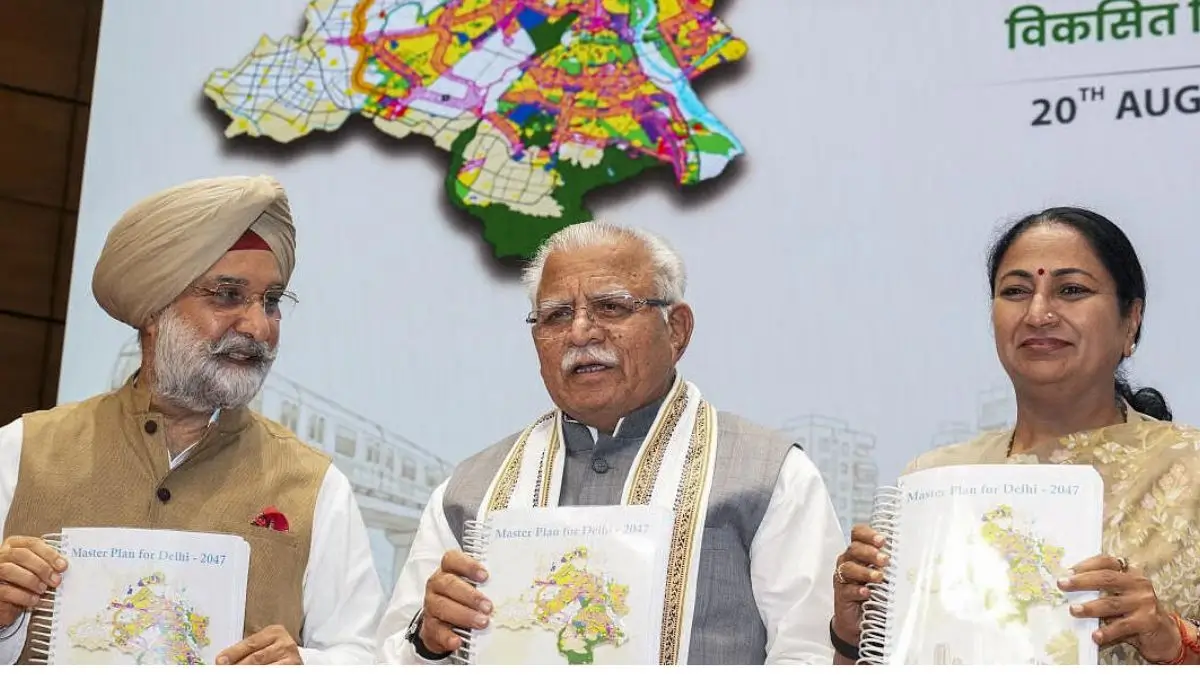
The Master Plan of Delhi-2047 has been unveiled as a long-term roadmap for shaping the future growth of the national capital. The plan aims to make Delhi more inclusive, sustainable, resilient and globally competitive by addressing major challenges related to housing, transportation, infrastructure, environmental protection and economic development.
The new urban planning framework focuses on preparing Delhi for future population growth while improving the quality of life for residents. It gives importance to affordable housing, redevelopment, better public transport, land pooling and environmental conservation. The plan was announced by Union Housing and Urban Affairs Minister Manohar Lal on August 20, 2026.
Major Focus on Housing Development
Housing is one of the most important components of the Delhi Master Plan 2047. The plan seeks to create around 40 lakh homes through a combination of affordable housing, redevelopment and new urban development initiatives.
Around 18 lakh affordable homes are proposed in Transit-Oriented Development zones along major metro corridors. The plan also aims to create about 7 lakh additional dwelling units through the redevelopment of group housing, Delhi Development Authority housing and government housing areas.
The needs of residents living in jhuggi-jhopri clusters have also received special attention. The plan aims to address the housing requirements of more than 17 lakh residents of such settlements. Rental housing is proposed for students, professionals, migrant workers and economically weaker communities. The initiative also supports the vision of providing permanent housing to eligible families living in informal settlements.
Land Pooling to Support Urban Expansion
The Land Pooling Policy has been given greater importance under the new master plan. The policy covers nearly 200 square kilometres of urbanisation area and is expected to facilitate the creation of around 12 lakh additional houses.
The proposed development is also expected to include a road network of approximately 600 kilometres. Under an infrastructure-first approach, major roads of 30 metres and above are expected to be developed before large-scale urban expansion.
High-Density Corridors are also proposed in selected land pooling areas. In certain pockets, the Floor Area Ratio may be increased up to 400 to support higher-density development and better utilisation of urban land.
Better Public Transport and Urban Mobility
Transit-Oriented Development is another major feature of the plan. The approach focuses on concentrating residential, commercial and other activities around public transport corridors. This can help create more connected neighbourhoods while reducing excessive dependence on private vehicles.
The plan proposes multimodal transit hubs connecting the Metro, Regional Rapid Transit System, buses, walking routes and cycling facilities. Improvements to UER-I, UER-II and UER-III have also been proposed.
A Unified Metropolitan Transport Authority is planned to improve coordination among different transport agencies. The master plan also proposes a unified approach to parking management and improved cycling infrastructure, including a 52-kilometre cycle track along the Yamuna floodplain.
Green Growth and Environmental Protection
Environmental sustainability has been placed at the centre of Delhi’s future development strategy. Around 1,700 hectares of the Yamuna floodplain are proposed to be developed through ecological restoration projects.
The plan promotes rooftop solar energy, rainwater harvesting, water recycling, waste-to-resource initiatives and green mobility. It also supports energy-efficient buildings and low-carbon urban development.
These measures are important because Delhi faces major environmental challenges, including air pollution, water stress, waste generation and the ecological pressure caused by rapid urbanisation.
Heritage Conservation and New Growth Centres
The Delhi Master Plan 2047 also gives importance to the protection of the city’s historical and cultural heritage. Around 1,500 heritage properties are proposed to be conserved with the support of Cultural Resource Management Plans.
Adaptive reuse of heritage structures may allow them to be used as museums, hotels, libraries and other cultural spaces while protecting their historical character.
The plan also identifies new centres of economic and educational growth. Narela is proposed as an educational growth centre, with 138 hectares designated for universities. Dwarka is being developed as an international gateway with proposed space for information technology companies, startups, data centres and industrial parks.
Reforms for Unauthorised Colonies and Urban Governance
The master plan proposes measures for buildings in 1,511 unauthorised colonies. The proposed approach is expected to improve security of ownership and provide greater planning certainty for millions of residents.
Regulatory reforms are also included to simplify urban development processes. The number of use premises is proposed to be reduced from 133 to 45, while greater use of online approvals is expected to support Ease of Doing Business and Ease of Living.
Overall, the Delhi Master Plan 2047 represents a major effort to balance population growth, economic development, housing requirements and environmental sustainability. For government exam aspirants, it is important because it connects with urbanisation, sustainable development, housing policy, transport planning, environmental conservation and public administration.

Why this News is Important
Important for Urbanisation and Governance Questions
The Delhi Master Plan 2047 is important for competitive examinations because urbanisation is a major issue in India’s development process. Delhi is one of the country’s largest metropolitan regions, and its future development policies can provide important examples of the challenges faced by rapidly growing cities.
Questions related to master plans, urban planning, affordable housing, redevelopment and metropolitan governance can be relevant for UPSC, State PCS and other civil service examinations. The topic can also be useful for SSC, railway, banking and general awareness examinations.
Link with Sustainable Development
The plan has a strong connection with sustainable urban development. Its proposals include ecological restoration, green mobility, solar energy, rainwater harvesting, water recycling and energy-efficient buildings.
These issues are connected with important examination topics such as climate action, environmental conservation, sustainable cities and resource management. Aspirants should understand how urban planning can help balance economic growth with environmental protection.
Relevance for Housing and Infrastructure Policy
The proposal to create around 40 lakh homes highlights the importance of housing in urban policy. Affordable housing, rental housing, redevelopment and the development of informal settlements are major governance concerns in large Indian cities.
The plan also demonstrates the importance of integrated infrastructure. Public transport, roads, cycling facilities, multimodal hubs and coordinated transport management are essential for reducing congestion and improving urban mobility.
Important for Prelims and Mains
For preliminary examinations, students should remember facts such as the target of 40 lakh homes, 1,511 unauthorised colonies, around 1,500 heritage properties and 1,700 hectares of Yamuna floodplain proposed for ecological restoration.
For mains examinations, the Delhi Master Plan 2047 can be used as an example while writing answers on urban planning, sustainable development, affordable housing, metropolitan governance, environmental conservation and infrastructure development.
Historical Context: Evolution of Delhi’s Urban Planning
The Need for Long-Term Planning in Delhi
Delhi has experienced rapid population growth and urban expansion over several decades. As the national capital, it faces enormous pressure on housing, transport, land, water resources and public infrastructure.
Long-term master plans have been used to guide the planned development of Delhi and address the challenges created by increasing population and economic activity.
Role of the Delhi Development Authority
The Delhi Development Authority has played a central role in the planning and development of Delhi. It has been involved in land development, housing projects, infrastructure planning and the implementation of development policies.
Over time, Delhi’s planning strategy has evolved to address issues such as unauthorised colonies, informal settlements, redevelopment and the need for improved public transportation.
Shift Towards Sustainable and Integrated Development
Modern urban planning increasingly focuses on sustainability rather than only physical expansion. Transit-Oriented Development, mixed land use, public transport, green infrastructure and ecological restoration are now important parts of urban development strategies.
The Delhi Master Plan 2047 reflects this changing approach by combining housing development with mobility, environmental conservation, heritage protection and economic growth.
Key Takeaways from Delhi Master Plan 2047
| S. No. | Key Takeaway |
|---|---|
| 1 | The Master Plan of Delhi-2047 aims to make Delhi more inclusive, sustainable, resilient and globally competitive. |
| 2 | The plan proposes the development of around 40 lakh homes through affordable housing, redevelopment and land pooling initiatives. |
| 3 | The Land Pooling Policy covers nearly 200 square kilometres and is expected to support the creation of around 12 lakh additional houses. |
| 4 | Major environmental proposals include ecological restoration of around 1,700 hectares of Yamuna floodplains, rooftop solar energy, rainwater harvesting and green mobility. |
| 5 | The plan proposes the conservation of around 1,500 heritage properties and reforms related to 1,511 unauthorised colonies. |
FAQs: Delhi Master Plan 2047
- What is the Delhi Master Plan 2047?
The Delhi Master Plan 2047 is a long-term urban development roadmap designed to guide the national capital’s growth in areas such as housing, transport, infrastructure, environment, heritage conservation and economic development. - What is the main objective of the Delhi Master Plan 2047?
Its main objective is to develop Delhi as a more inclusive, sustainable, resilient and globally competitive city. - How many homes are proposed under the Delhi Master Plan 2047?
The plan proposes the development of around 40 lakh homes through affordable housing, redevelopment and new urban development initiatives. - What is Transit-Oriented Development (TOD)?
Transit-Oriented Development is an urban planning approach that promotes high-density residential and commercial development around public transport systems such as Metro corridors. - What is the role of the Land Pooling Policy in the plan?
The Land Pooling Policy is expected to support urban expansion and facilitate the development of around 12 lakh additional houses. - Which area is proposed for ecological restoration under the plan?
Around 1,700 hectares of the Yamuna floodplain are proposed for ecological restoration and related environmental initiatives. - How many unauthorised colonies are covered under the proposed reforms?
The plan includes reforms concerning 1,511 unauthorised colonies. - What measures are proposed for improving urban mobility?
The plan focuses on multimodal transport hubs, Metro connectivity, RRTS integration, bus services, cycling infrastructure and improved road networks. - How many heritage properties are proposed for conservation?
Around 1,500 heritage properties are proposed to be conserved under the plan. - Why is the Delhi Master Plan 2047 important for competitive examinations?
It is relevant for questions related to urbanisation, sustainable development, affordable housing, environmental conservation, transport planning, infrastructure and public administration.
Some Important Current Affairs Links