









Chandrayaan-3 AIAA Goddard Astronautics Award 2026 highlights India’s historic lunar south pole landing by ISRO, marking global recognition in space exploration achievements.
Chandrayaan-3 Receives Global Recognition for Lunar South Pole Landing
🚀 Chandrayaan-3 Honoured with Prestigious International Space Award
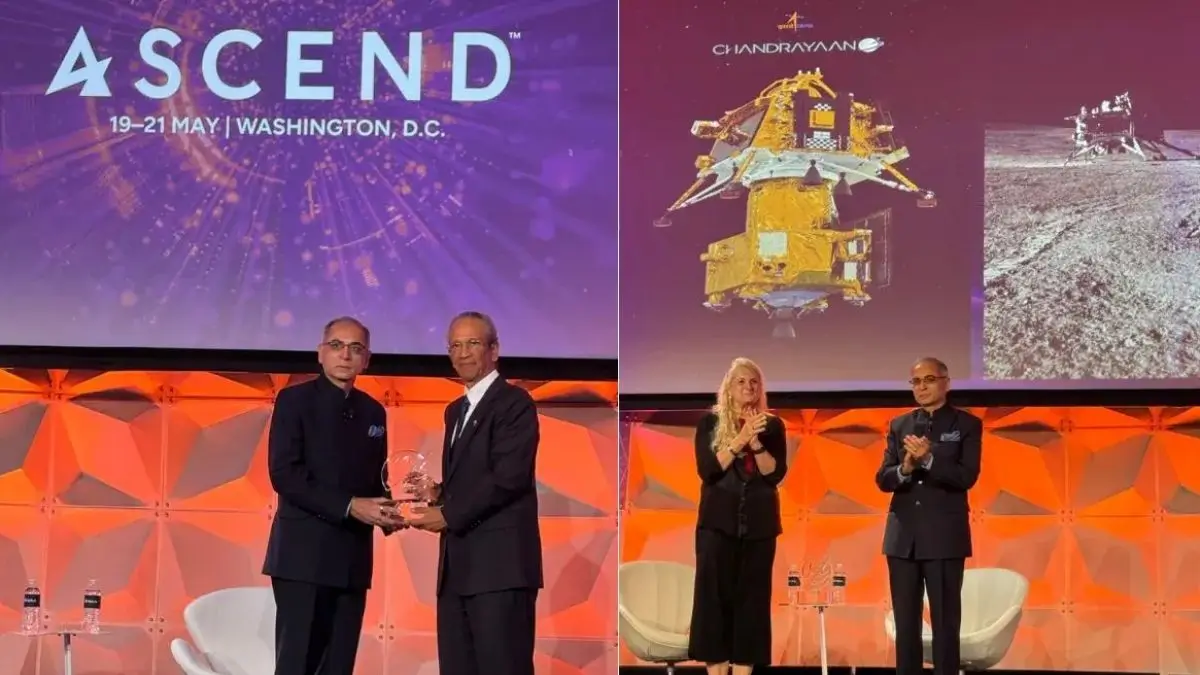
India’s historic lunar mission Chandrayaan-3, developed by the Indian Space Research Organisation (ISRO), has been awarded the 2026 AIAA Goddard Astronautics Award by the American Institute of Aeronautics and Astronautics (AIAA). The recognition was presented in Washington DC during the AIAA ASCEND 2026 Conference, marking a major global acknowledgment of India’s space capabilities.
The award is considered one of the highest honours in astronautics, given for outstanding achievements that significantly advance space exploration.
🌙 Historic Soft Landing Near Lunar South Pole
Chandrayaan-3 created history on August 23, 2023, when it successfully achieved a soft landing near the Moon’s south polar region—a location never explored by any previous mission. This region is scientifically important due to its potential presence of water ice and other key resources essential for future lunar exploration and human habitation.
The mission’s success made India the first country to land near the Moon’s south pole, strengthening its position in global space research.
🔬 Scientific Contribution and Mission Impact
The mission not only demonstrated landing capability but also delivered valuable scientific data from the lunar surface. Chandrayaan-3’s instruments helped in studying the Moon’s soil composition and identifying important chemical elements that could support future lunar missions.
These findings are crucial for upcoming deep-space missions and align with global efforts to establish sustainable lunar exploration programs.
🇮🇳 India’s Growing Space Leadership
With this award, ISRO’s reputation in global space research has further strengthened. The recognition highlights India’s progress in developing cost-effective yet highly successful space missions. The achievement also reflects India’s long-term vision for interplanetary exploration and human spaceflight programs.

📌 Why this News is Important
🌍 Global Recognition for India’s Space Program
The award places India among the top space-faring nations, recognizing Chandrayaan-3 as one of the most significant lunar missions in recent history. For students preparing for UPSC, SSC, Railways, Banking, Defence, and State PCS exams, this highlights India’s strategic importance in global science and technology.
🚀 Boost to Scientific Research and Innovation
The mission’s success encourages further advancements in robotics, satellite technology, and lunar exploration. It also supports India’s long-term goal of expanding its space economy and international collaborations.
🧠 Relevance for Competitive Exams
Questions based on ISRO missions, awards, and international recognition are frequently asked in current affairs sections. This topic is especially important for science, geography, and international organizations-related exam segments.
📜 Historical Context: India’s Lunar Missions Journey
India’s lunar exploration began with Chandrayaan-1 (2008), which confirmed the presence of water molecules on the Moon. This was followed by Chandrayaan-2 (2019), which aimed for a soft landing but faced partial success.
Building on these missions, Chandrayaan-3 (2023) achieved a historic breakthrough by successfully landing near the lunar south pole. This success marked a turning point in India’s space exploration journey, showcasing improved technology, mission planning, and execution by ISRO.
The 2026 AIAA Goddard Astronautics Award further validates India’s consistent progress in lunar research and exploration.
📊 Key Takeaways from Chandrayaan-3 Wins AIAA Goddard Award
| S. No. | Key Takeaway |
|---|---|
| 1 | Chandrayaan-3 received the 2026 AIAA Goddard Astronautics Award for its historic lunar mission. |
| 2 | The mission successfully achieved a soft landing near the Moon’s south pole on 23 August 2023. |
| 3 | It made India the first country to land in the lunar south polar region. |
| 4 | The mission provided important scientific data on lunar soil and surface composition. |
| 5 | The recognition highlights India’s growing leadership in global space exploration and technology innovation. |
FAQs on Chandrayaan-3 Wins 2026 AIAA Goddard Astronautics Award
1. What is the AIAA Goddard Astronautics Award?
It is one of the most prestigious international awards given by the American Institute of Aeronautics and Astronautics (AIAA) for outstanding achievements in astronautics and space exploration.
2. Why was Chandrayaan-3 awarded this honour?
Chandrayaan-3 received the award for its historic success in achieving a soft landing near the Moon’s south pole, a region never explored before.
3. When did Chandrayaan-3 land on the Moon?
Chandrayaan-3 successfully landed on the lunar surface on 23 August 2023.
4. Which organisation developed Chandrayaan-3?
The mission was developed by the Indian Space Research Organisation (ISRO).
5. What is the significance of the lunar south pole?
The lunar south pole is believed to contain water ice and important minerals, making it crucial for future human settlement and space exploration.
6. How does this award benefit India?
It strengthens India’s global space reputation and highlights ISRO’s capabilities in cost-effective and advanced space missions.
Some Important Current Affairs Links




