










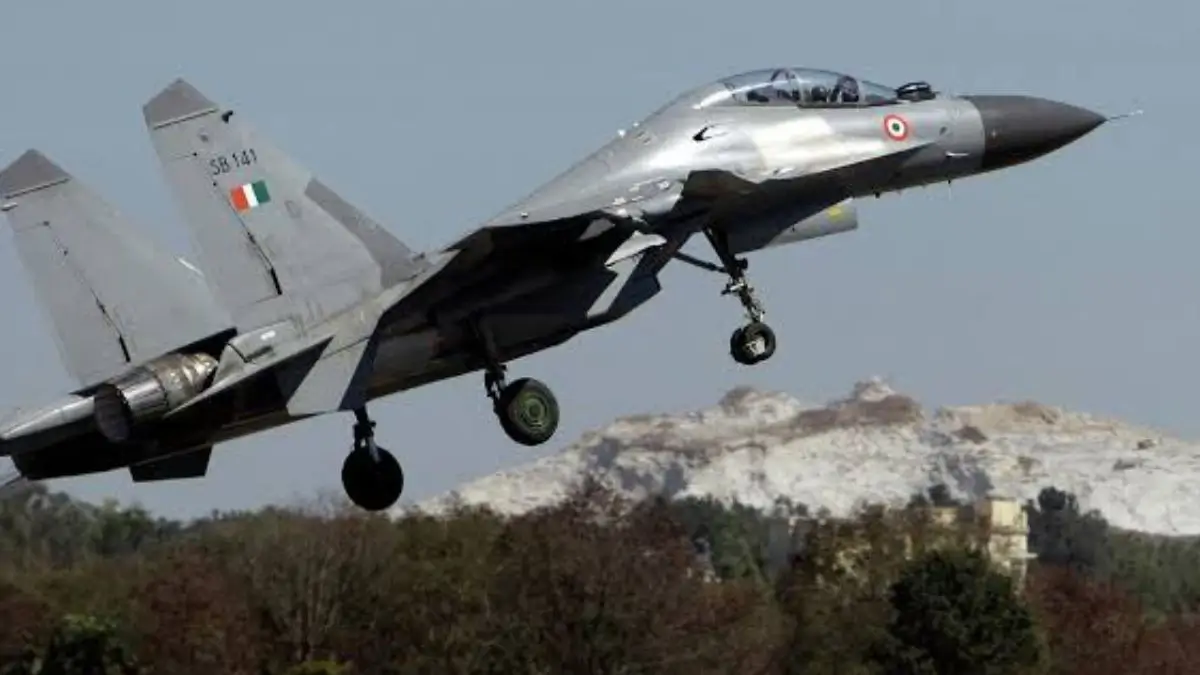
BrahMos missile Su-30MKI integration strengthens the Indian Air Force by equipping 40 fighter jets with advanced long-range precision strike capability. Learn key facts, significance, FAQs, MCQs, and exam-oriented insights for UPSC, SSC, Banking, Defence, Railways, and State PSC exams.
Indian Air Force Enhances Its Strategic Air Power
The Indian Air Force (IAF) has taken a significant step towards strengthening India’s military preparedness by equipping around 40 Sukhoi Su-30MKI fighter aircraft with the air-launched BrahMos supersonic cruise missile. This major capability upgrade enhances the IAF’s ability to carry out long-range precision strikes against strategic targets on land and at sea, improving the country’s conventional deterrence capability.
The integration of the BrahMos missile with the Su-30MKI fleet demonstrates India’s continued emphasis on modernising its armed forces and building a technologically advanced defence ecosystem.
BrahMos Missile Adds Powerful Strike Capability
The BrahMos is one of the world’s fastest operational supersonic cruise missiles. It is capable of travelling at nearly Mach 3, making it extremely difficult for enemy air defence systems to intercept. The missile is designed to accurately destroy high-value targets such as command centres, military installations, naval vessels, and critical infrastructure.
When launched from a Su-30MKI fighter aircraft, the BrahMos missile offers a significant stand-off attack capability. The aircraft can release the missile from a safe distance without entering heavily defended enemy airspace, reducing operational risks while increasing mission effectiveness.
Su-30MKI Remains the Backbone of the Indian Air Force
The Sukhoi Su-30MKI is the Indian Air Force’s premier multirole fighter aircraft. Developed with advanced avionics, long operational range, and superior manoeuvrability, the aircraft is capable of performing air superiority, ground attack, reconnaissance, and maritime strike missions.
Its ability to carry heavy payloads makes it an ideal platform for the air-launched BrahMos missile. The combination creates one of the most potent air strike systems available in the region.
Strategic Importance for India’s National Security
The deployment of BrahMos-equipped Su-30MKI fighter jets significantly strengthens India’s strategic reach across multiple theatres of operation. It enables the Air Force to respond rapidly to emerging security challenges while maintaining a credible deterrence against hostile forces.
The upgraded aircraft are capable of conducting precision strikes on both land and maritime targets, thereby enhancing India’s preparedness in the Indian Ocean Region and along sensitive border areas.

Indigenous Defence Manufacturing Receives a Boost
The successful integration of the BrahMos missile highlights India’s progress towards defence self-reliance. BrahMos Aerospace, a joint venture between the Defence Research and Development Organisation (DRDO) and Russia’s NPO Mashinostroyeniya, has played a crucial role in developing this advanced missile system.
The programme also supports the Government of India’s vision of promoting indigenous defence manufacturing under the broader objective of strengthening domestic defence capabilities.
Relevance for Competitive Examinations
This development is highly important for aspirants preparing for UPSC Civil Services, CDS, NDA, CAPF, SSC, Banking, Railways, State PSCs, and various defence examinations. Questions related to India’s defence modernisation, missile systems, DRDO, Indian Air Force capabilities, and India-Russia defence cooperation frequently appear in competitive examinations.
Candidates should remember that the BrahMos is a supersonic cruise missile, the Su-30MKI is the launch platform, and the integration significantly enhances India’s long-range precision strike capability.
Conclusion
The integration of BrahMos missiles with approximately 40 Sukhoi Su-30MKI fighter jets marks another milestone in India’s defence modernisation programme. By combining one of the world’s fastest cruise missiles with one of its most capable fighter aircraft, the Indian Air Force has substantially improved its long-range strike capability, operational flexibility, and strategic deterrence. This achievement reflects India’s commitment to strengthening national security while advancing indigenous defence technology and military preparedness.
Frequently Asked Questions (FAQs)
1. Why has the Indian Air Force equipped Su-30MKI fighter jets with BrahMos missiles?
The integration significantly enhances the Indian Air Force’s long-range precision strike capability, allowing it to engage high-value land and sea targets from stand-off distances while improving deterrence against potential adversaries.
2. What is the BrahMos missile?
BrahMos is a supersonic cruise missile jointly developed by India and Russia. It is capable of being launched from land, sea, air, and submarine platforms and is known for its high speed, precision, and versatility.
3. What is the significance of the Su-30MKI in the Indian Air Force?
The Su-30MKI is India’s primary air superiority fighter. It is a multirole combat aircraft capable of carrying advanced weapons, conducting long-range missions, and performing both offensive and defensive operations.
4. Which organizations developed the BrahMos missile?
The missile was developed by BrahMos Aerospace, a joint venture between India’s Defence Research and Development Organisation (DRDO) and Russia’s NPO Mashinostroyeniya.
5. What is the approximate speed of the BrahMos missile?
The BrahMos missile travels at approximately Mach 2.8 to Mach 3, making it one of the fastest operational cruise missiles in the world.
6. Why is the BrahMos missile important for India’s defence strategy?
Its high speed, accuracy, and long-range strike capability strengthen India’s conventional deterrence and provide rapid-response options during military operations.
7. How many Su-30MKI aircraft are being equipped with BrahMos missiles?
According to recent reports, around 40 Su-30MKI fighter aircraft are being equipped with the air-launched BrahMos missile.
8. Which government examination topics are related to this news?
The news is relevant for Defence and Security, Science & Technology, International Relations, Current Affairs, DRDO, Indian Air Force, and India’s indigenous defence manufacturing.
9. What is the difference between a cruise missile and a ballistic missile?
A cruise missile flies at relatively low altitude using jet propulsion throughout its flight, while a ballistic missile follows a high-arching trajectory after its powered launch phase.
10. Why is this development important for UPSC and other government exams?
Questions related to India’s defence capabilities, indigenous military technology, DRDO projects, strategic partnerships, and national security frequently appear in UPSC, CDS, CAPF, NDA, SSC, Banking, State PSCs, and Defence recruitment examinations.
Some Important Current Affairs Links




