









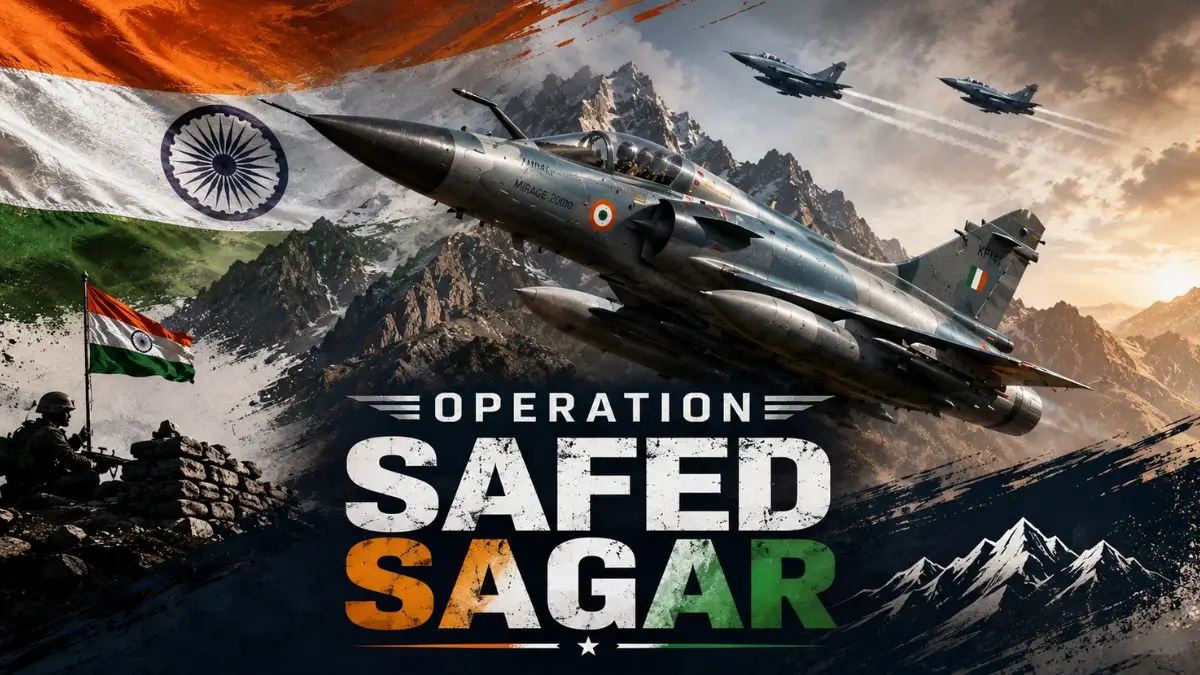
Operation Safed Sagar Kargil War explains the Indian Air Force’s 1999 air campaign, Mirage 2000 strikes, high-altitude challenges, Operation Vijay and key defence lessons for government exams.
Operation Safed Sagar and the Kargil War
Operation Safed Sagar was the codename given to the Indian Air Force’s air campaign during the 1999 Kargil War. It was conducted in support of the Indian Army’s broader Operation Vijay, which aimed to evict Pakistani forces and armed infiltrators from Indian positions along the Line of Control (LoC). The operation became an important chapter in India’s military history because it demonstrated how air power could be effectively employed in extremely difficult high-altitude terrain.
Background to Operation Safed Sagar
The Kargil conflict began after Pakistani soldiers and irregular forces occupied strategically important heights on the Indian side of the LoC during the winter of 1998–99. The intruders occupied positions overlooking important routes and created a serious military challenge for India. The Indian Army launched Operation Vijay to recapture the occupied positions, while the Indian Air Force was subsequently brought into the campaign to provide aerial support.
IAF Enters the Kargil Battlefield
The Indian Air Force commenced air operations in the Kargil sector in May 1999. Operation Safed Sagar involved attacking enemy positions, providing close air support and assisting ground forces in their effort to regain strategically important heights. The mission was particularly challenging because most targets were located at altitudes of around 14,000 feet or higher, where thin air, steep mountains and unpredictable weather affected aircraft performance and weapons employment.
High-Altitude Warfare Created Unique Challenges
Unlike conventional warfare over plains, the Kargil battlefield presented extraordinary difficulties for air operations. Enemy positions were located on mountain ridges and peaks, often above the attacking aircraft’s approach level. Pilots had to identify targets accurately while avoiding civilian areas and ensuring that strikes remained on the Indian side of the LoC. The mountainous terrain also restricted attack angles and made conventional bombing extremely difficult.
Mirage 2000 Played a Crucial Role
One of the most significant aircraft deployed during Operation Safed Sagar was the Mirage 2000. Its capabilities and precision-strike role proved particularly valuable against fortified positions in the mountains. The aircraft was used for accurate attacks on important enemy locations, demonstrating the growing importance of precision-guided air power in modern warfare.
Precision Strikes Changed the Battlefield
Operation Safed Sagar highlighted the importance of accurate targeting in air warfare. The Indian Air Force employed precision weapons against selected enemy positions, reducing the requirement for repeated attacks and helping ground troops advance against strongly defended heights. The successful use of precision strikes during the conflict later contributed to discussions about improving India’s precision-guided weapon capabilities and modernising its air fleet.
Coordination Between Army and Air Force
A major lesson of Operation Safed Sagar was the importance of coordination between air and ground forces. The Indian Army was engaged in physically recapturing mountain positions, while the Air Force provided aerial support against enemy positions. This coordination helped weaken defensive locations and assisted ground troops during difficult assaults. The operation therefore remains an important example of joint military operations.
India Maintained Restraint Along the LoC
One of the defining features of the Indian air campaign was the political and military decision to respect the Line of Control. The IAF was tasked with attacking positions within the operational area without crossing the LoC. This imposed additional constraints on pilots but also demonstrated India’s effort to contain the conflict geographically and prevent its escalation into a wider war. The restraint became an important element of India’s diplomatic position during the conflict.
Role in Turning the Tide of the War
Air operations significantly increased the pressure on Pakistani positions. Along with artillery and infantry operations, aerial attacks helped disrupt enemy defences and contributed to the eventual recapture of important heights. Operation Safed Sagar thus became an important force multiplier for Operation Vijay and demonstrated the value of integrating air power with ground operations.
Kargil War and the Road to Victory
The Indian Armed Forces gradually recaptured occupied positions during the conflict. Major battles were fought in areas such as Tololing, Drass and Tiger Hill. By July 1999, Indian forces had regained most of the strategically important positions. The conflict formally ended with India’s victory on July 26, 1999, a date subsequently observed as Kargil Vijay Diwas.
Strategic Lessons for India
The Kargil conflict exposed gaps in India’s intelligence, surveillance, reconnaissance and defence preparedness. The experience encouraged reforms in national security and military coordination. The Kargil Review Committee was established after the war to examine the circumstances that led to the conflict and recommend measures to strengthen national security.
Long-Term Impact on Indian Air Power
Operation Safed Sagar also influenced the modernisation of the Indian Air Force. The conflict reinforced the importance of precision-guided weapons, improved surveillance, advanced navigation systems and capabilities suited for high-altitude warfare. The lessons of Kargil became part of India’s broader effort to develop a more technologically capable and integrated military.
Importance for Government Exams
For candidates preparing for UPSC, State PCS, CDS, AFCAT, NDA, CAPF, police and other government examinations, Operation Safed Sagar is important under defence studies, modern Indian history, national security and international relations. Aspirants should remember that Operation Safed Sagar was the IAF’s air campaign during the Kargil War, while Operation Vijay was the broader Indian military operation to recapture occupied territory. The distinction between these two operations is particularly relevant for objective-type examinations.

Why This News Is Important
Understanding India’s Air Power
Operation Safed Sagar is important because it represents a landmark episode in the use of air power in high-altitude warfare. The operation demonstrated that air forces could support ground troops even when battlefield conditions were extremely difficult. For defence-related examinations, it provides an important example of the operational value of air superiority, precision strikes and close coordination between military branches.
Significance of Joint Operations
The Kargil conflict highlighted the importance of cooperation between the Indian Army and Indian Air Force. While the Army conducted difficult ground assaults, the IAF attacked enemy positions and provided crucial aerial support. This makes Operation Safed Sagar relevant to questions concerning jointness, integrated military operations and modern defence strategy.
Lesson in High-Altitude Warfare
The operation is also significant because of the extraordinary geographical conditions under which it was conducted. Targets were located at very high elevations, while mountains restricted aircraft manoeuvrability and conventional bombing approaches. The experience demonstrated the need for specialised training, accurate intelligence, suitable aircraft and precision weapons for mountain warfare.
Importance of Precision-Guided Weapons
The successful employment of precision air strikes during the conflict reinforced the importance of accuracy in modern warfare. Instead of relying exclusively on conventional bombing, military forces increasingly require weapons and targeting systems capable of hitting specific objectives with greater precision.
Relevance to National Security
The Kargil War ultimately resulted in several lessons for India’s defence and intelligence architecture. The post-war review process examined intelligence failures, border surveillance and military preparedness. For civil services and defence examinations, Operation Safed Sagar therefore connects military history with broader themes such as national security, defence modernisation and strategic preparedness.
Historical Context: Background of Operation Safed Sagar
India-Pakistan Conflict Before Kargil
The Kargil War was part of the wider history of conflict between India and Pakistan over Jammu and Kashmir. The two countries had previously fought wars in 1947–48, 1965 and 1971. The Siachen region also remained a major area of military confrontation because of its strategic location and extreme altitude.
Lahore Declaration and the 1999 Conflict
India and Pakistan signed the Lahore Declaration in February 1999, signalling an effort to improve bilateral relations and reduce the possibility of conflict. However, Pakistani military personnel subsequently infiltrated positions along the Kargil sector and occupied high-altitude locations on the Indian side of the LoC.
Launch of Operation Vijay
After detecting the intrusion, India launched Operation Vijay to clear the occupied positions. The Indian Army faced heavily fortified positions on dominating mountain heights. Because conventional ground attacks were extremely difficult, air support became increasingly important.
Beginning of Operation Safed Sagar
The Indian Air Force launched Operation Safed Sagar as its air campaign in support of the ground offensive. The operation represented a major application of air power in the Jammu and Kashmir region since the 1971 India-Pakistan War.
Lasting Military Legacy
The Kargil experience influenced India’s subsequent approach to defence preparedness, surveillance, intelligence gathering and military modernisation. It also reinforced the importance of integrated operations and precision capabilities. The conflict remains an important case study in high-altitude warfare and India’s national security planning.
Key Takeaways from Operation Safed Sagar: IAF’s Kargil Air Campaign
| S. No. | Key Takeaway |
|---|---|
| 1 | Operation Safed Sagar was the codename for the Indian Air Force’s air campaign during the 1999 Kargil War. |
| 2 | The operation was conducted in support of Operation Vijay, the broader Indian military campaign to recapture occupied positions. |
| 3 | The IAF faced the major challenge of conducting air operations in high-altitude mountainous terrain. |
| 4 | The Mirage 2000 played an important role in precision attacks against selected enemy positions. |
| 5 | Operation Safed Sagar demonstrated the importance of air-ground coordination, precision weapons and modern defence preparedness. |
FAQs
1. What was Operation Safed Sagar?
Operation Safed Sagar was the codename for the Indian Air Force’s air operations during the 1999 Kargil War. It was conducted to support Indian ground forces in their effort to recapture positions occupied by Pakistani forces and infiltrators.
2. When was Operation Safed Sagar conducted?
Operation Safed Sagar was conducted during the Kargil conflict in 1999, with IAF operations beginning in May 1999.
3. What was Operation Vijay?
Operation Vijay was the broader Indian military operation launched to evict Pakistani forces and infiltrators from positions occupied on the Indian side of the Line of Control during the Kargil War.
4. What is the difference between Operation Safed Sagar and Operation Vijay?
Operation Safed Sagar refers specifically to the Indian Air Force’s air campaign, whereas Operation Vijay refers to the wider Indian military campaign involving the recapture of occupied positions.
5. Which aircraft played an important role in Operation Safed Sagar?
The Mirage 2000 played a particularly important role in precision attacks during the Kargil conflict. Its capabilities were valuable for striking difficult targets in mountainous terrain.
6. Why was air warfare difficult during the Kargil War?
The conflict took place in extremely high-altitude mountainous terrain. Thin air, steep slopes, weather conditions and the location of enemy positions on mountain ridges created significant challenges for pilots and aircraft operations.
7. Did the Indian Air Force cross the Line of Control during Operation Safed Sagar?
No. The IAF operated under instructions to respect the Line of Control, which placed significant operational restrictions on targeting and attack routes.
8. What was the significance of precision strikes during the Kargil War?
Precision strikes helped the IAF attack selected enemy positions more accurately. The conflict demonstrated the importance of precision-guided weapons and advanced targeting capabilities in modern warfare.
9. When is Kargil Vijay Diwas observed?
Kargil Vijay Diwas is observed on July 26 every year to commemorate India’s victory in the 1999 Kargil War.
10. What were the major lessons of the Kargil War?
The conflict highlighted the importance of intelligence, surveillance, reconnaissance, high-altitude preparedness, inter-service coordination, precision weapons and modernisation of India’s defence capabilities.
Some Important Current Affairs Links