

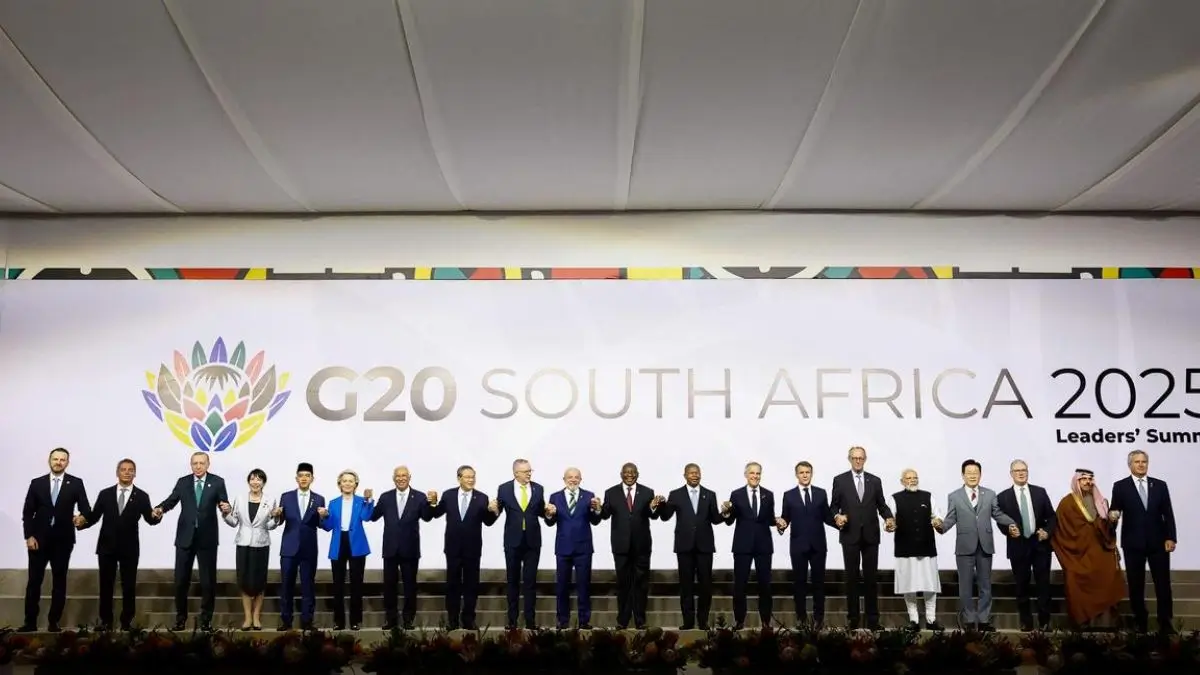
G20 Johannesburg Summit 2025 adopts joint declaration despite US objections, focusing on multilateralism, climate action, SIDS and LDC support, and global debt sustainability.
G20 Summit Adopts Joint Declaration Despite US Objections
Consensus Achieved at Johannesburg Summit
On 22 November 2025, leaders of the G20 convened in Johannesburg, South Africa, and adopted a 39‑page joint declaration by consensus, despite visible objections raised by the United States. The declaration reaffirmed the G20’s commitment to multilateral cooperation, inclusive sustainable development and rule‑based global governance.
Major Themes of the Declaration
The declaration covers several key themes:
- A strong reaffirmation of multilateralism and peaceful resolution of disputes, referencing respect for sovereignty and human rights (though not naming specific countries).
- Climate action and energy transition, including references to the “Critical Minerals Framework” that supports sustainable mining, recycling and access to clean‑technology raw materials.
- Support for vulnerable nations, particularly Small Island Developing States (SIDS) and Least Developed Countries (LDCs), through disaster preparedness, infrastructure resilience, digital inclusion and technology transfer.
- Global inequality and debt sustainability, acknowledging public debt in developing nations as a barrier and calling for debt restructuring, investment in education, health and infrastructure and stronger roles for Multilateral Development Banks (MDBs).
- Digital technology, migration and corruption: committing to digital access, public‑digital infrastructure, responsible AI, inclusive labour mobility and anti‑corruption efforts.
Host Country’s Role & Africa’s Voice
As host of the summit, South Africa played a significant role in shaping the inclusive tone of the declaration. The summit treated the African Union (AU) — now a permanent member of G20 from 2023 onwards — as an equal partner. South Africa’s representative described the consensus as a “milestone for the African continent”. This highlighted Africa’s concerns around skills development, sustainable industrialisation, climate justice and global inclusion.
What the US Objection Signifies
While the declaration was adopted by consensus, the United States registered objections in the negotiations. The US dissent underscores tensions within the G20 regarding certain elements — likely around wording on conflicts, sovereignty and global governance. Yet the adoption of the document despite those objections signals the willingness of the majority of G20 members to press ahead with a unified agenda, even if the US stands apart.
Implications for Global Governance and India
For India and other emerging economies, the declaration offers an opportunity. As a G20 member, India can leverage the emphasis on “inclusive growth, digital inclusion, green transition and support for vulnerable countries” to align national policies with these global priorities. It reflects the growing importance of consensus‑based action even amid geopolitical rifts, underscoring that multilateral forums are evolving rather than dissolving.

Why This News Is Important
Relevance for Government Exam Aspirants
This news matters for students preparing for teaching, police, banking, railways, defence and civil services, because the G20 Summit covers broad themes that appear in General Studies, Current Affairs and Governance sections of exams. The themes of multilateralism, climate action, global debt, digital inclusion and development of vulnerable nations are recurring in civil services and competitive exam syllabi.
Insights into Global Policy Trends
The adoption of the G20 declaration despite US objections demonstrates how global leadership is shifting. It indicates that major developing and emerging economies are asserting greater influence in shaping the global agenda. For aspirants, recognising such shifts is important because it affects how India positions itself globally, and how global agreements translate into domestic policies (e.g., climate change mitigation, digital infrastructure, debt relief).
Strategic Significance for India
India, being a G20 member, is directly impacted by the decisions of this grouping. The focus on inclusive growth, technology transfer, support to LDCs/SIDS and climate resilience align closely with India’s priorities such as “Digital India,” “Green India,” and support to neighbours under regional cooperation frameworks. Understanding how this declaration maps onto India’s own strategy strengthens an aspirant’s grasp of policy‑linkages and current affairs relevance.
Historical Context
The G20 (Group of Twenty) was established in 1999 as a response to the financial crisis of the late 1990s and initially met at the ministerial level. Its membership comprises 19 countries plus the European Union; as of 2023, the African Union was made a permanent member. The grouping represents more than 85 % of global GDP, 75 % of global trade and two‑thirds of the world’s population.
Over the years, G20 summits have expanded from purely economic coordination to encompass climate change, sustainable development, digital transformation and global inequality. The Johannesburg 2025 Summit continues this trend by adopting a broad declaration that goes beyond economic policy to include human rights, debt, climate, and technology. The fact that such a consensus was reached despite objections from a major power underscores evolving power dynamics in global governance.
Key Takeaways from the G20 Johannesburg Joint Declaration
| S.No | Key Takeaway |
|---|---|
| 1 | The G20 adopted a 39‑page joint declaration at Johannesburg on 22 November 2025, despite opposition from the US. |
| 2 | The declaration reaffirmed commitment to multilateralism, rule‑based order, peaceful dispute resolution and human rights. |
| 3 | It emphasised climate action and energy transition, including a Critical Minerals Framework for cleaner technologies. |
| 4 | Special focus was placed on SIDS and LDCs for disaster resilience, digital inclusion and access to climate finance. |
| 5 | It addressed global inequality and debt, calling for debt restructuring, increased investments in health and education, and reform of MDBs. |
FAQs: Frequently Asked Questions
1. What was the main outcome of the G20 Johannesburg Summit 2025?
The summit concluded with a 39‑page joint declaration adopted by consensus, reaffirming multilateralism, climate action, global debt sustainability, and support to vulnerable nations like SIDS and LDCs.
2. Why did the United States object to the G20 declaration?
The US raised objections likely related to wording on global governance, conflicts, and sovereignty, but the declaration was still adopted by consensus, highlighting majority agreement among G20 members.
3. Which new member represents Africa in the G20?
The African Union (AU) became a permanent member of the G20 in 2023 and played a significant role in the 2025 Johannesburg Summit.
4. What is the Critical Minerals Framework mentioned in the declaration?
It is a plan to ensure sustainable mining, recycling, and access to essential raw materials for clean technologies to support climate action and energy transition.
5. How does the G20 declaration impact India?
India can leverage the declaration’s focus on inclusive growth, digital inclusion, green transition, and support for vulnerable nations to align national policies with global priorities and multilateral initiatives.
6. What are SIDS and LDCs referred to in the declaration?
SIDS stands for Small Island Developing States, and LDCs are Least Developed Countries. Both groups received special attention for climate resilience, infrastructure, and digital access.
7. Why is the G20 considered important in global governance?
The G20 represents 85% of global GDP, 75% of global trade, and two-thirds of the world population. Its decisions influence global economic stability, development, and multilateral cooperation.
Some Important Current Affairs Links