







Supreme Court Collegium recommends five new judges including senior advocate V. Mohana in a major judicial appointment update aimed at strengthening the judiciary, reducing backlog, and improving efficiency in India’s Supreme Court system.
Supreme Court Collegium Expands Bench with Five New Recommendations
🏛️ Supreme Court Collegium Decision on Judicial Elevation
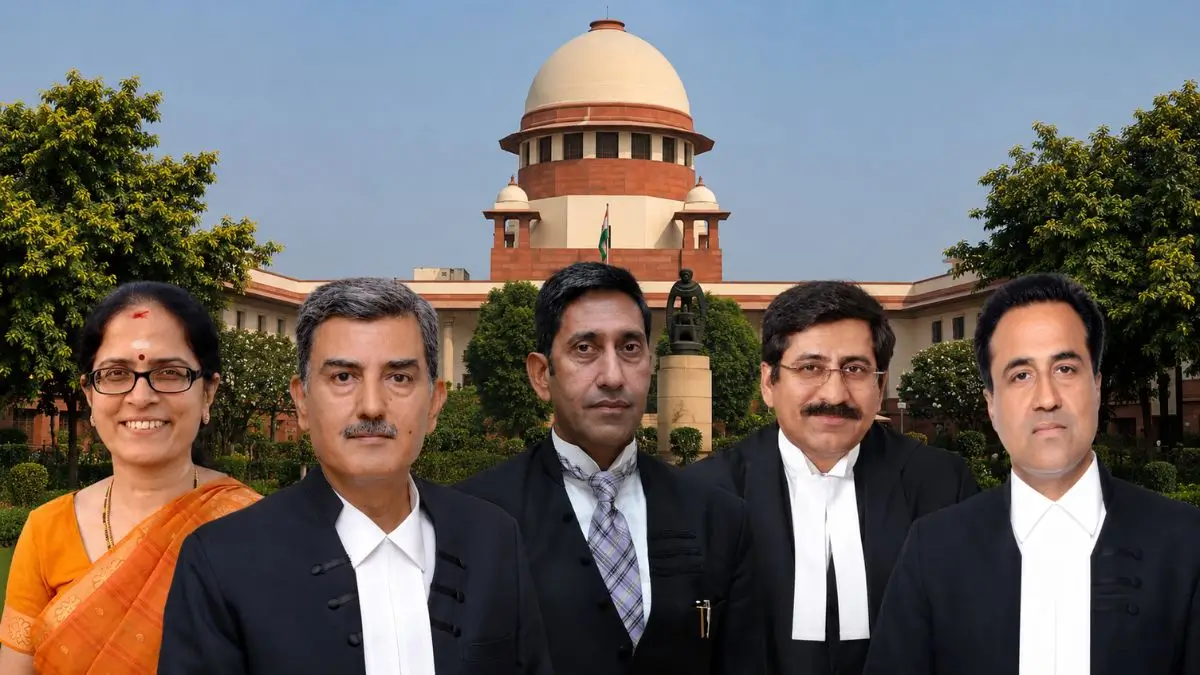
The Supreme Court Collegium has recommended the elevation of five eminent legal professionals to the Supreme Court of India. The list includes four sitting Chief Justices of various High Courts and Senior Advocate V. Mohana, marking a significant development in India’s judicial appointment process. The recommendation aims to strengthen the apex court amid rising caseloads and upcoming retirements.
The decision was taken during recent collegium meetings and reflects the judiciary’s ongoing effort to ensure balanced representation and efficient functioning of the Supreme Court.
⚖️ List of Recommended Judges for Supreme Court Elevation
The Collegium has proposed the following names:
- Justice Sheel Nagu
- Justice Shree Chandrashekhar
- Justice Sanjeev Sachdeva
- Justice Arun Palli
- Senior Advocate V. Mohana
These individuals come from diverse legal backgrounds, including constitutional law, civil litigation, and administrative jurisprudence. Their inclusion is expected to bring wider judicial experience to the Supreme Court bench.
📊 Judicial Strength and Context of the Recommendation
At present, the Supreme Court operates below its sanctioned strength, which has led to workload pressure and case backlog. With multiple retirements expected soon, the recommendation is seen as a strategic move to maintain judicial efficiency.
The inclusion of a senior advocate from the Bar, V. Mohana, also highlights the importance of direct elevation in bringing experienced legal practitioners into constitutional courts.
👩⚖️ Representation and Diversity in Judiciary
The recommendation of V. Mohana is particularly notable as it strengthens representation of women in the Supreme Court. Judicial diversity continues to be a key discussion point in India’s legal system, especially in higher judiciary appointments.

🧭 Why This News is Important
⚖️ Strengthening the Supreme Court System
The recommendation of five new judges is crucial as the Supreme Court handles constitutional matters, appeals, and public interest litigation. Increasing the bench strength ensures faster disposal of cases and reduced backlog, which is essential for justice delivery.
📈 Impact on Judicial Efficiency and Governance
A stronger Supreme Court improves judicial efficiency and supports constitutional governance. With rising litigation in economic, civil, and criminal matters, additional judges help maintain balance in workload distribution.
👩⚖️ Representation and Inclusivity
The inclusion of Senior Advocate V. Mohana is significant for gender representation in the judiciary. It also reflects the evolving nature of judicial appointments, where experienced lawyers from the Bar are increasingly being considered for elevation.
🏛️ Institutional Balance and Legal Stability
Judicial appointments ensure continuity in the interpretation of law and stability in governance. Such recommendations directly influence how constitutional principles are interpreted and applied in India.
📚 Historical Context
The Supreme Court of India, established in 1950, functions as the highest judicial authority in the country. The collegium system of appointments, evolved through landmark Supreme Court judgments known as the Three Judges Cases (1981, 1993, 1998), gives senior judges the authority to recommend appointments and transfers.
Over the years, the Supreme Court’s sanctioned strength has gradually increased to handle growing litigation. Earlier expansions were also made through amendments and ordinances to ensure the judiciary keeps pace with increasing demand.
The elevation of High Court Chief Justices and senior advocates has been a consistent practice to bring experienced judicial leadership into the apex court. This ensures continuity, expertise, and diversity in constitutional interpretation.
📌 Key Takeaways from “Supreme Court Collegium Judicial Recommendation”
| S.No. | Key Takeaway |
|---|---|
| 1 | Supreme Court Collegium recommended five new judges for elevation to the apex court. |
| 2 | The list includes four High Court Chief Justices and one senior advocate. |
| 3 | Senior Advocate V. Mohana is among the recommended names, strengthening Bar representation. |
| 4 | The move aims to address judicial workload and pending case backlog in the Supreme Court. |
| 5 | The recommendation highlights ongoing efforts to improve diversity and efficiency in the judiciary. |
FAQs: Supreme Court Collegium Judicial Recommendation
1. What is the Supreme Court Collegium?
The Supreme Court Collegium is a system of senior judges of the Supreme Court responsible for recommending appointments and transfers of judges in the higher judiciary, including the Supreme Court and High Courts.
2. Who heads the Collegium system?
The Collegium is headed by the Chief Justice of India and includes the four senior-most judges of the Supreme Court.
3. How are Supreme Court judges appointed in India?
Supreme Court judges are appointed by the President of India based on the recommendations of the Collegium system.
4. Why is the elevation of High Court judges important?
High Court judges bring extensive judicial experience, which helps in handling constitutional matters and complex legal cases in the Supreme Court.
5. What is the significance of including a senior advocate in Supreme Court appointments?
It ensures representation from the Bar, bringing practical courtroom experience and diversity in judicial interpretation.
6. What is the sanctioned strength of the Supreme Court of India?
The sanctioned strength is currently 34 judges, including the Chief Justice of India.
7. Why is judicial vacancy a concern in India?
Vacancies lead to increased case backlog and delay in justice delivery, affecting judicial efficiency.
Some Important Current Affairs Links