





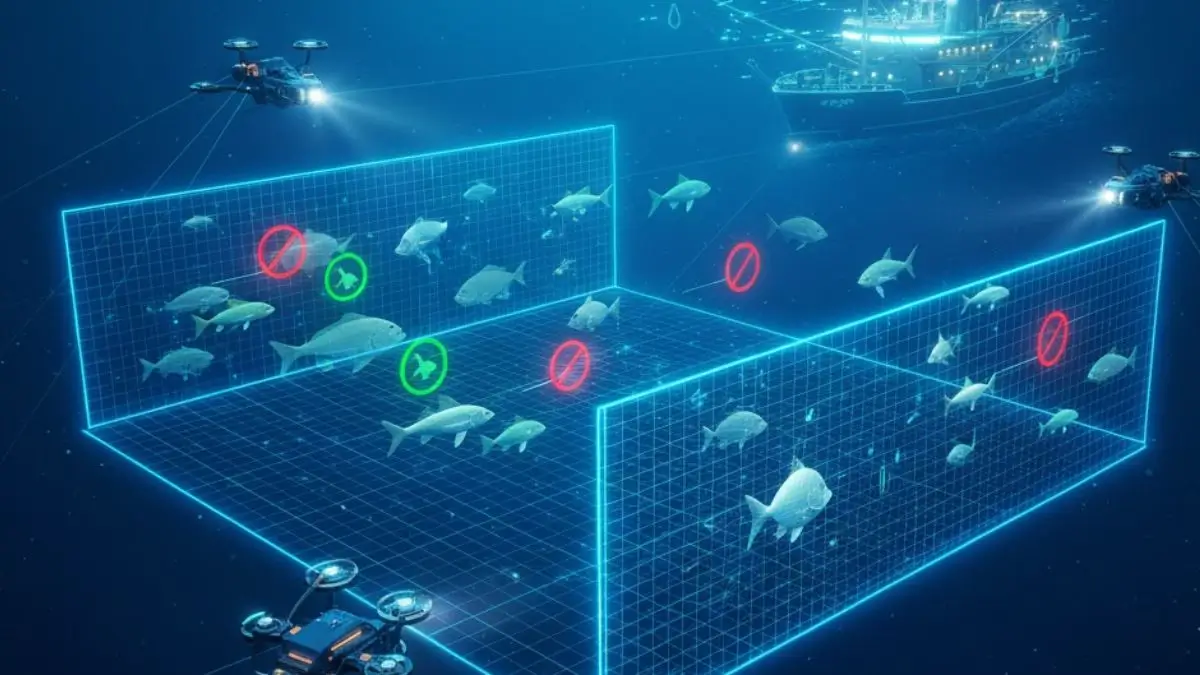
Deep Sea Fishing Rules India EEZ 2025 prioritize local cooperatives, ban foreign vessels, introduce mother-and-child vessels, and strengthen marine export sustainability.
Centre Notifies New Deep‑Sea Fishing Rules for EEZ
“New Deep‑Sea Fishing Rules for India’s EEZ & Marine Exports”
On 4 November 2025, the Government of India formally notified a sweeping new regulatory framework designed to govern deep‑sea fishing operations within its vast Exclusive Economic Zone (EEZ) of approximately 2.3 million square kilometres. These rules mark a strategic pivot toward enhancing domestic fisher empowerment, strengthening resource sovereignty and facilitating India’s emergence as a global player in sustainable marine exports.
Prioritising Indian Cooperatives and Fish‑Farmer Producer Organisations
Under the new norms, priority access to deep‑sea fishing rights will be given to domestic fishermen’s cooperative societies and Fish Farmer Producer Organisations (FFPOs). This means that these indigenous groups will now be eligible to deploy advanced vessels in deep‑sea operations—opening up opportunities for smaller stakeholders who previously may have been excluded due to capital or technological constraints.
Ban on Foreign Fishing Vessels in Indian EEZ
A major element of the reforms is the blanket prohibition of foreign‑flagged fishing vessels from operating within India’s EEZ. This step is aimed at safeguarding livelihoods of coastal fish‑ers and asserting sovereign control over marine resources—especially in deeper waters.
Introduction of the “Mother‑and‑Child” Vessel Model
To bolster operational efficiency and regional equity, the rules introduce a “mother‑and‑child” vessel model.Under this model, smaller vessels operating near the coast can transfer their catch mid‑sea to larger “mother” ships, thereby enhancing reach and scale. This is particularly relevant for the strategic island territories of the Andaman & Nicobar and Lakshadweep Islands, which together hold 49 % of India’s EEZ.
Digital Access Pass via the “ReALCraft” Portal
Mechanised and large motorised vessels (as opposed to small-scale traditional craft) must now obtain a free “Access Pass” through the ReALCraft digital portal. The registration process is streamlined and linked with live‑tracking systems and export certification entities such as the Marine Products Export Development Authority (MPEDA) and the Export Inspection Council (EIC). According to the notification, out of 2.38 lakh registered vessels, 64,187 mechanised boats required the Pass.
Environmental Protections and Sustainability Measures
The rules embed strong ecological safeguards: use of destructive fishing techniques such as LED‑light fishing, pair‑trawling and bull‑trawling are banned. Moreover, minimum legal size norms will be enforced to prevent juvenile fish harvest and Fisheries Management Plans will be developed collaboratively with coastal states and stakeholders.
Boosting Marine‑Export Competitiveness and Traceability
By integrating digital tracking and linking catch certificates to export mechanisms, India is positioned to meet stringent global standards of sanitary and eco‑labelling, enhance traceability and improve competitiveness in the marine‑export market, which is valued at roughly ₹ 60,000 crore annually. The rules also stipulate that fish caught beyond the contiguous zone but within the EEZ will now be treated as “Indian origin”, thereby simplifying customs and revenue processes.
Financial, Technical and Safety Support
The regulatory framework is supplemented by enabling provisions: credit access under flagship schemes such as the Pradhan Mantri Matsya Sampada Yojana (PMMSY) and the Fisheries and Aquaculture Infrastructure Development Fund (FIDF) will help fishers upgrade infrastructure, branding and marketing. Safety and surveillance measures include mandatory transponders on deep‑sea vessels, QR‑coded Aadhaar/Fisher ID cards, coordination with the Indian Coast Guard and the Indian Navy, as well as integration with the Nabhmitra App for navigation alerts.

Why this News is Important
Relevance for Government‑Exam Aspirants
For candidates preparing for roles across teaching, police, banking, railways, defence and civil services (including the Union Public Service Commission [UPSC] exams), this policy notification offers multiple relevant linkages: it falls under national economic policy, maritime governance, export promotion, sustainable fisheries and resource security. Understanding such inter‑sectoral reforms showcases the government’s broader vision and can feature in the General Studies (GS) papers, especially in topics covering “Government Policies”, “Indian Economy”, “Environmental Ecology” and “International Relations”.
Implications for Coastal & Marine Economy
The new rules signify a pivot in India’s marine economy—from largely coastal and small‑scale fishing toward organized, deep‑sea and export‑oriented operations. By prioritising local entities, banning foreign vessels and introducing digital regulation, the government is strengthening resource sovereignty and aligning with the “Blue Economy” paradigm. This is of relevance to defence, maritime security, export logistics, small‑farmer empowerment and sustainable development—topics frequently tested in civil‑services and professional‑exams alike.
Historical Context
India’s maritime zones have been governed by the framework of the United Nations Convention on the Law of the Sea (UNCLOS) and its concept of the Exclusive Economic Zone (EEZ) established globally in the late 20th century. For India, the EEZ extends up to 200 nautical miles from the coast and includes about 2.3 million sq. km of marine area. The marine‑fisheries sector has traditionally been dominated by coastal small‑scale fishers, with large‑scale deep‑sea operations remaining limited.
Over recent years the Indian government has pushed the idea of a “Blue Economy” — harnessing sustainable use of ocean resources for economic growth, improved livelihoods and marine ecosystem health. Previous schemes such as PMMSY (launched in 2020) have focused on infrastructure, mechanisation and value‑addition in fisheries. The new deep‑sea rules represent an evolution: integrating digital monitoring, export traceability, and explicit bans on foreign‑vessel operations.
In the global context, countries are increasingly emphasising traceability and sustainability in seafood exports—both for market access and for marine‑biodiversity preservation. India’s effort aligns with global trends such as eco‑labelling, MSC (Marine Stewardship Council) certification and digital trace‑log systems. The mother‑and‑child vessel model and ban on destructive practices position India among progressive maritime‑policy adopters.
Key Takeaways from “New Deep‑Sea Fishing Rules for India’s EEZ”
| S.No | Key Takeaway |
|---|---|
| 1 | Priority access is given to Indian fishermen’s cooperative societies and Fish Farmer Producer Organisations (FFPOs) for deep‑sea fishing operations. |
| 2 | Foreign‑flagged fishing vessels are banned from operating in India’s EEZ under the new rules. |
| 3 | The “mother‑and‑child” vessel model is introduced to enable mid‑sea transhipment and improve operational reach, especially for island regions. |
| 4 | Mechanised and large‑sized motorised vessels must obtain digital Access Passes via the ReALCraft portal; small traditional boats are exempt. |
| 5 | Environmental safeguards include bans on LED‑light fishing, pair‑trawling and bull‑trawling; minimum legal‑size norms and development of Fisheries Management Plans are mandated. |
FAQs on India’s New Deep-Sea Fishing Rules for EEZ
Q1. What is the purpose of the new deep-sea fishing rules in India?
The rules aim to regulate fishing in India’s Exclusive Economic Zone (EEZ), prioritize local fishermen’s cooperatives and FFPOs, promote sustainable practices, and boost marine exports.
Q2. Which vessels are required to register via the ReALCraft portal?
All mechanised and large motorised fishing vessels must obtain a digital Access Pass through the ReALCraft portal. Small traditional boats are exempt.
Q3. Are foreign vessels allowed to fish in India’s EEZ under the new rules?
No, foreign-flagged fishing vessels are completely banned from operating in India’s EEZ.
Q4. What is the “mother-and-child” vessel model?
It is a system where smaller vessels transfer their catch to larger “mother” ships mid-sea, enhancing operational reach and efficiency, particularly for island regions.
Q5. Which destructive fishing practices are banned under the new rules?
LED-light fishing, pair-trawling, and bull-trawling are prohibited to protect marine biodiversity and promote sustainable fishing.
Q6. How does the new policy benefit India’s marine export sector?
By integrating digital tracking, access passes, and linking with MPEDA and EIC certifications, India ensures traceability, eco-labelling compliance, and improved competitiveness in the global seafood market.
Q7. What role does the Blue Economy concept play in these rules?
The rules support India’s Blue Economy by sustainably managing marine resources, boosting livelihoods, and enhancing export potential while preserving marine ecosystems.
Some Important Current Affairs Links