









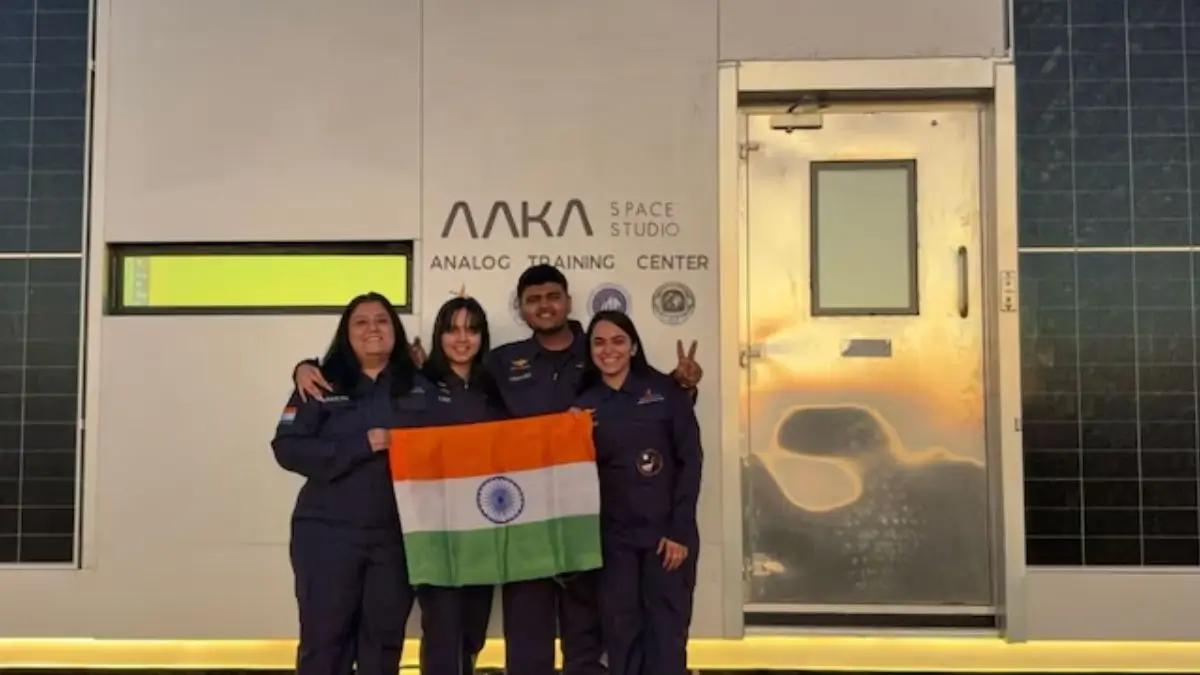
Youngest Indian analog astronaut Aditya Pandya completes eight-day lunar habitat simulation mission in Gujarat. Explore India’s analog astronaut missions, youth innovation, and space technology updates.
Youngest Indian Analog Astronaut: Aditya Pandya Makes History at 17
In a significant milestone for India’s growing involvement in space science and technology, 17‑year‑old Aditya Pandya has become the youngest male analog astronaut in the country after completing a spectacular space simulation mission. This achievement took place during a lunar habitat analog mission — a rigorous Earth‑based simulation that replicates the conditions of living and working on the Moon. The mission was conducted by AAKA Space Studio in Dholavira, Kutch, Gujarat, from 1 to 8 February 2026.
The mission placed a crew inside a specially programmed habitat that simulated loneliness, restricted resources, and the kind of isolation future astronauts might experience during actual extraterrestrial missions. Over the course of eight demanding days, Aditya and his team lived, worked, and carried out scientific studies — all without any external contact — under strict isolation protocols designed to mimic Moon‑like conditions.
Unlike typical participants, Aditya didn’t just live in the habitat — he designed and engineered core systems used during the experiment. His contributions included development of environmental sensors, biometric monitoring systems, Internet of Things (IoT)–based communication networks, and complex 3D‑printed modules that kept the analog station operational. A digital twin — a virtual replica of the lunar habitat — also enabled mission supervisors to monitor systems in real time.
🧠 What Is an Analog Astronaut Mission?
An analog astronaut mission is a ground‑based simulation where participants live in conditions that closely resemble what astronauts might experience on other celestial bodies like the Moon or Mars. These simulations test:
- Psychological endurance and isolation tolerance
- Engineering reliability of habitat systems
- Human autonomy and decision‑making under stress
- Environmental control systems that mirror space habitats
Such missions are vital for preparing humans for future space expeditions by identifying potential challenges and solutions before actual space deployment.

📌 Why This News Matters for Government Exams
The selection of Aditya Pandya as India’s youngest male analog astronaut is not only inspirational but also immensely relevant for students preparing for competitive exams. Here’s why:
1. Space Technology Awareness: Competitive exams increasingly include questions about space science, astronaut missions, and India’s role in space exploration. This achievement introduces aspirants to the concept of analog missions and how India is expanding its capabilities beyond traditional space milestones.
2. Innovation and Youth Leadership: Aditya’s achievement underscores the role of young innovators in contributing to technical and scientific progress. Government exams test not only factual knowledge but also understanding of modern scientific advancements and India’s emerging talent ecosystem.
3. STEM and Policy Alignment: This news aligns with national policy thrusts like Atmanirbhar Bharat and Science, Technology & Innovation initiatives. It demonstrates the country’s growing focus on research platforms that nurture future space scientists and engineers — essential knowledge for UPSC, SSC, and other competitive papers.
4. Cross‑Disciplinary Learning: The technology involved — IoT, digital twins, habitat design — reflects modern interdisciplinary scientific knowledge that aspirants can relate to subjects such as General Science, Technology, and Reasoning.
📜 Historical Context: Space Exploration and Analogue Missions
India has long aspired to be a global space leader, and its space journey has evolved from satellite launches to complex planetary missions. India’s space reputation was cemented by achievements such as Chandrayaan lunar missions, which explored the Moon’s surface and discovered water molecules. Subsequently, missions like Mangalyaan to Mars illustrated India’s ability to conduct interplanetary expeditions at competitive costs.
Analog astronaut missions represent a ground‑breaking frontier in space preparation. Unlike typical astronaut training focused on physical rigour and microgravity, analog missions simulate psychological and operational conditions of extraterrestrial environments on Earth. Space agencies worldwide — including NASA and ESA — use such analog missions to test technology and strategy. India’s involvement in these missions signals a growing participation in advanced space research and human space exploration training.
📊 Key Takeaways from “Aditya Pandya Becomes India’s Youngest Male Analog Astronaut”
| S.No | Key Takeaway |
|---|---|
| 1 | Aditya Pandya, aged 17, became India’s youngest male analog astronaut. |
| 2 | He completed an eight‑day lunar habitat simulation mission in Dholavira, Gujarat. |
| 3 | The mission replicated Moon‑like isolation, confinement, and autonomous operations. |
| 4 | Aditya not only participated but also engineered habitat systems and IoT tools. |
| 5 | Analog missions prepare humans for future space exploration and technology testing. |
FAQs: Frequently Asked Questions
1. Who is Aditya Pandya?
Aditya Pandya is a 17-year-old Indian student who became the youngest male analog astronaut in India after successfully completing an eight-day lunar habitat simulation mission.
2. What is an analog astronaut mission?
An analog astronaut mission is a ground-based simulation that replicates the living, working, and psychological conditions of space environments such as the Moon or Mars. It helps in testing technology, human endurance, and decision-making in isolated conditions.
3. Where did Aditya Pandya complete his mission?
The mission took place at AAKA Space Studio in Dholavira, Kutch, Gujarat, from 1 to 8 February 2026.
4. What were Aditya’s contributions to the mission?
Aditya designed and developed core habitat systems, environmental sensors, IoT-based communication networks, biometric monitoring systems, and 3D-printed modules for the mission.
5. Why are analog missions important for India?
These missions prepare astronauts for future space exploration, help test advanced technologies, and allow India to strengthen its human space research capabilities in line with global space initiatives.
6. How long did the mission last?
The lunar habitat analog mission lasted for eight days, during which the crew remained in isolation to simulate Moon-like conditions.
7. How is this news relevant for government exams?
This news highlights India’s space technology initiatives, youth innovation, STEM advancements, and government-backed research programs — all of which are often asked in UPSC, PSC, SSC, banking, and defence exams.
Some Important Current Affairs Links