







Vande Mataram National Anthem rules: Learn the latest MHA directive on the order and protocol of India’s National Song and National Anthem for official events, ceremonies, and exams preparation.
MHA Updates Rules on Order of National Song and Anthem in India
The Ministry of Home Affairs (MHA) has issued a new and detailed protocol mandating the sequence and manner in which India’s National Song — Vande Mataram and the National Anthem — Jana Gana Mana should be presented at official, government, and public functions. This directive dated 28 January 2026 marks the first formal set of guidelines concerning the National Song’s role and precedence during state ceremonies.
🎼 New Protocol for Vande Mataram and National Anthem
Under the new rules:
- The National Song (Vande Mataram) must be rendered before the National Anthem (Jana Gana Mana) whenever both are played together at events.
- All six stanzas of Vande Mataram must be sung or played in full — a complete rendition lasting approximately 3 minutes and 10 seconds.
- This replaces the long‑standing practice where only the first two stanzas were commonly sung at functions.
The directive clearly outlines proper decorum — including attendees standing in attention during the rendition of the National Song — to maintain uniformity and dignity at official occasions.
📅 Where and When Will the Protocol Apply?
The revised rules will govern government events, public ceremonies, cultural programmes, school functions, civil award ceremonies, and other official gatherings. In addition:
- Educational institutions are encouraged to begin activities with Vande Mataram followed by the National Anthem.
- The protocol also includes ceremonial functions such as flag hoisting, arrival of the President or governors, and other state functions.
This step reflects an effort to strengthen patriotic values among citizens, especially young students, by ensuring respect for national symbols within structured ceremonial frameworks.
📊 Public Responses and Controversies
The directive has generated mixed public responses across the country:
- Some state leaders, including those from Madhya Pradesh, welcomed the decision and pledged implementation of the order.
- Others, including leaders from opposition political parties and community groups, have criticised the change — calling it inconsistent with constitutional principles or potentially exclusionary due to religious connotations associated with the full song.
Debates continue as stakeholders weigh the cultural, constitutional, and social implications of mandating the full rendition and precedence of Vande Mataram.

📌 Why This News Is Important
🇮🇳 Strengthening National Identity and Civic Values
The MHA’s updated protocol on the order of Vande Mataram and the National Anthem has significant relevance for government exam aspirants, especially for subjects such as Polity, Governance, Constitution, Culture, and History:
- The rule reinforces the official status of national symbols, defining how they should be honoured at formal functions — a concept frequently tested in UPSC Civil Services, State PSCs (like PSCs, RPSC, MPPSC etc.), and SSC, Banking, and Defence exams.
- Understanding this protocol enhances awareness of citizens’ duties and state practices, which are directly linked to constitutional values and national ethos.
- The introduction of a uniform order for ceremonial songs ensures standardisation across government functions, an important governance principle relevant for public administration exams.
By knowing these changes, aspirants can confidently answer questions related to national symbols, government policies, and civic obligations, giving them an edge in objective, descriptive, and interview phases across competitive exams.
🕰️ Historical Context: Evolution of the National Song Protocol
🧡 Origin and Significance of Vande Mataram
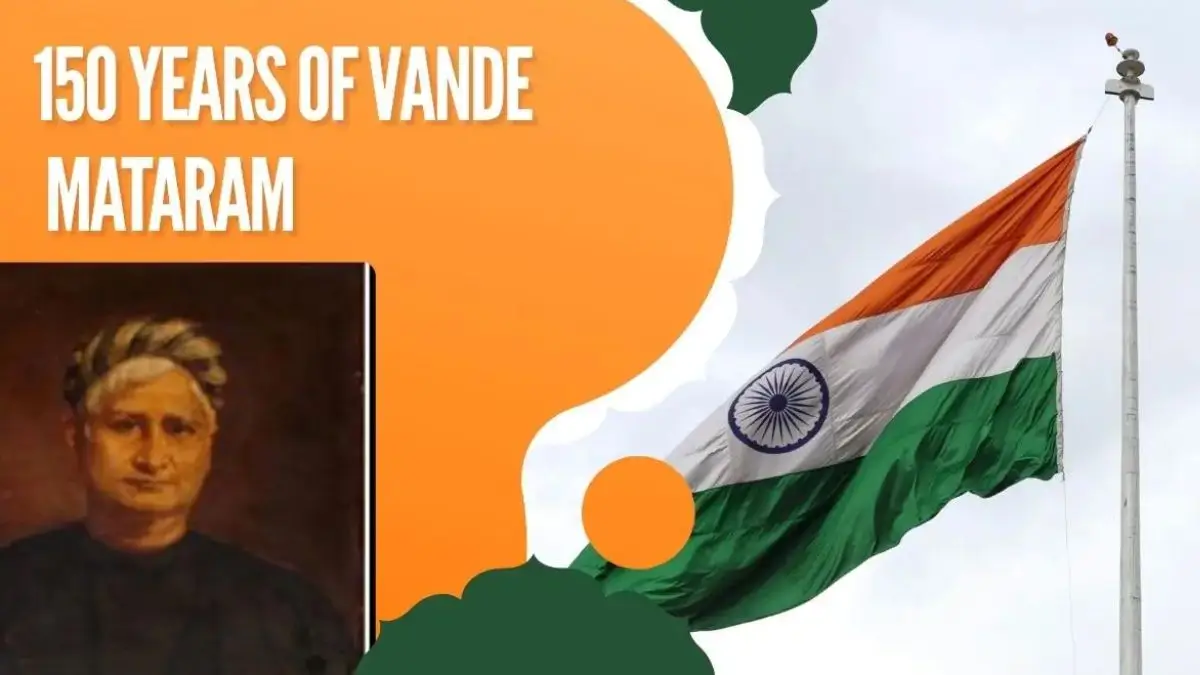
Vande Mataram, composed by Bankim Chandra Chattopadhyay in the 1870s, was first published in the novel Anandamath and became a rallying cry during India’s freedom struggle against British colonial rule. Its powerful patriotic sentiment united people across regions.
🪩 Adoption as National Song
- The song was adopted as the National Song in 1950 by the Constituent Assembly of India. Its adoption recognised its role in India’s cultural and historical identity, distinct from the National Anthem (Jana Gana Mana).
- Historically only the first two stanzas of Vande Mataram were commonly used at official functions — a practice intended to maintain inclusivity and secular ethos.
📜 New Protocol as a Milestone
The latest MHA directive represents the first formal protocol governing:
- The order of performance between the National Song and National Anthem.
- The requirement to use all six stanzas in full at state and official events.
This shift marks a noteworthy point in India’s ceremonial norms and reflects ongoing debates about national identity, historical legacy, and constitutional culture.
📑 Key Takeaways from “MHA Order on National Song and Anthem Protocol”
| S.No | Key Takeaway |
|---|---|
| 1. | The Ministry of Home Affairs (MHA) issued a new protocol mandating that Vande Mataram be rendered before the National Anthem at official functions. |
| 2. | All six stanzas of Vande Mataram must be sung or played in full, replacing the earlier practice of singing only the first two. |
| 3. | The complete rendition lasts approximately 3 minutes and 10 seconds and must be respected with attendees standing in attention. |
| 4. | The directive applies to government events, public functions, schools, and ceremonies involving dignitaries. |
| 5. | The move has sparked political and social debate, with differing views on its constitutional and cultural implications. |
FAQs: Frequently Asked Questions
1. What is the new order of the National Song and National Anthem?
The Ministry of Home Affairs (MHA) has mandated that Vande Mataram should be rendered before the National Anthem (Jana Gana Mana) at all official, government, and public functions.
2. How many stanzas of Vande Mataram must be sung under the new protocol?
All six stanzas of Vande Mataram must be sung or played in full, replacing the previous practice of singing only the first two stanzas.
3. Where does this new protocol apply?
The directive applies to government events, schools, public ceremonies, civil award programs, and functions involving dignitaries such as the President, Governors, or Ministers.
4. What is the duration of the complete rendition of Vande Mataram?
The full rendition of all six stanzas lasts approximately 3 minutes and 10 seconds.
5. Why has the MHA introduced this protocol?
The new guidelines aim to strengthen respect for national symbols, maintain uniform ceremonial practices, and promote patriotism and civic values across India.
6. Is it mandatory for attendees to stand during Vande Mataram?
Yes, attendees are expected to stand in attention as a mark of respect during the rendition of Vande Mataram and the National Anthem.
7. Has the new order faced any opposition?
Yes, some political leaders and community groups have raised concerns about cultural inclusivity and constitutional implications.
8. Who composed Vande Mataram?
Vande Mataram was composed by Bankim Chandra Chattopadhyay in the 1870s and first published in the novel Anandamath.
Some Important Current Affairs Links