








S‑500 missile system India: Learn about Russia’s advanced air and missile defence system, its features, range, capabilities, and why India is interested in procurement and co-production to strengthen its strategic defence.
S-500 Prometheus air defence system: A New Shield for India’s Skies
What is the S-500?
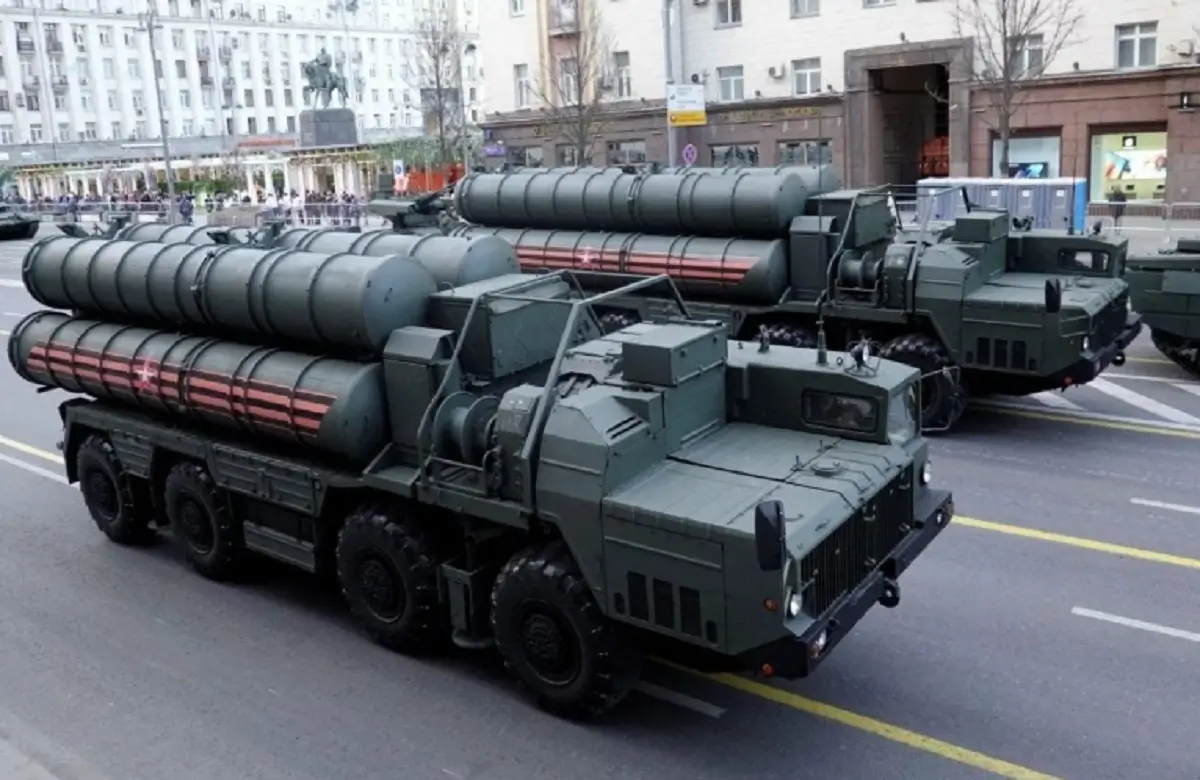
The S-500 — developed by Russia’s Almaz-Antey — is a next-generation long-range mobile air and missile defence system. It is engineered to neutralise a wide range of threats: from conventional aircraft and cruise missiles to ballistic missiles, hypersonic glide vehicles, and even certain satellites or near-space objects.
The system relies on advanced interceptor missiles (notably the 77N6-N and 77N6-N1 kinetic kill interceptors, along with the long-range 40N6M missile) to achieve what is often termed “hit-to-kill”: a direct collision with a target rather than an explosion nearby.
Range, Altitude & Interception Capabilities
One of the S-500’s standout features is its extended engagement envelope. It reportedly can intercept ballistic targets at ranges up to 600 km, and its altitude coverage extends up to 180–200 km, pushing into the near-space domain — far beyond what legacy air-defence systems typically cover.
Its radar and detection architecture — including radars capable of detecting ballistic threats at great distances — provide a comprehensive early-warning and target-tracking ability.
Moreover, the S-500 is designed for rapid response. Its reaction time — the time taken from target detection to initiation of engagement — is reportedly in the range of 3–4 seconds, which is significantly faster than its predecessor systems.
What India Is Considering and Why
With evolving strategic threats — including from hypersonic missiles, cruise missiles, and stealth aircraft — India is reported to be seriously evaluating procurement of the S-500 system. Discussions between India and Russia have gained renewed attention, especially in the context of recent geopolitical changes and growing regional tensions.
Under proposals currently under consideration, the deal might include not only direct procurement but also co-production and technology transfer under a government-to-government (G2G) arrangement. That would align with India’s aim to bolster indigenous defence manufacturing.
What Sets S-500 Apart from Earlier Systems (e.g. S-400)
Compared to the older generation S-400 Triumf air defence system (also Russian), the S-500 represents a major leap:
- Longer Range & Higher Altitude: S-400 covers up to 400 km; S-500 extends range up to ~600 km and altitude to near 200 km.
- Broader Threat Spectrum: S-500 is built to counter hypersonic missiles, ballistic missiles, cruise missiles, stealth aircraft, UAVs — and even low-Earth orbit (LEO) satellites.
- Faster Reaction & Advanced Tracking: The system uses modern radar and engagement technology (e.g., Gallium Nitride-based radars) for quick detection and jamming resistance — capabilities that older systems find challenging.

Why This News Matters
Strengthening India’s Defence Posture
As India navigates an increasingly volatile regional security environment — with rising capabilities of neighbouring adversaries in ballistic missiles, hypersonic weapons, and stealth technology — the S-500 offers a strategic edge. Its ability to intercept advanced threats at high altitude and long range provides a formidable deterrent against hostile incursions or surprise missile strikes.
By integrating S-500 in its air-defence architecture, India would not only safeguard its airspace but also protect critical infrastructure and assets (including satellites and communication networks).
Boost to Indigenous Defence Manufacturing & Strategic Autonomy
The proposed co-production and technology transfer aspect of the S-500 deal dovetails with India’s broader ambition of enhancing its indigenous defence manufacturing capabilities under initiatives like “Make in India.” If realised, it would reduce reliance on imports over time and foster self-reliance in high-end defence tech.
Moreover, such a deal reflects India’s growing strategic closeness with Russia — reinforcing defence diplomacy. It also signals to potential adversaries that India is upgrading its defence deterrence to meet 21st-century threats.
Relevance for Government-Exam Aspirants
For students preparing for civil service, defence or related exams, understanding the S-500’s significance offers insight into contemporary India–Russia defence cooperation, shift in regional balance of power, and evolving warfare technology. It’s a classic example of how military modernization, international diplomacy, and strategic doctrines intersect — a topic often tested under “International Relations,” “Security,” or “Defence” current-affairs segments.
Historical Context
The evolution of India’s air defence systems reflects changing global and regional threats. In 2018, India signed a ₹ ~5 billion deal with Russia to acquire five units of S-400 Triumf systems.
The S-400 — itself among the most advanced surface-to-air missile (SAM) systems — significantly enhanced India’s air defence capability against conventional aircraft and missile threats. However, as new threats emerged in the form of hypersonic weapons, stealth technology, and potentially space-based assets (satellites, drones, reconnaissance platforms), the limitations of older systems became apparent.
Over the last few years, Russia developed the S-500 — a next-generation system intended to address these emerging threats. First inducted into Russian service in limited capacity around 2021, by 2024 the system had achieved initial operational capability.
Now, with shifting geopolitical dynamics — especially in South Asia and the Indo-Pacific — India sees strategic value in acquiring or co-producing the S-500, to ensure its airspace and near-space assets remain protected against evolving threats from ballistic missiles, hypersonic glide vehicles, stealth aircraft and potentially hostile satellites or drones.
The prospective S-500 deal thus represents both continuity and evolution: continuity in India–Russia defence cooperation, and evolution in adapting to 21st-century security challenges.
Key Takeaways from This News
| # | Key Takeaway |
|---|---|
| 1 | The S-500 is a next-generation Russian air & missile defence system capable of intercepting ballistic missiles, hypersonic weapons, aircraft, cruise missiles, and even certain low-Earth-orbit satellites. |
| 2 | Its engagement envelope extends up to ~600 km range and ~180–200 km altitude — significantly broader than older systems. |
| 3 | The system uses advanced “hit-to-kill” interceptors (77N6-N, 77N6-N1 and 40N6M) and modern radars to detect, track, and neutralize high-speed and stealth threats. |
| 4 | India is reportedly exploring a deal (potentially under a G2G agreement) for acquisition or co-production of S-500, aligning with its strategic and indigenous-defence goals. |
| 5 | For India, S-500 promises enhanced deterrence, protection of airspace and near-space assets, and a vital boost to multi-layered defence architecture — making it strategically significant for future security planning. |
FAQs: Frequently Asked Questions
1. What is the S‑500 Prometheus missile system?
The S‑500 is Russia’s next-generation long-range air and missile defence system, designed to intercept ballistic missiles, hypersonic weapons, aircraft, cruise missiles, and some satellites in low-Earth orbit.
2. How is the S‑500 different from the S‑400?
S‑500 has a longer range (~600 km vs 400 km), higher altitude interception (~180–200 km vs ~30–40 km), faster reaction time, and can target hypersonic weapons and low-orbit satellites, which the S‑400 cannot.
3. Why is India interested in the S‑500 system?
India aims to strengthen its air-defence capabilities against emerging threats, including hypersonic missiles and stealth aircraft, while also exploring co-production and technology transfer under a G2G agreement.
4. What type of missiles does the S‑500 use?
The system uses interceptor missiles such as 77N6‑N, 77N6‑N1 for kinetic kill, and 40N6M for long-range interception, designed for precise “hit-to-kill” capability.
5. When did the S‑500 become operational in Russia?
The S‑500 achieved initial operational capability in Russia around 2021, with continuous upgrades and deployment since then.
6. What threats can the S‑500 neutralize?
It can intercept ballistic missiles, cruise missiles, stealth aircraft, hypersonic glide vehicles, drones, and some low-Earth-orbit satellites.
7. How does S‑500 benefit India’s strategic defence?
It enhances India’s multi-layered air defence, protects critical infrastructure, deters potential adversaries, and supports indigenous defence manufacturing through possible co-production.
Some Important Current Affairs Links