









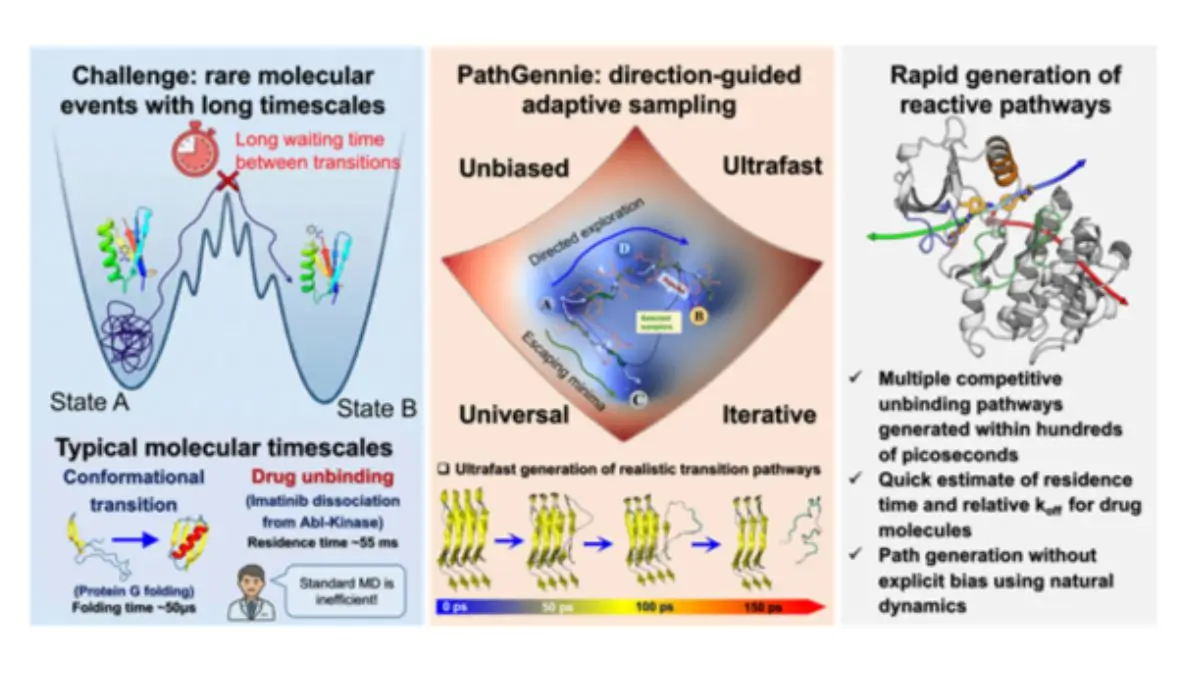
Open-source drug discovery tool PathGennie developed in India accelerates computational drug research by simulating protein-drug interactions naturally, boosting innovation in biomedical research.
India Develops Open-Source Tool PathGennie to Boost Drug Research
Introduction – A New Era in Drug Discovery
India has made a significant technological breakthrough in biomedical science with the development of PathGennie, a cutting-edge open-source computational tool designed to accelerate drug discovery research. Announced by the Ministry of Science and Technology, this innovative software aims to strengthen India’s computational biology and pharmaceutical research ecosystem by accurately simulating how drug molecules interact with their protein targets.
What is PathGennie?
PathGennie is an open-source computational framework that predicts how drug molecules unbind from their target proteins—an essential step in understanding a drug’s effectiveness and safety in the human body. Unlike traditional simulation tools that introduce artificial forces to speed up analysis, PathGennie simulates natural molecular dynamics, producing more realistic and reliable results.
How PathGennie Works
Rather than relying on long, costly conventional simulations, PathGennie uses intelligent sampling methods. It runs a large swarm of ultra-short simulation trajectories and selectively extends those that are moving in a meaningful direction toward the desired outcome. This strategy mimics natural selection at the molecular level, enabling scientists to trace rare molecular events—like unbinding pathways—without applying external biases or distortions.
Scientific Significance in Drug Development
For researchers, predicting the “residence time”—how long a drug remains bound to its target protein—is often more important than just measuring how tightly it binds. Insights into both binding and unbinding pathways can lead to improved assessment of drug stability, effectiveness, side effects, and proper dosage levels. PathGennie’s ability to simulate these events quickly and accurately is a major boost to modern drug discovery research.
Applications Beyond Drug Discovery
Although developed primarily for drug–protein interaction studies, PathGennie’s flexible algorithms are applicable in other scientific areas such as chemical reactions, catalytic processes, phase transitions, and molecular self-assembly phenomena. It is also compatible with machine-learning techniques, opening avenues for integration with advanced computational research methodologies
Why Open-Source Matters
Making PathGennie freely available to researchers worldwide can democratize high-fidelity drug unbinding simulations, promoting greater collaboration, innovation, and transparency in biomedical research. Open-source platforms empower academic institutions, startups, and pharmaceutical companies to adapt and enhance the software based on specific research needs.

Why This News is Important for Government Exam Aspirants
Impact on Science & Technology Syllabus
Current affairs related to technological innovations like PathGennie are highly relevant for general studies sections in exams such as UPSC, State PSCs, SSC, Bank PO, and Railways. They illustrate India’s growing competence in cutting-edge research, especially in fields intersecting biology, computation, and artificial intelligence.
Relevance to National Policy and Research Ecosystem
This development highlights the role of government investment in science and technology, which is a recurring theme in questions related to national policy, innovation missions, and research infrastructure. Aspirants may encounter questions on how open-source tools contribute to national goals such as Atmanirbhar Bharat and global competitiveness in pharmaceuticals.
Linkage to Healthcare and Innovation
Understanding novel research tools like PathGennie also helps aspirants connect current trends in health innovation, drug discovery, and public health policy—concepts that frequently appear in essay papers and policy analysis sections across competitive exams.
Historical Context: India’s Journey in Computational Drug Discovery
India’s contribution to pharmaceutical sciences has traditionally been strong in generic drug manufacturing and chemical synthesis. However, in recent years, there has been a marked shift toward high-value research and innovation—from AI-aided diagnostics to advanced computational tools like PathGennie. This trajectory reflects India’s broader shift from a low-cost manufacturer to a knowledge-driven hub in the global pharmaceutical ecosystem.
The use of computational methods in drug discovery has been increasing globally, driven by the need to reduce time and costs associated with laboratory trials and clinical studies. PathGennie represents a strategic step in aligning India’s research capabilities with international standards, especially in simulating complex molecular interactions that are vital for next-generation therapeutics.
Key Takeaways from PathGennie Boosts Drug Research
| S. No. | Key Takeaway |
|---|---|
| 1. | PathGennie is an open-source computational tool developed by Indian scientists. |
| 2. | It simulates natural drug–protein unbinding pathways without artificial biases. |
| 3. | The tool improves predictions of drug residence time, aiding drug efficacy analysis. |
| 4. | PathGennie reduces time and computational cost compared to conventional methods. |
| 5. | Its open-source nature encourages collaboration in global biomedical research. |
FAQs: Frequently Asked Questions
1. What is PathGennie?
Answer: PathGennie is an open-source computational tool developed in India to simulate natural drug–protein unbinding pathways, helping accelerate drug discovery and research.
2. Who developed PathGennie?
Answer: PathGennie was developed by Indian scientists under the guidance of the Ministry of Science and Technology.
3. How does PathGennie differ from traditional drug simulation tools?
Answer: Unlike conventional tools that use artificial forces to speed simulations, PathGennie runs natural molecular dynamics using short simulation trajectories, making results more realistic and accurate.
4. What is the significance of drug “residence time” in research?
Answer: Residence time refers to how long a drug remains bound to its target protein. PathGennie helps predict this, which is crucial for understanding drug efficacy, stability, and side effects.
5. Is PathGennie open for global researchers?
Answer: Yes, PathGennie is open-source and freely available, allowing researchers worldwide to use, modify, and enhance the tool.
6. Can PathGennie be used outside drug discovery?
Answer: Yes, it can be applied in other scientific areas such as chemical reactions, catalytic processes, molecular self-assembly, and machine-learning-assisted simulations.
7. Why is PathGennie important for India?
Answer: It strengthens India’s position in computational biology and pharmaceuticals, promotes Atmanirbhar Bharat in science, and accelerates innovation in high-quality research.
8. How does PathGennie reduce research costs?
Answer: By simulating molecular interactions efficiently using intelligent sampling, it avoids long and expensive conventional simulations, reducing computational resources and time.
Some Important Current Affairs Links