








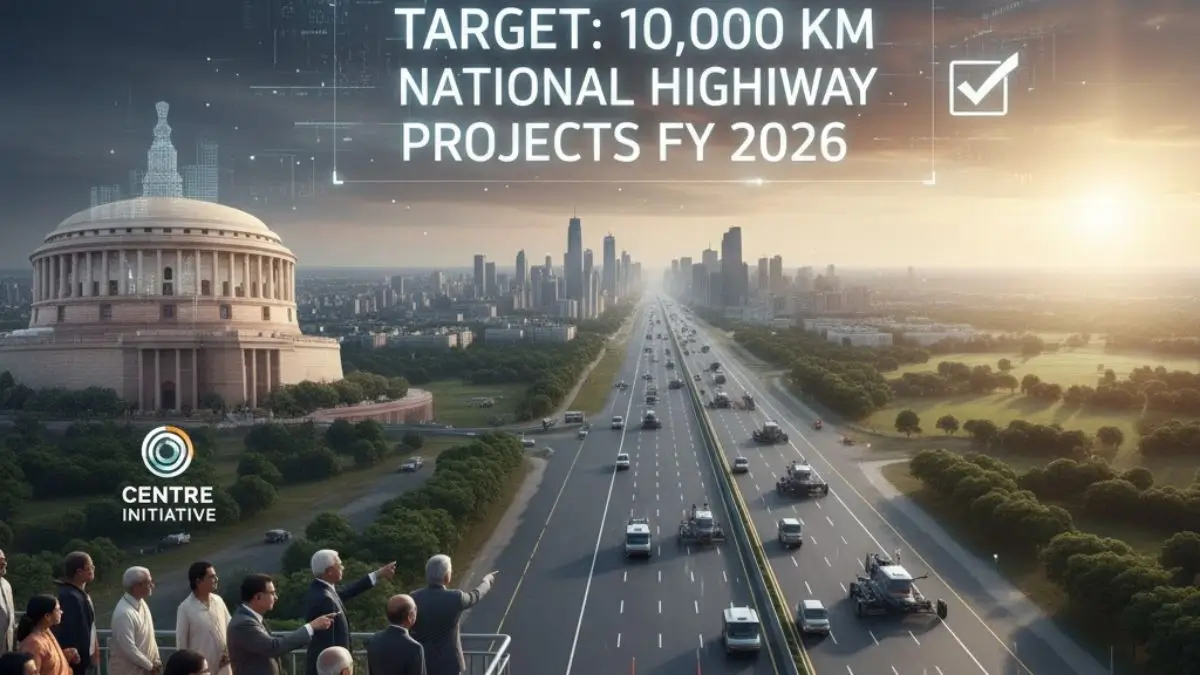
10,000 km national highway projects in FY 2025‑26 mark India’s ambitious push for improved road connectivity, faster execution, and economic growth.
Centre Plans to Award 10,000 km of National Highway Projects in FY 2026
Rising Backlog & New Ambitious Target
The Union Government, via the Ministry of Road Transport & Highways (MoRTH), has set an ambitious target to award 10,000 km of national highway (NH) projects in the financial year 2025‑26 (FY 2026). This represents a concerted effort to reverse a recent decline in project awards following slower years.
In the preceding years, the pace of awarding new NH contracts had slumped dramatically: from around 12,000 km in FY 2023, to ~7,500 km in FY 2024, and further down to ~6,000 km in FY 2025. The new target, therefore, is not just about increasing length, but also about revitalising the country’s highway infrastructure push.
Emphasis Beyond Quantity
While the 10,000 km goal is numerical, MoRTH’s strategy also focuses on quality, speed, and efficient contract execution. The ministry aims to shorten the typical lag between project approval and actual execution, improving transparency and project delivery.
Addressing Key Challenges
There are significant obstacles to achieving this target: land acquisition, environmental clearances, and right-of-way (RoW) issues remain persistent roadblocks.To counter this, the ministry is pushing for 90% of land acquisition to be completed before awarding projects under BOT (Build-Operate-Transfer) and HAM (Hybrid Annuity Mode), aligning these models with the norms followed for EPC (Engineering, Procurement, Construction) contracts.
Funding and Monetisation Strategy
Funding is another critical piece. The government plans to scale up asset monetisation, using models such as Toll-Operate-Transfer (TOT), InvITs, and toll securitisation. This not only helps raise capital but also attracts private-sector participation — a key factor in delivering these projects rapidly.
Execution & Quality Assurance
Rapid awarding must be matched with equally prompt construction. The ministry is keen to ensure that awarded contracts translate into actual on-ground work with strict quality controls, maintenance provisions, and safeguards for future‐proofing (e.g., expressways and high-speed corridors).

Why This News Is Important
Boost to Infrastructure & Economic Growth
This move is a major indicator of the government’s renewed commitment to infrastructure development. National highways serve as vital economic arteries, enabling better connectivity between industrial hubs, rural areas, and ports. By accelerating NH project awards, the government is likely aiming to stimulate economic activity, lower transportation costs, and improve logistics efficiency.
Implications for Exam Aspirants
For students preparing for government exams (like SSC, UPSC, railways, banking), such infrastructure-related policies are often framed in current affairs and economy sections. Understanding the government’s highway push can help in answering questions on infrastructure policy, capital expenditure, and public-private partnerships.
Challenges Reflect Policy Realities
The plan also highlights execution challenges — land acquisition, clearances, and funding — which are commonly asked in exams. These obstacles reflect the real-world complexity of infrastructure implementation in India. Recognising them helps aspirants analyze not just the “what” but the “how” and “why” behind policy decisions.
Historical Context
- Over the years, India’s highway construction has seen considerable fluctuations. According to the Times of India, the country’s highway construction peaked at 13,327 km in FY 2020‑21, while the lowest point in recent times was 10,237 km in FY 2019‑20.
- In FY 2024‑25, the National Highways Authority of India (NHAI) reported constructing 5,614 km, beating its target of 5,150 km.AI raised substantial funds through monetisation — mobilising Rs 28,724 crore via formats like InvITs and toll securitisation.
- Historically, delays in land acquisition and environmental clearance have slowed many highway projects. The new push to require 90% land acquisition before awarding BOT/HAM contracts reflects a policy shift to address these long-standing challenges.
Key Takeaways from This News
| S.No. | Key Takeaway |
|---|---|
| 1 | The government aims to award 10,000 km of national highway projects in FY 2025‑26. |
| 2 | There has been a decline in awards in recent years: ~12,000 km in FY 2023 → ~7,500 km in FY 2024 → ~6,000 km in FY 2025. |
| 3 | To speed up execution, MoRTH wants 90% land acquisition completed before contract awards under BOT and HAM models. |
| 4 | Funding strategy includes asset monetisation (TOT, InvITs, toll securitisation) to raise capital. |
| 5 | The 10,000 km goal underscores not just quantity, but better quality, speed, and efficient execution of highway projects. |
FAQs: Frequently Asked Questions
1. What is the target set by the Indian government for national highway projects in FY 2025‑26?
The government aims to award 10,000 km of national highway projects in FY 2025‑26.
2. Which ministry is responsible for awarding and monitoring national highway projects?
The Ministry of Road Transport & Highways (MoRTH) oversees highway project awards and monitoring.
3. What challenges does India face in executing national highway projects?
Key challenges include land acquisition delays, environmental clearances, right-of-way issues, and funding gaps.
4. What funding methods are being used to support highway project execution?
Funding is being raised through asset monetisation, TOT (Toll-Operate-Transfer), InvITs, and toll securitisation.
5. Why is completing 90% of land acquisition before awarding contracts important?
This ensures faster project execution and reduces delays in BOT (Build-Operate-Transfer) and HAM (Hybrid Annuity Mode) projects.
6. How does this highway development plan benefit the economy?
It improves connectivity, reduces transportation costs, stimulates industrial growth, and strengthens logistics efficiency.
7. What has been the trend in highway project awards in recent years?
Awards declined from ~12,000 km in FY 2023 to ~6,000 km in FY 2025, prompting the new ambitious target
Some Important Current Affairs Links