







India mega telescope project in Ladakh boosts solar and deep space research with new advanced observatories, a key science development important for competitive exams.
India Gets Two Mega Telescopes — A Leap in Astronomy and Scientific Research
India’s scientific community has received a major boost with the Union Budget 2026 announcement approving two new mega telescopes and the upgradation of an existing observatory in the Ladakh region. These initiatives aim to propel India into the forefront of global astronomical research and deepen our understanding of celestial phenomena.
The National Large Solar Telescope (NLST) and the National Large Optical–Near Infrared Telescope (NLOT) have been sanctioned for construction at high-altitude sites in Ladakh, alongside an enhanced Himalayan Chandra Telescope (HCT). Combined, these facilities will expand India’s observational capabilities from solar physics to distant galaxies and exoplanets.
National Large Solar Telescope (NLST): Studying Our Sun Like Never Before
The National Large Solar Telescope is envisioned as a specialised ground-based facility dedicated to solar observation. Positioned in the high-altitude, dry climate of Ladakh, NLST will provide extremely clear views of the Sun’s surface and atmosphere, enabling scientists to study solar magnetic fields, solar flares, sunspots, and coronal mass ejections (CMEs).
This telescope will significantly advance India’s heliophysics research — that is, the scientific study of the Sun and its effects on the solar system. NLST’s data will help improve space weather prediction models that are vital for satellite communication and safeguarding power grids on Earth.
National Large Optical–Near Infrared Telescope (NLOT): Peering Deep into the Universe
The National Large Optical–Near Infrared Telescope will be one of the largest optical/infrared telescopes in South Asia once completed. With a segmented mirror spanning about 13.7 metres, NLOT will observe faint and distant objects such as exoplanets, stellar nurseries, nebulae, and galaxies.
Its optical and near-infrared capabilities will complement space telescopes and other global observatories. India’s scientists will get preferential observation time — a major advantage over relying solely on international telescopes.
Upgraded Himalayan Chandra Telescope (HCT): Modernising Legacy Infrastructure
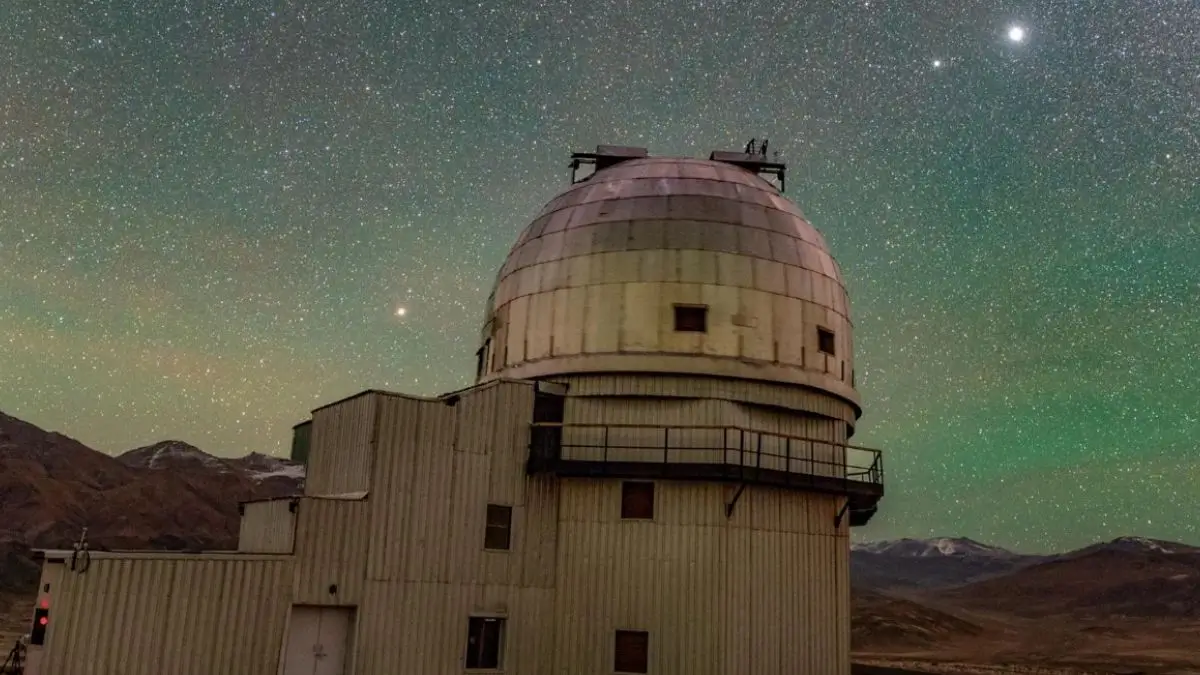
The Himalayan Chandra Telescope, part of the Indian Astronomical Observatory (IAO) at Hanle, has been operational for decades. Under the latest plan, it will be upgraded with advanced optics and enhanced instrumentation, boosting its sensitivity in optical and infrared wavelengths.
HCT plays an important role in studying transient astronomical events — short-lived cosmic occurrences such as supernovae. Its upgrade will strengthen multi-messenger astronomy involving gravitational wave, optical and radio observations.
Why Ladakh Is India’s Astronomy Hub
Ladakh’s unique geography — high altitude, low humidity, and very dark skies — makes it ideal for astronomy. The region’s atmosphere allows clearer views of the sky, with minimal light pollution and atmospheric interference. This has already made Ladakh home to several research telescopes and astronomical infrastructure.
By setting up advanced telescopes here, India not only capitalises on these natural advantages but also strengthens its scientific leadership globally.
Synergy with Global Astronomy
These initiatives will expand India’s role in collaborative research with international observatories and scientific institutions. The data and discoveries generated could deepen human knowledge about cosmic origins, star evolution, and the universe’s structure.
With these projects, India is poised to contribute significantly to frontier space science, astrophysics, and technologies critical for 21st-century exploration and innovation.

Why This News Is Important
Scientific and Strategic Significance
The approval of NLST and NLOT marks a major milestone in India’s scientific development strategy. These telescopes will enable cutting-edge research in solar physics, astronomy, and cosmology, sectors traditionally dominated by developed scientific nations. Their establishment reflects India’s growing capabilities in high-precision scientific infrastructure and research leadership.
For students preparing for government exams like UPSC (IAS, PCS), defence, banking (GK section), teacher recruitment and science-tech related posts, this news is valuable. It offers insights into government priorities in science and technology, budget allocation trends, and India’s role in global scientific advancements — all common themes in current affairs sections of competitive exams.
Economic and Development Context
Investment in astronomy infrastructure reflects broader budgetary emphasis on scientific research, innovation, and indigenisation. The benefits extend beyond pure science to technological spillovers — such as sensor technology, data analytics, and international scientific collaboration networks.
Moreover, increased scientific activity in regions like Ladakh supports local development through educational opportunities, talent attraction, and tourism linked to observatories and “dark sky” attractions.
Historical Context: India’s Journey in Astronomy
India’s involvement in advanced astronomy is decades old. Since independence, institutions like the Indian Institute of Astrophysics (IIA) and the Inter-University Centre for Astronomy and Astrophysics (IUCAA) have nurtured research. India’s first space observatory AstroSat — launched in 2015 — opened new frontiers in space-based astronomy, observing the universe across multiple wavelengths.
Ground-based observatories played an equally significant role. The Himalayan Chandra Telescope (HCT) at Hanle and the 3.6m Devasthal Optical Telescope (DOT) in Uttarakhand have contributed to important discoveries, helping India gain a strong foothold in optical astronomy.
The recent Budget announcements build on this legacy, ushering in a new era of astrophysical research with larger and more capable telescopes — bringing India closer to studying fundamental questions about the universe and our place in it.
Key Takeaways from ‘India Gets Two Mega Telescopes’
| S. No. | Key Takeaway |
|---|---|
| 1 | Government approves two new giant telescopes: National Large Solar Telescope and National Large Optical–Near Infrared Telescope. |
| 2 | NLST focuses on advanced solar research, improving our understanding of space weather and solar physics. |
| 3 | NLOT will be one of the largest optical-infrared telescopes, studying distant galaxies and exoplanets. |
| 4 | Himalayan Chandra Telescope will be upgraded with advanced instruments. |
| 5 | These projects position India as a major global player in astronomical research. |
FAQs: Exam-Oriented Questions on India’s New Mega Telescopes
Q1. What are the two new mega telescopes recently approved by India?
India has approved the National Large Solar Telescope (NLST) and the National Large Optical–Near Infrared Telescope (NLOT) to strengthen astronomical research. These telescopes will enhance India’s capacity in solar and deep-space observation, a key development in science and technology for competitive exams.
Q2. Where will these telescopes be located and why is the location important?
The telescopes will be set up in Ladakh, a high-altitude cold desert region known for clear skies, low humidity, and minimal light pollution. Such conditions are ideal for astronomical observation and are frequently asked in geography-science integrated exam questions.
Q3. What is the primary purpose of the National Large Solar Telescope?
The NLST will study solar activities such as sunspots, solar flares, and coronal mass ejections. This research is crucial for understanding space weather, which affects satellite communication and power systems on Earth.
Q4. How will the new telescopes benefit India scientifically?
They will allow Indian scientists to conduct advanced research in astrophysics, reduce dependence on foreign observatories, and improve India’s participation in global scientific collaborations — an important point for science & technology sections of exams.
Q5. Which existing telescope is being upgraded along with the new projects?
The Himalayan Chandra Telescope is being upgraded to improve its optical and infrared observation capabilities.
Q6. Which institutions are associated with India’s astronomical research ecosystem?
Key institutions include the Indian Institute of Astrophysics and the Inter-University Centre for Astronomy and Astrophysics, which support advanced research and training in astronomy.
Q7. Why is this development important for competitive exams like UPSC and SSC?
The news highlights government investment in science infrastructure, regional development of Ladakh, and India’s progress in space research — common themes in general awareness and science & technology sections.
Q8. How can these telescopes impact everyday life on Earth?
Better solar observation improves space weather forecasting, which protects satellites, GPS systems, aviation communication, and electricity grids.
Some Important Current Affairs Links