







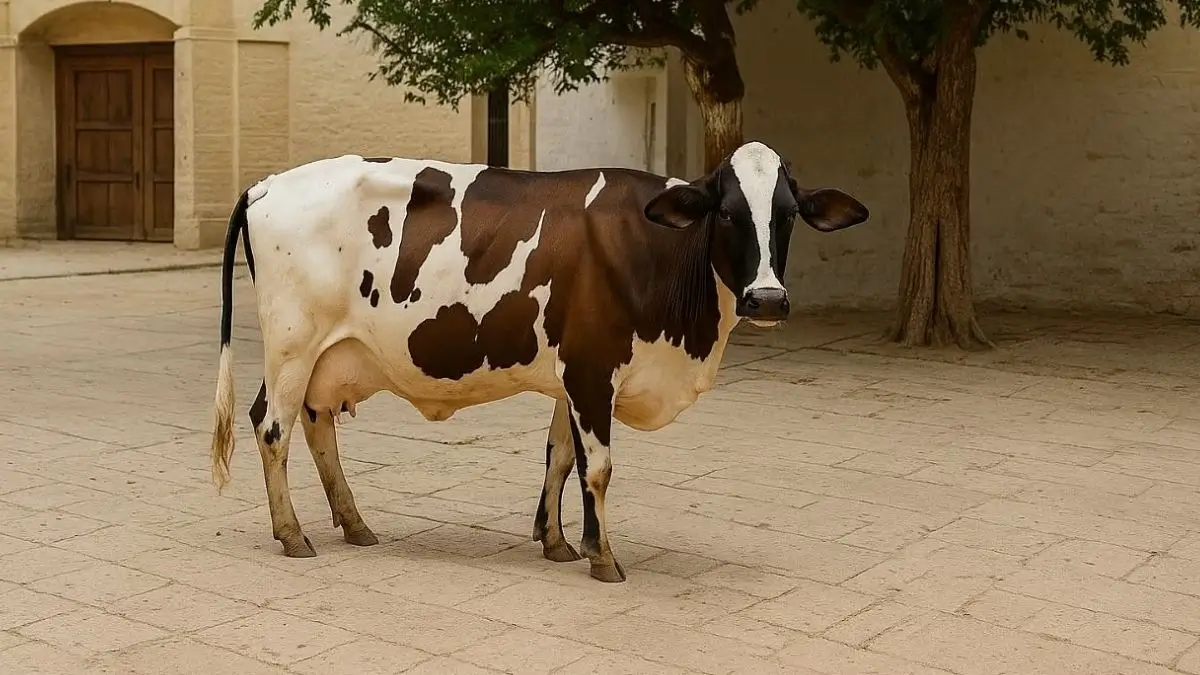
Karan Fries cattle breed developed by ICAR-NDRI offers high milk yield and climate resilience, boosting India’s dairy productivity and supporting rural farmers.
Karan Fries Breed: Climate-Resilient Powerhouse Strengthening India’s Dairy Sector
India’s dairy sector has taken a significant leap forward with the official registration of the Karan Fries cattle breed, a high-yielding and climate-adapted synthetic breed developed by the National Dairy Research Institute (NDRI), Karnal.
This new breed is the result of scientific crossbreeding between the indigenous Tharparkar cows and Holstein Friesian — a globally recognized high-yielding dairy breed. Scientists at NDRI have refined Karan Fries over decades to combine productivity with resilience, making it ideal for the Indian agro-climatic environment.
The Union Agriculture Minister, Shivraj Singh Chouhan, formally presented registration certificates for Karan Fries along with another synthetic breed, Vrindavani, and 16 other livestock breeds at an event organized by the Indian Council of Agricultural Research – National Bureau of Animal Genetic Resources (ICAR-NBAGR).
Exceptional Milk Production and Genetic Stability
Karan Fries cows have demonstrated remarkable dairy performance under Indian farm conditions. These animals yield an average of 3,550 kg of milk per lactation (about 11–12 kg per day), with top performers producing up to 5,851 kg in 305 days. The record peak daily milk yield has touched 46.5 kg — nearly twice the productivity of most indigenous breeds.
In contrast, indigenous cattle breeds typically produce only 1,000–2,000 kg per lactation and about 3–4 kg per day. Even some exotic breeds fail to combine high yield with heat tolerance effectively in Indian conditions.
Climate Resilience and Adaptability
A key advantage of the Karan Fries breed is its climate resilience. Through multiple generations of breeding and genetic selection, the breed has achieved uniform production traits and adaptability to India’s hot-humid subtropical climate — a crucial requirement given the accelerating impacts of climate change on agriculture and livestock.
The breed’s physical characteristics — including black-and-white coat and absence of a hump — represent the successful blending of exotic and indigenous genetic traits. This combination helps it withstand heat stress, disease challenges, and management conditions in India far better than many conventional high-yield breeds.
Strengthening India’s Dairy Economy
The registration of Karan Fries is more than just a scientific milestone — it’s a strategic boost to India’s dairy productivity ambitions under the Viksit Bharat vision. With India being the world’s largest milk producer, demand for higher output combined with sustainability continues to grow.
By providing farmers access to a genetically stable and high-yielding breed adaptable to Indian conditions, Karan Fries serves as foundation stock for livestock improvement programmes across the country. Its adoption can accelerate milk production, empower rural livelihoods, and strengthen the dairy value chain from farm to market.

Why This News Is Important for Government Exam Aspirants
Boost to Dairy Sector and Rural Economy
The official registration of the Karan Fries cattle breed marks a vital development in India’s dairy industry — a sector that supports millions of smallholder farmers and contributes substantially to rural income and nutrition. With milk demand rising in both urban and rural markets, an improved breed that delivers higher milk yields while tolerating local climatic stresses directly enhances productivity and profitability.
Integration of Science, Climate Strategy and Policy
This news has multidimensional significance for examinations like UPSC Civil Services, SSC, Bank PO, Railways, and State PSCs because it intersects science and technology, agriculture policy, climate resilience, and rural development. It reflects how scientific innovation in livestock genetics is aligned with national development goals, especially in the context of climate change adaptation and sustainable agriculture.
Relevance to Government Initiatives
Recognition and registration by ICAR-NBAGR demonstrate the role of government research institutions in strengthening livestock genetic resources. This action supports broader frameworks like the National Innovations in Climate Resilient Agriculture (NICRA), which focuses on building resilience in agriculture, including livestock, against climate variability.
For government exams, such developments are directly relevant to General Studies papers, Science and Technology sections, Agriculture and Rural Development, Government Schemes, and Economic Growth topics — making this news crucial for current affairs preparation.
Historical Context of Cattle Breeding in India
Evolution of Crossbreeding Initiatives
India’s journey in livestock improvement began several decades ago, with systematic crossbreeding programmes initiated to address the limitations of purely indigenous breeds in terms of milk productivity. These efforts aimed to combine the heat tolerance and disease resistance of indigenous zebu cattle with the high milk-producing traits of exotic dairy breeds.
Role of ICAR and NDRI
Institutions like the Indian Council of Agricultural Research (ICAR) and its research arms, such as the National Dairy Research Institute (NDRI), have been at the forefront of genetic improvement. Over time, breeds like Karan Swiss and now Karan Fries were developed at NDRI’s Livestock Farm to enhance milk yields while maintaining adaptability to diverse Indian agro-climates.
Registration and Genetic Stability
While early generations of crossbreeds often struggled with issues like heat stress and inconsistent production traits, sustained genetic monitoring and selective breeding over generations helped stabilise desirable traits. This culminated in the formal registration of synthetic breeds like Karan Fries, acknowledging their genetic uniformity and utility at scale.
Integration Into National Breeding Policies
The process of breed registration, conducted by the ICAR-National Bureau of Animal Genetic Resources, is essential for conserving animal genetic resources, enabling tailored regional breeding programmes, and giving legal recognition and protection to improved breeds.
Key Takeaways from Karan Fries Breed Registration
| S.No. | Key Takeaway |
|---|---|
| 1 | Karan Fries is a new high-yielding synthetic cattle breed developed by ICAR-NDRI, Karnal. |
| 2 | It combines Holstein Friesian and indigenous Tharparkar genetics for productivity and resilience. |
| 3 | The breed yields an average of 3,550 kg per lactation with peak yields up to 46.5 kg/day. |
| 4 | Registration of Karan Fries expands India’s officially recognised livestock breeds to 246. |
| 5 | It supports national goals in dairy productivity, climate resilience, and rural economic growth. |
FAQs: Frequently Asked Questions
1. What is Karan Fries breed?
Karan Fries is a high-yielding synthetic cattle breed developed by ICAR-NDRI, combining Holstein Friesian and indigenous Tharparkar genetics.
2. Which institution developed the Karan Fries breed?
The breed was developed by the National Dairy Research Institute (NDRI), Karnal under the ICAR.
3. What is the average and peak milk yield of Karan Fries?
The average milk yield per lactation is 3,550 kg, while the peak daily milk yield can reach 46.5 kg.
4. How is Karan Fries climate-resilient?
The breed is adapted to India’s hot and humid conditions and resistant to heat stress, combining exotic and indigenous genetic traits.
5. When was the Karan Fries breed officially registered?
The breed was recently registered by ICAR-NBAGR along with 16 other livestock breeds.
6. Why is Karan Fries important for India’s dairy sector?
It helps increase milk production, improve farmer income, and supports sustainable livestock development in India.
7. How many officially recognised livestock breeds are there in India after Karan Fries registration?
After registration, India now has 246 officially recognised livestock breeds.
8. Which other synthetic breed was registered along with Karan Fries?
The Vrindavani breed was also registered alongside Karan Fries.
Some Important Current Affairs Links