


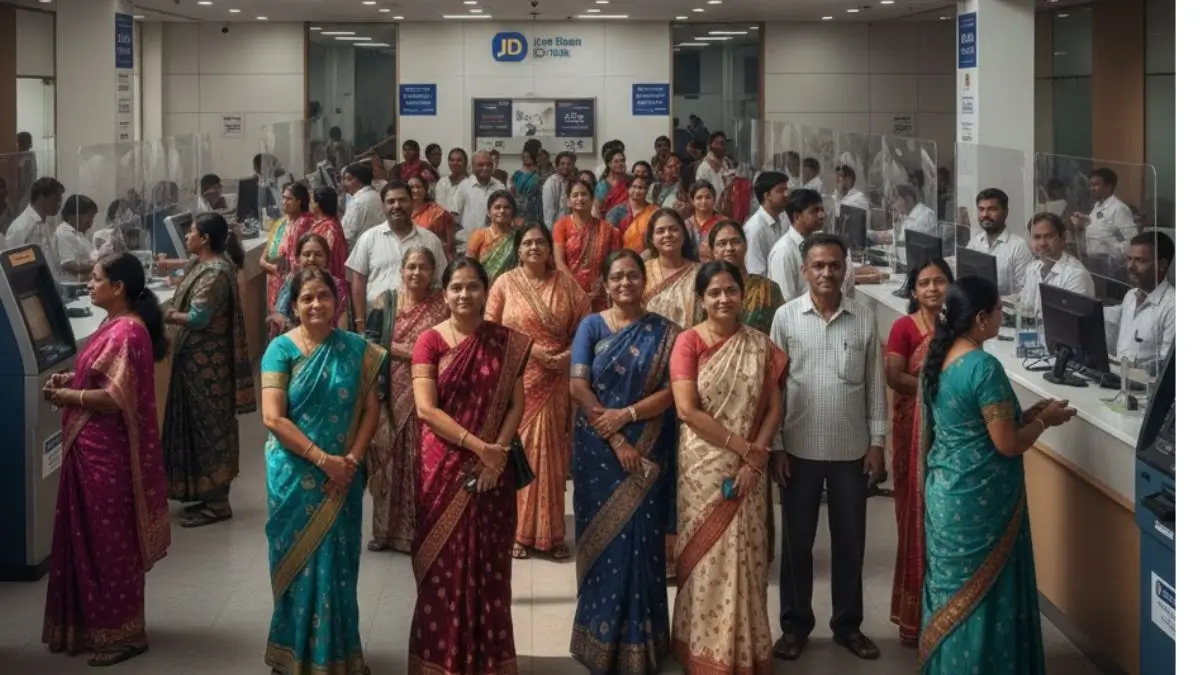
Jan Dhan accounts deposits cross ₹2.75 lakh crore in 2025, reflecting India’s financial inclusion progress, DBT benefits, and rural banking empowerment.
Jan Dhan Accounts Cross ₹2.75 Lakh Crore — What It Means for India’s Banking Inclusion
Overview of the Milestone
The total bank deposits in accounts opened under Pradhan Mantri Jan Dhan Yojana (PMJDY) have reached a historic milestone of ₹2.75 lakh crore. This milestone reflects the growing uptake of banking services among previously unbanked segments. As of the latest update in November 2025, over 56 crore Jan Dhan accounts have been opened across India.
Under the scheme, account holders — many of whom are from rural and semi‑urban areas, or are women — get access to zero‑balance savings accounts, free RuPay debit cards, and benefits like overdraft facility and insurance cover.
Current Deposit Statistics & Account Profile
As per the latest data (as on October 22, 2025), cumulative balance across all PMJDY accounts stood at approximately ₹2,75,057 crore. That works out to an average of about ₹4,815 per account — showing that many account holders are actively saving or receiving funds.
Breaking down the distribution: a vast majority of accounts are concentrated in rural and semi-urban areas (around 78.2%), while nearly 50% of account holders are women.
Why This Surge Happened: Reactivation and DBT Flow
The recent increase in deposit balance is attributed in part to a push on reactivating dormant accounts. A nationwide “Financial Inclusion Saturation Programme” (July–September 2025) was aimed at re‑verifying KYC for inactive accounts and encouraging usage.
Moreover, several direct benefit transfers (DBTs) under government welfare schemes have been routed through Jan Dhan accounts — thereby increasing activity and deposit balances.
Significance for Financial Inclusion & Economy
The growth of PMJDY in terms of deposits and active usage underlines a deeper integration of marginalized sections into the formal banking system. Increased savings, improved access to banking services and insurance, and digital financial inclusion through RuPay cards and DBT flows are gradually reshaping the economic participation of rural and low-income households.
For students preparing for government exams (banking, general awareness, economy sections), this milestone is a key example of how government welfare schemes are contributing to financial inclusion, rural upliftment, and formal banking expansion.

Why This News Is Important
Implication for Economic Inclusion
The crossing of ₹2.75 lakh crore mark under PMJDY is not just a numerical achievement — it reflects real progress in bringing large portions of previously unbanked or underbanked populations into the formal financial ecosystem. For policy‑makers and students of public affairs, it signals the strengthening of financial inclusion, which is fundamental for inclusive growth, poverty reduction, and equitable development.
Relevance for Government‑Exam Aspirants
For aspirants preparing for banking exams, civil services, or other competitive tests, such milestones are often asked in static‑GK, current affairs and economy sections. Understanding PMJDY’s growth trajectory — number of accounts, deposit size, rural/women penetration — is useful not only for objective‑type questions but also for analytical questions on socio‑economic policies.
Impact on Welfare Delivery and Digital India Push
High deposit balances and active accounts facilitate smoother and leak‑free delivery of welfare benefits via DBT (Direct Benefit Transfer). This enhances the credibility and effectiveness of government schemes. The surge also underscores India’s push towards digital payments, formal banking, and financial empowerment of marginalized communities — a major policy thrust in recent years.
Historical Context
Birth of PMJDY and Its Objectives
Launched on 28 August 2014, the Pradhan Mantri Jan Dhan Yojana was designed as India’s flagship financial inclusion mission. The main objective: provide every Indian household access to basic banking services — especially savings accounts — even if they have zero balance. The scheme also included issuance of free RuPay debit cards, insurance cover, overdraft facility, and later linkage with government benefit transfers via the JAM (Jan Dhan–Aadhaar–Mobile) trinity.
Growth Over the Years
Since its inception:
- Within a few years, PMJDY had opened tens of crores of accounts, many belonging to rural populations and women.
- The cumulative deposits under the scheme have steadily increased — passing ₹1 lakh crore, then ₹2 lakh crore, reaching ₹2.63 lakh crore in early 2025.
- Over time, use of digital payments, DBT, RuPay cards, and other banking services via Jan Dhan accounts has expanded — helping integrate previously financially excluded individuals into formal banking and digital finance ecosystem.
Recent Push for Account Reactivation & Inclusion Saturation
In 2025, the government launched a renewed campaign to reactivate dormant Jan Dhan accounts and ensure KYC compliance This has resulted in increased activity and inflows into these accounts, contributing to the new deposit milestone.
Thus, the ₹2.75 lakh crore achievement is not abrupt — it is the result of sustained effort over more than a decade to bring financial inclusion to India’s masses.
Key Takeaways from This News
| S. No. | Key Takeaway |
|---|---|
| 1 | Total deposits under PMJDY have crossed ₹2.75 lakh crore as of late 2025. |
| 2 | Over 56 crore Jan Dhan accounts have been opened nationwide so far. |
| 3 | The average balance per account is around ₹4,815, indicating active use. |
| 4 | A majority of accounts are in rural or semi‑urban areas (~78.2%), and nearly half of holders are women. |
| 5 | The surge in deposits is aided by reactivation campaigns (2025 Saturation Drive), KYC regularization, and increased flow of DBTs and welfare benefits through Jan Dhan accounts. |
FAQs: Frequently Asked Questions
1. What is the total deposit in Jan Dhan accounts as of 2025?
The total deposits in Jan Dhan accounts have crossed ₹2.75 lakh crore as of late 2025.
2. How many Jan Dhan accounts have been opened in India?
Over 56 crore accounts have been opened across the country under PMJDY.
3. What is the average balance in a Jan Dhan account?
The average balance per account is approximately ₹4,815, indicating active usage.
4. Who are the major beneficiaries of Jan Dhan accounts?
Major beneficiaries include rural and semi‑urban populations, with around 50% of account holders being women.
5. When was the Pradhan Mantri Jan Dhan Yojana launched?
PMJDY was launched on 28 August 2014 to promote financial inclusion in India.
6. What facilities are offered under Jan Dhan accounts?
Facilities include zero-balance savings accounts, RuPay debit cards, overdraft facility, and insurance coverage.
7. How does Jan Dhan account help in Direct Benefit Transfers (DBT)?
Jan Dhan accounts enable direct transfer of subsidies and welfare benefits to account holders, minimizing leakages.
8. What government initiative contributed to the recent surge in deposits?
The Financial Inclusion Saturation Programme (2025) helped reactivate dormant accounts and ensure KYC compliance.
9. What percentage of Jan Dhan accounts are in rural and semi-urban areas?
Approximately 78.2% of accounts are in rural and semi-urban areas.
10. Why is the growth of Jan Dhan deposits significant for India?
It represents financial inclusion, digital banking adoption, and empowerment of marginalized populations, reflecting socio-economic development.
Some Important Current Affairs Links




