








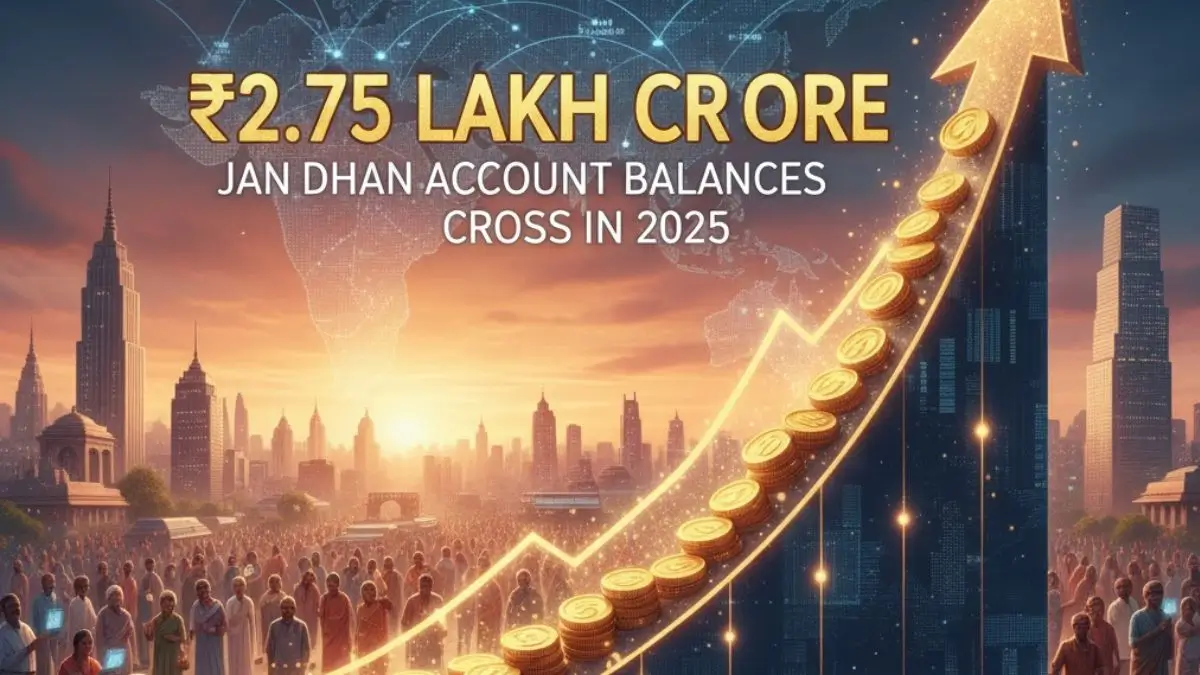
Jan Dhan Account Deposits 2025 have crossed ₹2.75 lakh crore, reflecting strong financial inclusion progress in India. Know key data, significance, government measures and exam-relevant facts.
Jan Dhan Account Balances Cross ₹2.75 Lakh Crore in 2025
Significant Surge in Formal Banking for the Unbanked
In a landmark development for India’s financial-inclusion agenda, the total deposit balance under the flagship scheme Pradhan Mantri Jan Dhan Yojana (PMJDY) has crossed ₹2.75 lakh crore (₹2,75,057 crore) as of 22 October 2025, according to recent government data.This milestone reflects heightened engagement with millions of “no-frills” bank accounts and marks a strong stride toward linking India’s underserved populations with formal financial services.
Scale and Scope of the Achievement
As of October 2025, approximately 56.85 crore accounts have been opened under the Jan Dhan scheme. Of the total deposits: Public Sector Banks (PSBs) hold around ₹2.15 lakh crore, Regional Rural Banks (RRBs) about ₹51,489 crore, and private-sector banks roughly ₹8,149 crore.This diversified banking participation underscores the scheme’s broad reach across banking institutions.
What Has Driven the Increase?
The growth is primarily attributed to three catalysts:
- The surge in account reactivation: Millions of dormant Jan Dhan accounts have been brought back to life through concerted outreach
- Direct Benefit Transfers (DBT) and welfare scheme linkages: Accounts under PMJDY are being increasingly used for welfare payouts, triggering higher balances.
- A focused campaign by the Department of Financial Services (DFS) — the “Financial Inclusion Saturation Programme” — launched from July to September 2025, aimed at saturation coverage, KYC-reverification, and bringing unbanked/under-banked segments into the fold.
Implications for Financial Inclusion
This milestone indicates more than just a numeric achievement: it reflects that the Jan Dhan initiative is not merely about opening accounts, but about making them live and meaningful. With higher balances, more transactions, and active utilisation, the accounts become effective tools for inclusion rather than dormant entries in banking records.
Challenges & Forward Path
Despite these gains, challenges remain. As government data shows, a significant portion of accounts remain inactive or under-utilised. For instance, at one point around 13 crore accounts out of 56 crore were inactive. Ensuring regular usage — linking to credit, savings, insurance and pension schemes — remains key for sustainability. The next phase of the scheme must focus on moving from access to usage.
What This Means for Students Preparing for Exams
For aspirants of banking, railways, defence, civil service (e.g., UPSC) and other government job exams, this development is a prime topic under schemes, banking & financial awareness, economic inclusion and recent government initiatives. Understanding the Jan Dhan scheme, its progress, data, and implications will help answer questions in sections such as General Awareness, Economy, Banking, Social Issues and Government Schemes.

Why This News Is Important
Relevance to Government Scheme Awareness
The rise in the deposits under PMJDY underlines how government schemes are translating into measurable outcomes. For competitive-exam aspirants (teachers, banking, railways, police, civil services), knowing the specifics — the amount (₹2.75 lakh crore), the number of accounts (56.85 crore), and the distribution among bank types — is critical. Many exam questions now probe scheme data, recent milestones and their significance.
Link to Broader Economic & Social Goals
This news is not just about banking numbers: it ties into larger themes of financial inclusion, empowerment of rural and marginalised populations, and formalisation of the economy. It shows how financial-inclusion works as a driver of welfare delivery (via DBT), digital transformation of banking, and strengthening of fiscal frameworks. Examiners often expect candidates to not only recall figures but also understand why such developments matter.
Usage as a Current Affairs Focus
In sectors like banking, railways, defence and civil services, one recurring topic is “how the central government’s flagship schemes are performing”. This milestone gives concrete evidence of success and ongoing challenges — making it a high-value current-affairs point. Also, aspirants can connect this to topics like zero-balance accounts, RuPay cards, overhaul of inactive accounts, re-KYC measures and saturation campaigns — all relevant for exam modules.
Historical Context: Background of the Jan Dhan Initiative
The Pradhan Mantri Jan Dhan Yojana (PMJDY) was launched on 28 August 2014 with the aim of bringing every Indian adult within the formal banking system — thereby “banking the unbanked”, “securing the unsecured” and “funding the unfunded”. The initial objectives included opening zero-balance savings bank accounts, issuing RuPay debit cards (often with accident insurance cover), facilitating direct transfers of subsidies and benefits, and enabling overdraft facilities.
Over the years, the scheme rapidly scaled: by August 2025, over 56 crore accounts had been opened. A key milestone was when total deposits in those accounts crossed levels of ₹2 lakh crore (reported in previous years). The scheme has been pivotal in enabling welfare benefit delivery, giving bank access to rural and semi-urban households, and fostering digital financial literacy.
The recent saturation drive (July–Sept 2025) marks a newer phase: shift from mere account opening to activation (ensuring accounts are used), KYC compliance, and connecting to additional products (insurance, pension). This progression highlights the dynamic nature of the scheme’s evolution. Understanding this background helps tie in the importance of the current milestone.
Key Takeaways from “Jan Dhan Account Balances Cross ₹2.75 Lakh Crore”
| S. No. | Key Takeaway |
|---|---|
| 1 | Total deposits under PMJDY reached ₹2,75,057 crore as of 22 October 2025. |
| 2 | Approximately 56.85 crore Jan Dhan accounts are active as of October 2025. |
| 3 | Public sector banks held the majority share: about ₹2.15 lakh crore, followed by RRBs (~₹51,489 crore) and private banks (~₹8,149 crore). |
| 4 | The Financial Inclusion Saturation Programme (July-Sept 2025) played a key role in reactivating dormant accounts and driving deposit growth. |
| 5 | The milestone reflects the shift from account opening to usage and engagement — crucial for the success of financial inclusion in India. |
Frequently Asked Questions (FAQs)
Q1. What is the Pradhan Mantri Jan Dhan Yojana (PMJDY)?
PMJDY is a national financial inclusion mission launched in August 2014 to provide universal access to banking facilities, especially to households and individuals who were previously outside the formal banking system.
Q2. How much total deposit balance has been recorded under Jan Dhan accounts as of October 2025?
The total deposit balance under PMJDY accounts has crossed ₹2.75 lakh crore (₹2,75,057 crore) as of 22 October 2025.
Q3. How many Jan Dhan accounts have been opened till now?
Approximately 56.85 crore Jan Dhan accounts have been opened across public, private, and regional rural banks.
Q4. Which banks hold the largest share of Jan Dhan deposits?
Public Sector Banks (PSBs) hold the largest share with around ₹2.15 lakh crore deposits.
Q5. What was the role of the Financial Inclusion Saturation Programme?
Implemented between July and September 2025, the programme aimed to ensure account activation, re-KYC, linking of welfare schemes, and reactivation of dormant accounts.
Q6. How does PMJDY support Direct Benefit Transfer (DBT)?
The Jan Dhan accounts allow citizens to receive government subsidies, pensions, and welfare payments directly, reducing leakage and improving transparency.
Q7. Do Jan Dhan account holders receive any insurance benefits?
Yes, PMJDY account holders are eligible for accidental insurance cover and an overdraft facility if conditions are met.
Q8. Why is the recent deposit increase important for the Indian economy?
It shows expansion of formal banking, reduced cash dependency, better welfare distribution, and financial empowerment of low-income groups.
Q9. Which segment of the population benefits most from Jan Dhan accounts?
Rural families, women, small workers, migrant labourers, and low-income households benefit significantly.
Q10. Are Jan Dhan accounts zero-balance accounts?
Yes, individuals can open these accounts with zero balance, although maintaining balance can provide additional benefits.
Some Important Current Affairs Links