






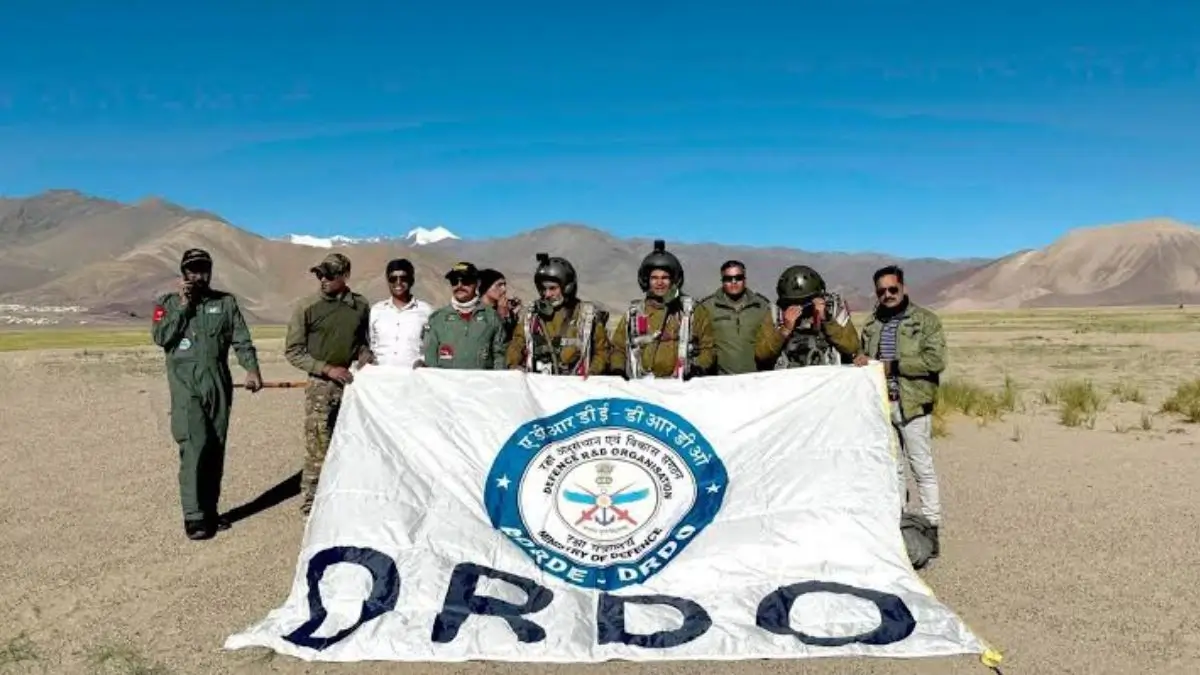
Indigenous military combat parachute system successfully tested by DRDO in Ladakh at 22,000 feet, marking a major milestone in India’s defence indigenisation efforts.
Successful High-Altitude Trial in Ladakh
The Defence Research and Development Organisation (DRDO) has successfully tested its indigenously developed Military Combat Parachute System (MCPS) at the Nyoma-Mudh Drop Zone in Ladakh. The latest trial was conducted under extreme high-altitude conditions, marking another important milestone in India’s efforts to strengthen indigenous defence technology.
The test was carried out at an altitude of 22,000 feet above mean sea level, where temperatures were around minus 15 degrees Celsius. Such conditions make the trial particularly significant because high-altitude military operations involve challenges such as low atmospheric pressure, reduced oxygen availability, freezing temperatures and difficult landing conditions.
Indigenous System Demonstrates Operational Capability
The indigenous Military Combat Parachute System was designed and developed by the Aerial Delivery Research and Development Establishment (ADRDE), a DRDO laboratory based in Agra. During the Ladakh trial, ADRDE test jumpers carried out the high-altitude jump using the MCPS and associated indigenous support systems.
The parachute system was deployed at around 20,000 feet, and the jumpers subsequently landed safely at approximately 13,700 feet. The successful demonstration highlighted the reliability, operational effectiveness and tactical employability of the indigenous system in demanding mountain conditions.
The trial also involved indigenous supporting equipment, including a para computer, oxygen system and specialised jumpsuits. This reflects India’s effort to develop an integrated ecosystem of indigenous equipment for specialised airborne operations.
Importance for Special Military Operations
The Military Combat Parachute System is designed to support the tactical insertion of military personnel into designated operational areas. Such systems are especially important for special operations conducted in difficult terrain or locations where conventional ground access may be limited.
High-altitude parachuting allows trained personnel to exit an aircraft at significant altitudes and navigate towards a predetermined landing area. Depending on operational requirements, such systems can support different types of specialised military insertion operations.
For India, the successful test in Ladakh is strategically important because the country operates in some of the world’s most challenging high-altitude regions. Indigenous systems capable of functioning reliably in extreme environments can improve operational preparedness and reduce dependence on foreign defence equipment.
Progress Towards Defence Self-Reliance
The successful MCPS trial also supports the broader objectives of Aatmanirbhar Bharat and defence indigenisation. Developing specialised military equipment within India can reduce dependence on imported systems and strengthen domestic defence research and manufacturing capabilities.
The latest Ladakh test builds upon earlier trials of the MCPS. In October 2025, the indigenous system successfully underwent a combat freefall jump from an altitude of 32,000 feet. The achievement demonstrated the advanced high-altitude capability of the parachute system and represented an important step in India’s development of indigenous aerial delivery technologies.
Significance of ADRDE and DRDO
The Aerial Delivery Research and Development Establishment (ADRDE) plays an important role in the development of aerial delivery systems and parachute technologies. The laboratory works under DRDO, which is India’s premier organisation for defence research and development.
The successful testing of the indigenous Military Combat Parachute System in Ladakh demonstrates India’s growing capability in developing advanced equipment for airborne and specialised military operations. It is also important for government exam aspirants because the news connects major themes such as DRDO, defence indigenisation, Aatmanirbhar Bharat, military technology, high-altitude operations and Ladakh’s strategic importance.

Why this News is Important
Important for Defence and Security Examinations
The successful high-altitude test of the Military Combat Parachute System is important for aspirants preparing for defence-related examinations because it demonstrates India’s progress in indigenous military technology. Questions may be asked about the organisation that conducted the trial, the laboratory that developed the system, the location of the test and the extreme conditions under which it was conducted.
Students should remember that the test took place at the Nyoma-Mudh Drop Zone in Ladakh, at an altitude of 22,000 feet above mean sea level and at a temperature of around minus 15 degrees Celsius.
Important for the Aatmanirbhar Bharat Theme
Defence indigenisation is an important topic for UPSC, State PCS, SSC, banking and other government examinations. The development of the MCPS reflects the objective of increasing India’s self-reliance in strategically important defence technologies.
Indigenous defence systems can help reduce dependence on imported equipment, improve maintenance capabilities and strengthen domestic research and manufacturing. The development of specialised systems within India is particularly important during military operations because access to foreign equipment and spare parts may be uncertain during conflicts or geopolitical disruptions.
Important for Geography and Strategic Studies
The news is also relevant from the perspective of the strategic importance of Ladakh. The region contains extremely high-altitude terrain, and military personnel operating in such environments face significant challenges.
High-altitude operations require specialised equipment capable of functioning in freezing temperatures, low atmospheric pressure and oxygen-deficient conditions. Therefore, the successful MCPS trial demonstrates the importance of developing technologies suited to India’s geographical and strategic environment.
Historical Context: Development of Indigenous Combat Parachute Systems
Evolution of India’s Aerial Delivery Capability
India has gradually expanded its indigenous capability in aerial delivery and parachute technologies through DRDO laboratories. The ADRDE has played an important role in developing systems for personnel and military equipment.
DRDO’s indigenous aerial delivery technologies include systems for combat freefall operations and heavy military equipment drops. These technologies are important for deploying personnel, vehicles, ammunition and other supplies into operational areas.
Earlier Military Combat Parachute System Trials
The development of the MCPS has involved multiple demonstrations and trials. DRDO had earlier reported successful combat freefall jumps using the indigenous system at high altitudes.
In October 2025, the MCPS successfully underwent a combat freefall jump from 32,000 feet, demonstrating its capability for extremely high-altitude deployment. The system incorporated advanced tactical features such as improved steering and a lower rate of descent. The system also has compatibility with Navigation with Indian Constellation (NavIC), supporting India’s indigenous satellite navigation ecosystem.
Role of Aerial Delivery Research and Development Establishment
The Aerial Delivery Research and Development Establishment (ADRDE), Agra, is a DRDO laboratory associated with the development of aerial delivery technologies. It has contributed to indigenous parachute and aerial delivery systems designed for military requirements.
The development and testing of the MCPS demonstrate the increasing importance of specialised indigenous defence technologies as India seeks to strengthen self-reliance in military research, equipment and operational capabilities.
Key Takeaways from DRDO’s Ladakh Parachute Test
| S. No. | Key Takeaway |
|---|---|
| 1 | DRDO successfully tested the indigenous Military Combat Parachute System (MCPS) in Ladakh. |
| 2 | The trial was conducted at the Nyoma-Mudh Drop Zone in the Leh district of Ladakh. |
| 3 | The test jump was carried out from an altitude of 22,000 feet above mean sea level in temperatures of around minus 15 degrees Celsius. |
| 4 | The MCPS was designed and developed by DRDO’s Aerial Delivery Research and Development Establishment (ADRDE), Agra. |
| 5 | The development supports India’s defence indigenisation and Aatmanirbhar Bharat objectives. |
Frequently Asked Questions
1. What is the Military Combat Parachute System (MCPS)?
The Military Combat Parachute System is an indigenous parachute system developed for specialised military airborne operations and tactical insertion of personnel.
2. Which organisation tested the indigenous MCPS?
The Defence Research and Development Organisation (DRDO) tested the indigenous Military Combat Parachute System.
3. Which DRDO laboratory developed the MCPS?
The system was developed by the Aerial Delivery Research and Development Establishment (ADRDE), Agra.
4. Where was the latest MCPS trial conducted?
The trial was conducted at the Nyoma-Mudh Drop Zone in Ladakh.
5. At what altitude was the high-altitude trial conducted?
The test was carried out at an altitude of approximately 22,000 feet above mean sea level.
6. What was the approximate temperature during the trial?
The trial was conducted in extreme cold conditions, with temperatures around minus 15 degrees Celsius.
7. What was the altitude at which the parachute system was deployed?
The parachute system was deployed at approximately 20,000 feet.
8. At what altitude did the test jumpers land?
The test jumpers landed at around 13,700 feet.
9. Which indigenous support systems were used during the trial?
The trial involved indigenous equipment such as a para computer, oxygen system and specialised jumpsuits.
10. Why is the MCPS test important for government exam aspirants?
The news is relevant for competitive examinations because it covers important topics such as DRDO, ADRDE, defence indigenisation, Aatmanirbhar Bharat, military technology, Ladakh and high-altitude operations.
Some Important Current Affairs Links